
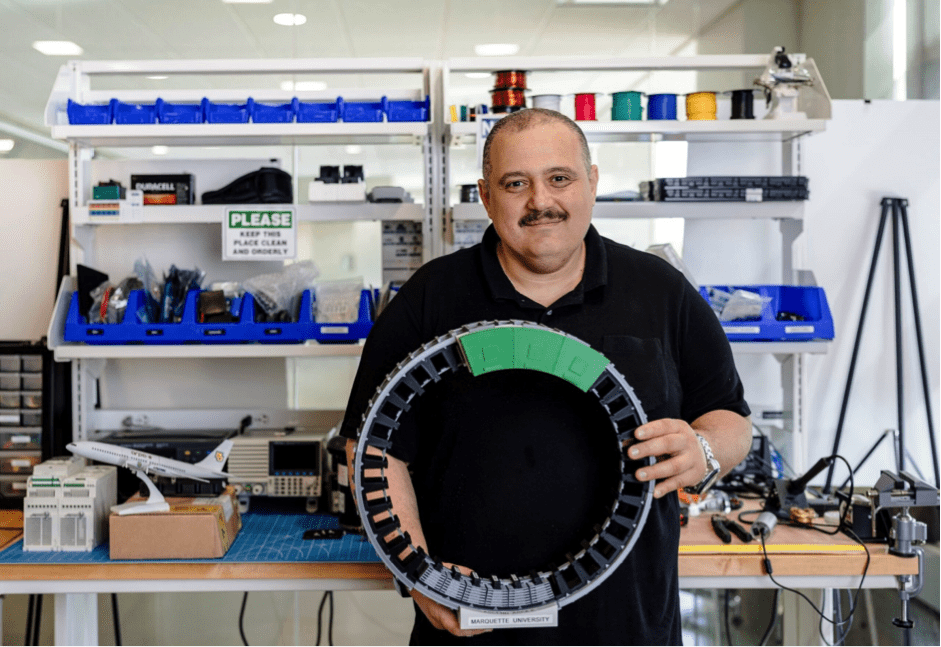
A white model plane, emblazoned with the logos of Marquette University and its partners, sits prominently in the Werner Sustainable Energy Lab at the Opus College of Engineering. It represents a vision of the future of aviation—a future powered by electricity and hybrid technology. Leading this ambitious endeavour is Dr. Ayman EL-Refaie, the Thomas and Suzanne Werner Endowed Chair of Secure and Sustainable Energy Systems and a professor of electrical and computer engineering. Together with his team of faculty and students, EL-Refaie is working to bring electric-powered and hybrid aircraft closer to reality.
“What we’re trying to do with planes today is what has been happening with cars,” explains EL-Refaie. “For larger planes, we’re developing hybrid models with jet engines and electric motor-driven propellers. For smaller planes, we’re working towards pure electric propulsion.”
Advancing Towards Net-Zero Emissions
This initiative is part of a broader effort to help the United States achieve its goal of net-zero emissions by 2050. In 2023, the Marquette-led team advanced to the second phase of a highly competitive project overseen by the U.S. Department of Energy, securing $5.6 million in funding. Of the seven teams advancing, Marquette and Texas A&M were the only universities, with the remaining five comprised of industry leaders like GE and Honeywell.
“It’s very unusual for a university, especially one the size of Marquette, to lead a project like this,” says EL-Refaie. “Typically, a major company takes the lead, with universities in supporting roles. Just making it this far is a huge achievement.”
Training the Next Generation of Engineers
The project is not only advancing technology but also providing invaluable opportunities for Marquette students. “Even though it’s challenging, it’s important that our students get full exposure to all aspects of the project,” EL-Refaie notes. “They’re learning about technical details, logistics, and the management of large-scale projects—essential training for real-world engineering.”
Overcoming Technical Hurdles
A significant challenge for the team is reducing the mass of the electric motor while maintaining sufficient power and managing heat output. “Everything has to be two to three times lighter than the best in class today,” EL-Refaie explains. To achieve this, the team is exploring advanced cooling methods, innovative manufacturing processes, and greater integration between motors and power electronics.
Progress is steady, but each solved challenge presents new obstacles. If successful, the team’s prototype will undergo testing at RTX Technology Research Center’s headquarters in Connecticut. Following this, the technology could be licensed to another company or adapted for specific industry needs.
The Path Ahead for Electric Aviation
EL-Refaie anticipates that small electric aircraft may take to the skies within five to ten years. Hybrid commercial planes, due to their larger size and stringent regulations, will likely take longer but could reduce fossil fuel consumption by over 20% compared to conventional aircraft.
In addition to aviation, EL-Refaie is also advancing electric mobility on the ground. With another $5 million U.S. Department of Energy grant, he is developing electric drivetrain systems that use iron nitride magnets, eliminating the need for expensive rare earth materials. This work, in partnership with Niron Magnetics, has already garnered attention, with Time magazine naming Niron’s Clean Earth Magnet one of the best inventions of 2023.
A Vision for Sustainability
“These two topics—hybridisation and electrification of aerospace, and reducing reliance on rare earth materials—are among the most critical global challenges today,” EL-Refaie concludes. “The fact that Marquette is at the forefront of these efforts, alongside world-class partners, speaks volumes about our commitment to sustainable innovation.”