
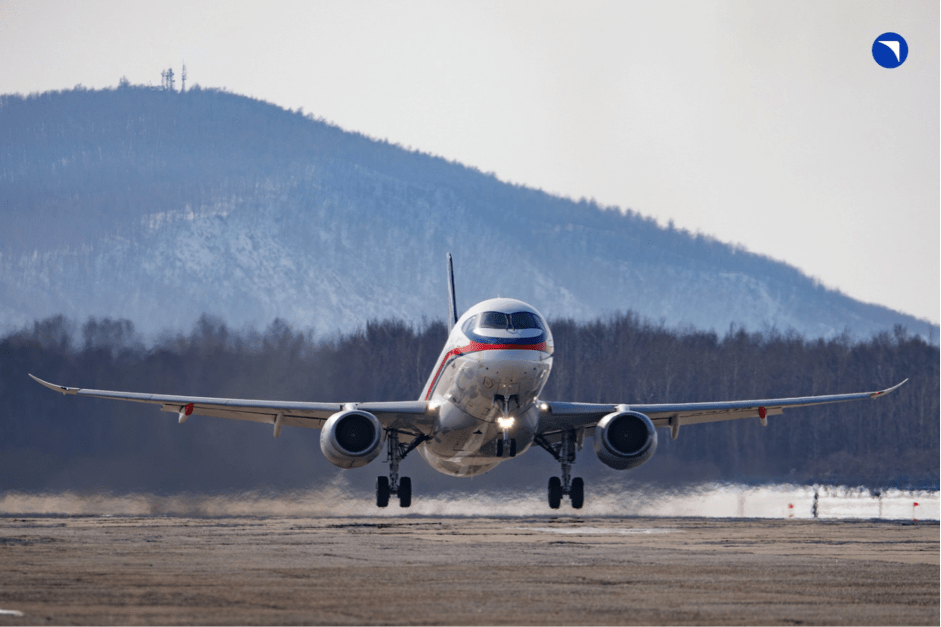
Russia’s aviation industry has reached a critical milestone as the Superjet 100 (SJ-100) successfully completed its first test flight powered by the domestically produced PD-8 engine. The achievement marks a significant step in Moscow’s broader strategy to develop a self-sufficient commercial aircraft sector following Western sanctions.
The test flight, conducted in Komsomolsk-on-Amur, lasted approximately 40 minutes, reaching speeds of 500 km/h (310 mph) and an altitude of 3,000 metres (9,800 feet), according to Rostec, Russia’s state defence and industrial conglomerate.
A Shift to Domestic Production
The SJ-100 is at the forefront of Russia’s drive to replace foreign-made components in its aviation industry. The aircraft must undergo around 200 test flights before it can be certified for mass production, with efforts underway to substitute at least 40 imported components.
“The PD-8 engine is a crucial element of our import substitution programme — it’s the ‘heart’ of the aircraft,” said Rostec CEO Sergei Chemezov. “The project is being completed in record time by global aviation standards. After 2022, the Superjet had to be practically reassembled from scratch.”
The PD-8 engine, developed by United Engine Corporation, is expected to receive certification later this year, paving the way for Russia’s existing Superjet fleet to be retrofitted with the new powerplant.
Expanding Domestic Aircraft Production
Beyond the Superjet, Russia is advancing its plans for the MC-21, a medium-range passenger jet designed to compete with the Boeing 737 and Airbus A320. The MC-21 is set to conduct its first test flight with the Russian-made PD-14 engine in June, according to Trade and Industry Minister Anton Alikhanov. The aircraft first flew with the PD-14 in late 2020, and mass production is targeted for 2026.
To support these ambitions, Russia has pledged over $2.7 billion towards domestic aircraft development, with plans to manufacture more than 600 aircraft by 2030. However, concerns remain over production capacity and delivery timelines, particularly as the country works to replace its aging Western-built fleet.
As flight testing progresses, the success of the SJ-100 and MC-21 programmes will be pivotal in determining Russia’s ability to establish a self-reliant aviation industry in the face of ongoing geopolitical challenges.
SOURCE AND IMAGE©: ROSTEC