
Airbus is advancing A350F certification testing in Bremen using full-scale cargo system demonstrators to validate the aircraft’s electric cargo door and cargo loading systems ahead of first flight.
Airbus is progressing certification and operational readiness testing for its new Airbus A350F, with large-scale demonstrators in Bremen being used to validate the aircraft’s cargo door systems and cargo handling capability ahead of the freighter’s planned first flight later this year.
According to Airbus, development work on the A350F extends beyond adapting a passenger aircraft into a freighter configuration, with a major focus placed on the systems required to secure, move and protect payloads of up to 111 tonnes.
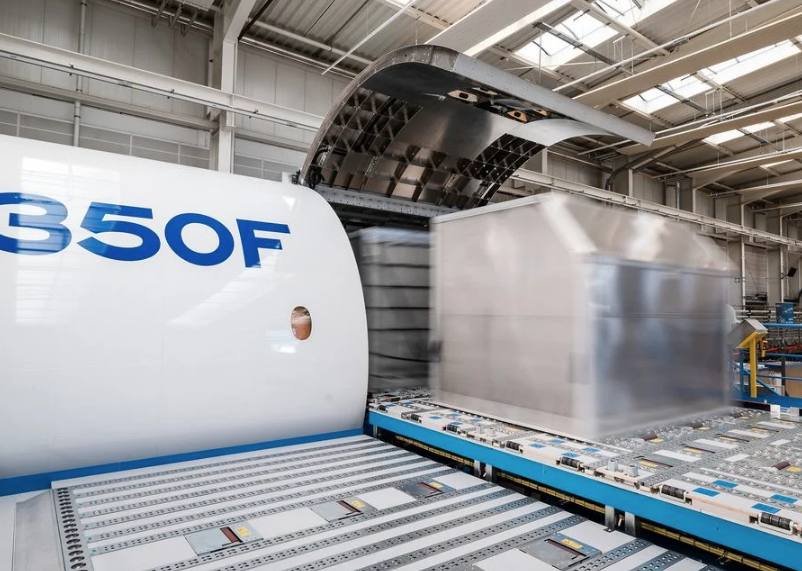
The company said testing is currently centred around two major demonstrators: the Cargo Door Actuation System System Integration Bench (CDAS SIB) and the “Cargo Zero” cargo loading demonstrator. These are intended to support certification readiness, operational reliability and flight-test preparation.
ALL-ELECTRIC MAIN-DECK CARGO DOOR UNDER TEST
Airbus stated that the A350F’s Main-Deck Cargo Door (MDCD) introduces an all-electric actuation architecture rather than a traditional hydraulic system. The electrically driven system uses geared rotary actuators capable of opening or closing the cargo door within 60 seconds, including in wind conditions of up to 40 knots.
The aircraft also incorporates a newly patented latching mechanism intended to reduce system complexity, weight and component count compared with conventional freighter cargo door systems.
Airbus explained that the test demonstrator for the cargo door weighs nearly 20 tonnes and is designed to replicate the stiffness, weight and centre of gravity characteristics of the final composite cargo door. The company described the rig as the proving ground for what it says is the industry’s largest cargo door, featuring a 170-inch-wide clear opening.
By repeatedly cycling the system under simulated structural loads, Airbus engineers are validating the electric actuators, sensors, software integration and latching systems before progressing toward certification testing.
TESTING SUPPORTS EASA CERTIFICATION CAMPAIGN
Jürgen Ruckes, Cargo and Door Testing Leader at Airbus, said the programme is currently focused on engineering tests to support aircraft ground testing and first-flight clearance.
Airbus noted that the door system must ultimately demonstrate compliance with European Union Aviation Safety Agency airworthiness requirements as part of the certification campaign.
“CARGO ZERO” REPLICATES REAL-WORLD FREIGHTER OPERATIONS
The second demonstrator, known as “Cargo Zero”, is being used to test loading and unloading operations under realistic operational scenarios. Airbus described the 24-metre-long rig as a partial full-scale replica of the A350F cargo hold, complete with cargo loading systems, powered drive units, rollers, latches and operational control panels.
The system is designed to simulate varying aircraft attitudes and structural loads, enabling engineers to evaluate the handling of large and heavy cargo items, including turbofan engines and Unit Load Devices (ULDs) weighing up to 28 tonnes.
According to Airbus, testing includes customer-representative loading scenarios, such as transporting large turbofan engines mounted on dedicated engine stands.
The company also confirmed that Cargo Zero is being used to test the aircraft’s Tail Tipping Warning System, which is designed to prevent the freighter from tipping backwards during adverse loading conditions.
Airbus said further normal and abnormal cargo loading system testing will continue through 2026 and into 2027, with plans to eventually offer customer-specific operational testing and training sessions using the demonstrator platform.
SOURCE: AIRBUS