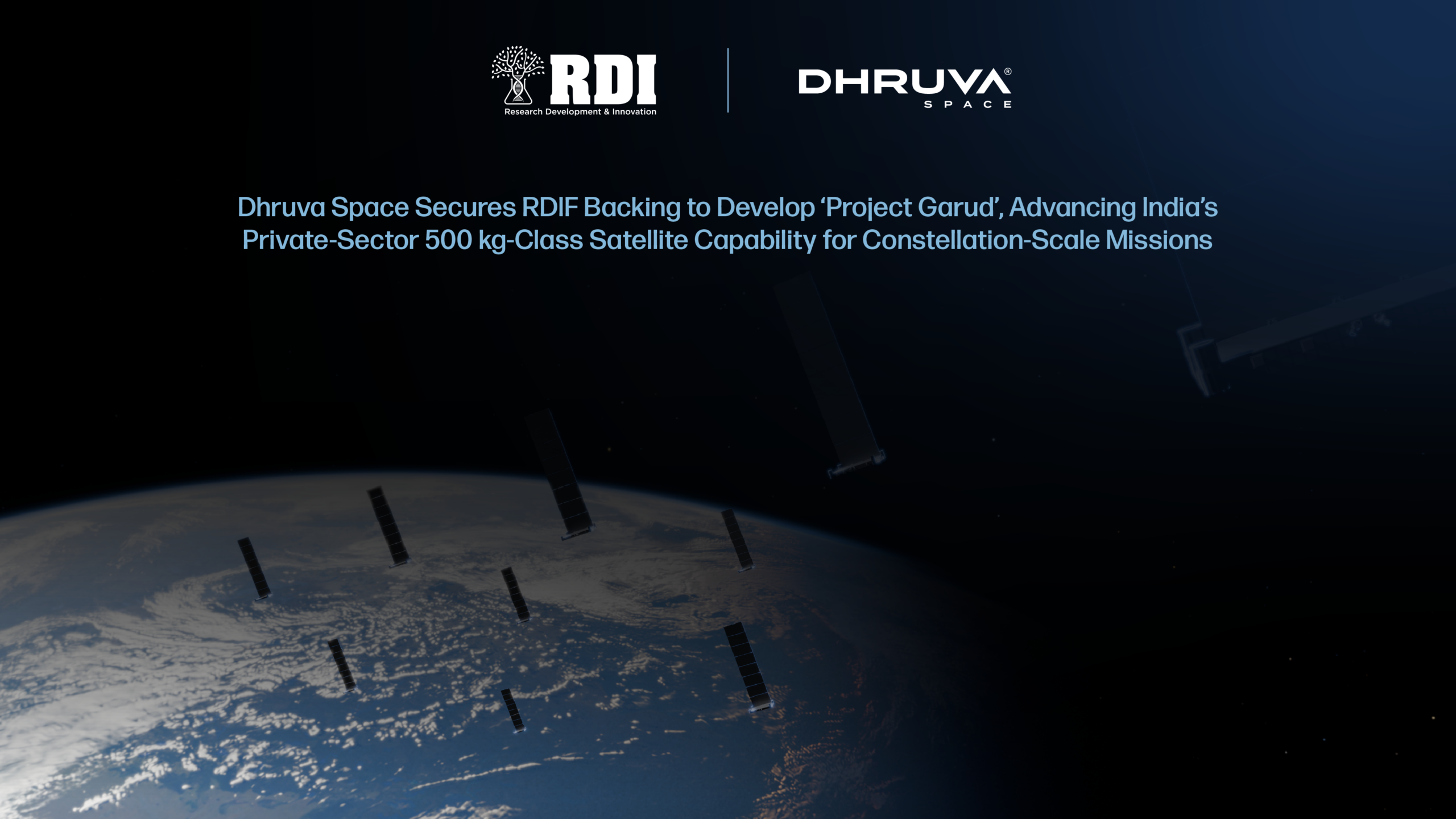
Dhruva Space has secured INR 105 crores in RDIF funding from the Government of India to develop Project Garud, a scalable 500 kg-class communications satellite platform for constellation-scale missions.
Indian private space company advances indigenous 500 kg-class communications satellite capability for constellation-scale deployment
Dhruva Space has secured INR 105 crores in support from the Government of India’s Research, Development & Innovation Fund (RDIF) for the development of “Project Garud”, a next-generation 500 kg-class communications satellite platform aimed at enabling constellation-scale sovereign and strategic satellite deployments.
The funding positions Dhruva Space among the first group of Indian startups to receive backing under the Government of India’s flagship RDI initiative. The programme is intended to support the development of an indigenous, modular, and mass-producible satellite architecture capable of serving telecommunications, defence, Earth observation, and next-generation space-based communications applications.
Announced in New Delhi on 14 May 2026, Project Garud forms part of India’s broader strategy to strengthen its domestic space manufacturing capability and expand its role within the global commercial space sector.
CONSTELLATION-READY SATELLITE ARCHITECTURE
The 500 kg-class platform is designed to bridge the gap between smaller experimental spacecraft and larger traditional satellite systems by offering an optimised balance of payload capacity, scalability, launch efficiency, and multi-mission adaptability.
Dhruva Space stated that the architecture is being developed as a standardised, production-oriented spacecraft platform capable of supporting diverse applications while enabling faster deployment cycles and improved manufacturing repeatability.
Project Garud introduces a flat-pack satellite architecture designed to support efficient launch stacking, faster integration, and improved deployment timelines for large-scale constellation operations.
The programme is also intended to establish a foundational layer for India’s next-generation space manufacturing ecosystem, with long-term applicability across Low Earth Orbit (LEO), Medium Earth Orbit (MEO), and future Geostationary Earth Orbit (GEO) mission architectures.
HIGH-VOLUME MANUFACTURING AMBITIONS
According to the company, the initiative seeks to address limitations associated with bespoke satellite manufacturing by transitioning toward a repeatable, production-ready industrial model.
As part of the programme, Dhruva Space plans to establish infrastructure, tooling, and industrial processes capable of supporting high-volume spacecraft manufacturing, targeting a production cadence of up to two satellites per day. The roadmap outlines annual manufacturing potential of approximately 500 to 600 satellites across multiple mission configurations.
The company stated that this manufacturing-first approach is intended to support growing global demand for sovereign and secure satellite constellations while strengthening India’s position as a competitive spacecraft production hub within the international space economy.
Commenting on the development, Abhay Egoor, CTO and Co-founder of Dhruva Space, said the project represented “the industrialisation of satellite manufacturing from India.”
“Our objectives are to build satellites for our own missions, and to position Dhruva Space as a globally competitive spacecraft OEM and subsystem supplier,” Egoor said.
INDIA’S COMMERCIAL SPACE EXPANSION
The grant was formalised during the inaugural Enterprise Technology Evaluation agreement signing and first fund disbursement under India’s ₹1 lakh crore RDI Scheme on 13 May 2026 in New Delhi.
The initiative builds on Dhruva Space’s existing work across spacecraft platforms and subsystems and is expected to support the advancement of multiple subsystems toward flight-qualified readiness for both domestic and global commercialisation opportunities.
SOURCE AND IMAGE: DHRUVA SPACE