
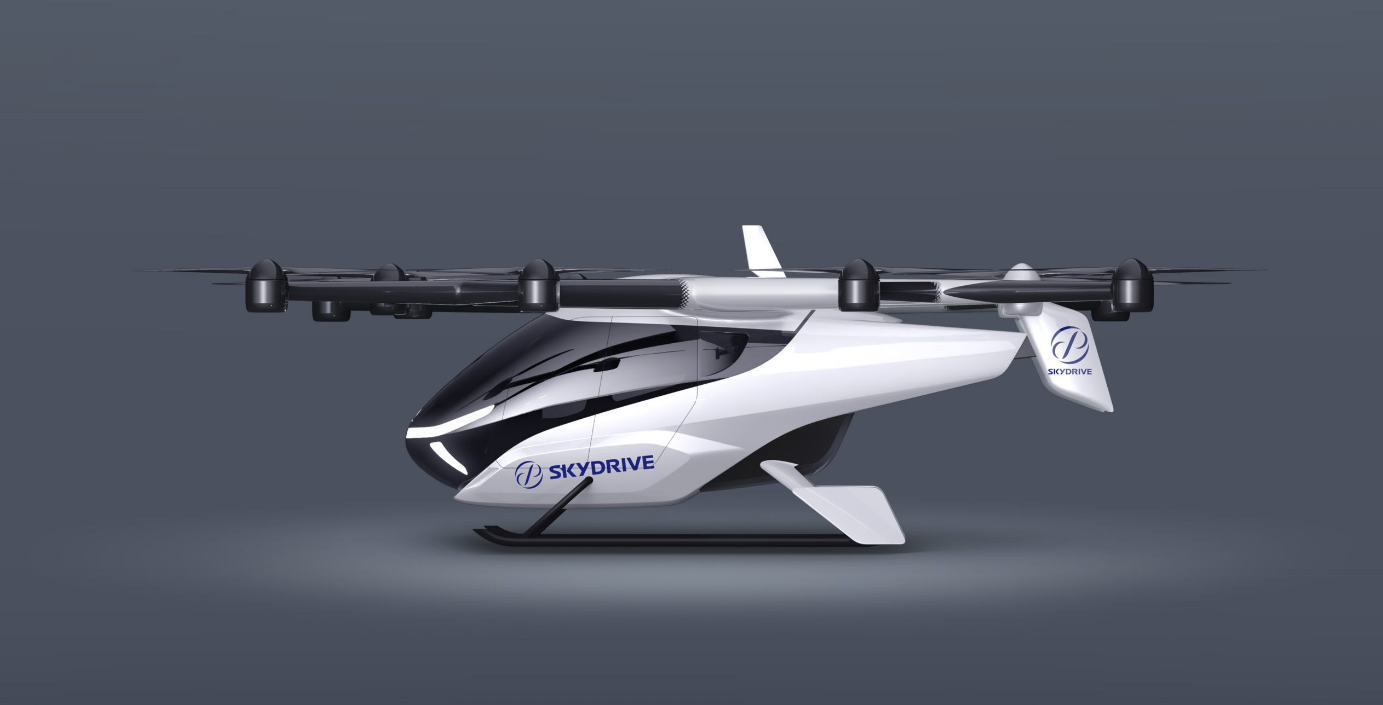
Japanese eVTOL developer SkyDrive has successfully flown its SD-05 aircraft at 100km/h, generating critical flight-test data that supports aircraft validation, certification activities and the company’s target of commercial operations by 2028.
HIGH-SPEED TESTING MILESTONE
SkyDrive has achieved a significant development milestone after accelerating its SKYDRIVE SD-05 eVTOL aircraft to 100km/h during a series of flight tests designed to evaluate aircraft performance, stability and controllability. The company said the achievement represents an important step towards type certification and the planned commercialisation of the aircraft in 2028.
According to SkyDrive, the test campaign verified the aircraft’s high-speed stability, manoeuvrability and control characteristics, while also assessing the performance of the propulsion system, flight-control systems and onboard avionics.
VALIDATING AIRCRAFT DESIGN
The company said the data gathered during the tests enabled engineers to compare actual aircraft behaviour with the performance predictions developed during the design and analysis phase. The results confirmed that the aircraft’s observed flight characteristics closely matched pre-flight simulations and engineering models.
For any new aircraft programme, flight testing plays a critical role in validating assumptions made during development.
SkyDrive noted that this process is particularly important for its aircraft because the design differs significantly from conventional fixed-wing aircraft and helicopters, meaning there is limited historical flight data available for comparison.
The company said high-speed testing allows engineers to assess the interaction of aerodynamic forces, vibrations, structural loads and flight-control responses under operational conditions that cannot be fully replicated through simulation or ground-based testing.
URBAN AIR MOBILITY APPLICATIONS
SkyDrive views the achievement as an important validation of its compact multicopter architecture, which is designed specifically for urban air mobility operations. Unlike many eVTOL concepts, the aircraft does not utilise fixed wings, relying instead on a compact configuration intended to maximise operational flexibility in constrained urban environments.
The company stated that the aircraft’s architecture incorporates 12 independent rotors controlled by a central flight-control system. The recent tests demonstrated the ability of this configuration to maintain stable high-speed forward flight while supporting the operational requirements of short-hop urban transport missions.
SkyDrive said the compact design could offer advantages in terms of take-off and landing flexibility, operational simplicity and maintainability, while helping to reduce operating costs.
BUILDING TOWARDS CERTIFICATION
The latest milestone follows an extensive development programme that has included hundreds of flight tests dating back to the company’s earlier SD-03 prototype. In addition to flight testing, SkyDrive has conducted battery, motor and rotor testing, aerodynamic evaluations in wind tunnels operated by the Japan Aerospace Exploration Agency (JAXA), and ground vibration testing.
The company said it will continue expanding the aircraft’s flight envelope through additional high-speed testing as it gathers the evidence required by regulatory authorities to support certification. Future testing will focus on confirming that the aircraft continues to perform in line with expectations established during the design phase and demonstrating its suitability for commercial operations.
SkyDrive recently became the first Japanese eVTOL developer to obtain Approved Design Organization (ADO) certification and continues to target entry into commercial service in 2028.
SOURCE AND IMAGE CREDIT: SkyDrive Inc.