
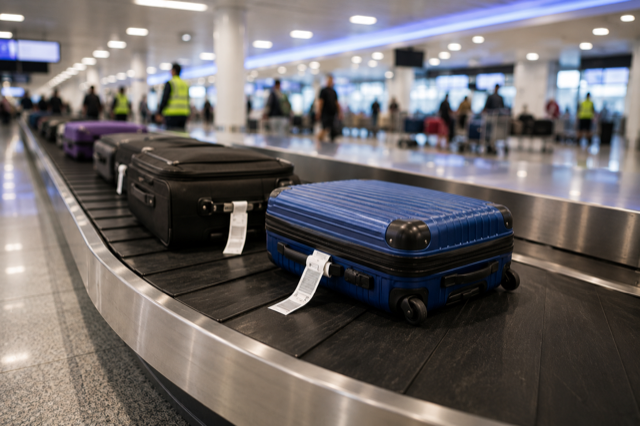
Global baggage mishandling rates fell by 23% in 2025, reaching their lowest level since before the pandemic, according to SITA’s latest Baggage IT Insights Report. However, Africa continues to record the highest baggage mishandling rate of any region, highlighting the operational challenges facing the continent’s aviation infrastructure.
GLOBAL BAGGAGE PERFORMANCE IMPROVES
Industry records strongest operational gains outside the pandemic period
The global aviation industry reduced baggage mishandling rates by 23% during 2025, despite passenger traffic increasing to a record five billion travellers worldwide, according to the 2026 edition of the SITA Baggage IT Insights Report.
The report found that the global baggage mishandling rate fell to 4.9 bags per 1,000 passengers, while the total number of mishandled bags declined by 19% to 24 million. Both figures are now below pre-pandemic levels, representing the strongest operational improvement achieved outside the disruption caused by the COVID-19 pandemic.
However, despite these gains, baggage disruptions continue to impose a significant financial burden on the industry, costing airlines and airports an estimated US$6.3 billion annually.
AFRICA REMAINS THE MOST CHALLENGING REGION
Continent records highest mishandling rate globally
The report identifies Africa as the region with the highest baggage mishandling rate worldwide, recording 12.1 mishandled bags per 1,000 passengers, more than double the global average.
According to SITA, international journeys remain a significant contributor to baggage disruption across the continent. Travel involving multiple airlines, airports and baggage handling organisations creates additional complexity and increases the likelihood of baggage transfer failures.
The report also points to capacity constraints and ageing infrastructure in parts of Africa as factors contributing to higher rates of baggage mishandling.
At the same time, SITA identifies Africa as presenting one of the greatest opportunities for operational improvement through the wider adoption of end-to-end baggage tracking, enhanced data sharing, biometric technologies and artificial intelligence-based predictive systems.
THE COST OF MISHANDLING
New industry benchmark significantly higher than previous estimates
The 2026 report introduces a revised industry benchmark for the cost of baggage disruption, estimating that each mishandled bag costs airlines an average of US$260. This figure replaces the long-standing industry estimate of US$150 per bag.
According to the report, delayed baggage accounts for approximately 70% of total baggage-related costs, with expenditure concentrated on recovery operations, rerouting and delivery logistics. For lost or damaged baggage, compensation payments account for as much as 70% of the associated costs.
The financial implications remain significant for an industry where average net profit margins remain relatively low. SITA notes that one mishandled bag can eliminate the profit generated by more than 30 passenger journeys.
DIGITAL TRANSFORMATION DRIVES IMPROVEMENT
Connected systems and predictive technologies deliver operational gains
SITA attributes the recent improvements not to a single technological development but to the growing integration of connected digital systems across the passenger journey.
These include real-time data sharing, artificial intelligence-driven baggage routing, biometric baggage processing and greater integration with passenger-owned devices.
According to Nicole Hogg, Portfolio Director Baggage at SITA, passenger expectations have shifted significantly towards real-time visibility and transparency throughout the baggage journey.
The report cites several examples of operational improvements already being achieved through digitalisation. Integration of Apple’s Find My technology with SITA WorldTracer reportedly reduced permanently lost baggage by 90% during its first year of operation while reducing delayed baggage recovery times by 26%. SITA has also integrated Google’s Find Hub item location sharing capability into the WorldTracer platform.
Meanwhile, Thai Airways reported reducing baggage reflight processing time from approximately three minutes to one second per bag across nine airports through implementation of SITA’s Auto Reflight solution.
INDUSTRY INVESTMENT CONTINUES
AI and end-to-end tracking expected to drive future gains
The report indicates that three-quarters of airlines intend investing in artificial intelligence technologies over the next two years, while approximately half plan to provide passengers with real-time baggage updates.
Industry implementation of baggage tracking under IATA Resolution 753 has now exceeded 50% globally, with full compliance targeted by 2027.
While global baggage performance continues to improve, SITA concludes that further gains will depend on extending digital visibility across every stage of the baggage handling process, particularly in regions where infrastructure constraints and operational complexity continue to challenge performance.
Source: SITA 2026 Baggage IT Insights Report, Image: World Airnews