
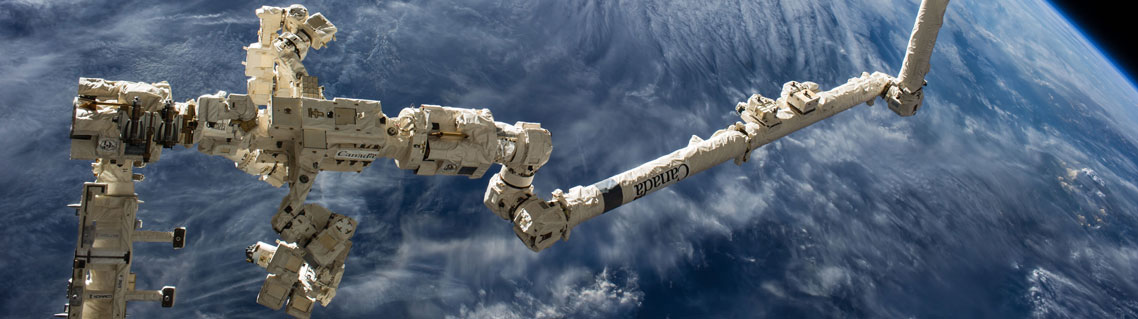
NASA astronauts Chris Williams and Jessica Meir are set to carry out a spacewalk to replace a failed joint on the International Space Station’s Canadarm2, more than 25 years after the robotic arm first helped assemble the orbiting outpost.
REPAIR MISSION FOLLOWS MAY FAULT REPORT
NASA astronauts Chris Williams and Jessica Meir are scheduled to perform a spacewalk to replace a failed joint on Canadarm2, the International Space Station’s robotic arm, following an issue first identified during routine operations on 27 May 2026. Canadian Space Agency astronaut Jenni Gibbons will serve as capsule communicator, responsible for all communications with the spacewalking astronauts throughout the operation.
Canadarm2, together with the Dextre robotic hand and the Mobile Base System, forms the Station’s robotic system, supporting maintenance work, the movement of supplies and equipment, and scientific activities. The system is also used to capture and dock visiting spacecraft to the Station.
Canadarm2 played a central role in assembling the International Space Station more than 25 years ago and continues to perform essential tasks a decade beyond its original design life. Following the repair, the arm is expected to resume normal operations.
OPERATION TIMELINE AND LIVESTREAM
Preparations for the spacewalk are due to begin at around 2:00am ET, with the operation itself expected to last roughly six and a half hours. NASA will livestream the spacewalk from 7:00am ET on its platforms.
HOW THE SPACESUIT PROTECTS ASTRONAUTS
During the spacewalk, the astronauts’ suits will function as personal spacecraft, sustaining life while they carry out repairs in orbit, with the Station travelling at around 8 km/s (28,000 km/h) and completing an orbit of Earth roughly every 90 minutes. The suits are designed to protect against known hazards including solar and cosmic radiation, micrometeoroid impacts and extreme temperature variation.
The overall pressurised suit takes around four and a half hours to put on and includes an integrated drink bag. It can sustain life in space for up to ten hours, against a typical spacewalk duration of six and a half hours, and is built with interchangeable parts to fit astronauts ranging from 1.5 metres to 1.88 metres in height.
The helmet incorporates a ventilation system for oxygen, lighting for work in darkness during each 45-minute orbital night, a camera allowing ground controllers to follow the work, a communications system with earphones and microphone, and a coated visor to block solar rays. The backpack, known as the Primary Life Support System, houses an oxygen tank, a ventilation fan, a battery and a warning system to monitor potential problems within the suit.
Gloves are tailor-made with moulded fingertips for dexterity, a small wrist-mounted mirror to allow astronauts to view the control panel on their chest, loops to hold tools, and a task checklist worn on the left arm. Undergarments include long underwear with circulating cool water and a highly absorbent garment to manage waste during the extended operation. As a safety measure, astronauts must remain secured by tethers throughout, with a propulsion system available in the event of accidental separation.
Source and Image: Canadian Space Agency