
China has successfully recovered the first stage of the Long March-10B carrier rocket at sea following its maiden flight on 10 July 2026, marking the country’s first controlled recovery of a carrier rocket and the world’s first recovery of a rocket stage using a net-based capture system.
HISTORIC RECOVERY COMPLETED SIX MINUTES AFTER STAGE SEPARATION
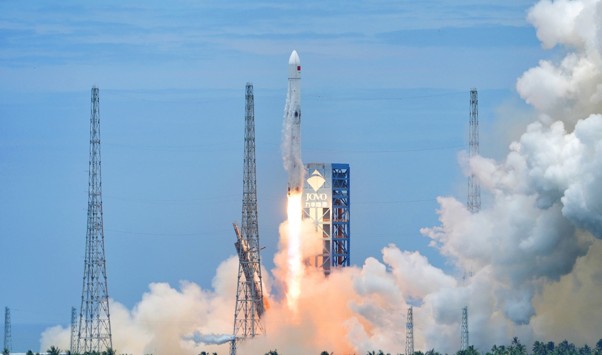
China’s Long March-10B carrier rocket completed its maiden flight on 10 July 2026, launching from the Hainan Commercial Space Launch Site at 12:15pm and successfully delivering its payload satellite to its predetermined orbit. Approximately six minutes after first and second stage separation, the rocket’s first stage returned vertically to a sea-based recovery platform and was captured successfully using a net-based capture mechanism — the first time such a recovery method has been used anywhere in the world. Both the launch and the first-stage recovery missions were declared complete successes by China Aerospace Science and Technology Corporation (CASC).
The Long March-10B has become China’s first successfully recovered reusable carrier rocket. The mission is designated the 657th launch of the Long March carrier rocket series, which has been the backbone of China’s space launch programme since 1970. CASC confirmed that the maiden flight successfully validated all key core technologies for first-stage reusability, including maritime platform capture and recovery, in addition to the principal technologies required for a new class of large reusable liquid-fuelled launch vehicle.
THE NET-BASED RECOVERY METHOD AND ITS ADVANTAGES
Unlike the propulsive vertical landing method used by SpaceX’s Falcon 9 — in which the returning rocket stage uses its engines to decelerate and land on designated legs — the Long March-10B employs a distinct approach in which the returning first stage flies directly into a massive net mounted on the recovery vessel and is captured by it. The return sequence involves coasting, attitude adjustment, powered braking and aerodynamic deceleration before the stage executes a precise descent to be caught by the net.
Chen Muye of CASC said the net-based recovery approach simplifies the onboard structure, reduces weight and boosts payload capacity relative to propulsive landing systems. It also demonstrates strong adaptability to landing deviations, effectively enlarging the capture window through coordinated net operations. The system relies on a cross-shaped high-strength buffered arresting net in coordination with an onboard hook mechanism on the returning rocket stage. The net itself is deployed on a purpose-built recovery platform delivered by the China Academy of Launch Vehicle Technology (CALT) in November 2025. The vessel measures 144 metres by 50 metres with a full-load displacement of 25,000 tonnes and is equipped with LiDAR units at each corner that automatically track the rocket’s position and attitude, using specialised cables to absorb its kinetic and potential energy in a fully automated, unmanned process.
TECHNICAL SPECIFICATION OF THE LONG MARCH-10B
The Long March-10B is a large liquid-fuelled carrier rocket in a two-stage tandem configuration with a diameter of five metres. The first stage uses liquid oxygen and kerosene propellant — the same propellant combination as the first stage of the Long March-10A — while the second stage uses liquid oxygen and methane. The rocket has a liftoff thrust of approximately 890 tonnes and a liftoff weight of approximately 760 tonnes. The first flight vehicle was approximately 63 metres in length. In its reusable configuration, the rocket has a low Earth orbit (LEO) payload capacity of 16 tonnes, meeting the requirements of multiple mission categories including LEO satellite internet constellation deployment and large commercial satellite launches.
The maiden flight validated a range of core technologies including the overall optimised design of the combined configuration, high-thrust tank bottom power transmission technology, propellant management technology based on the bulkhead tank, methane self-pressurisation technology, the engine’s ability to perform multiple starts and high-altitude ignition, adaptability to complex force and thermal environments, and high-precision navigation and control. The Long March-10B development team has stated that a first-stage reusable reflight is expected to be completed by the end of 2026.
WIDER SIGNIFICANCE FOR CHINA’S COMMERCIAL SPACE PROGRAMME
Chen described the Long March-10B’s maiden flight as a breakthrough in low-cost, heavy-lift reusable rocketry, aimed at bolstering China’s commercial space competitiveness and accelerating routine reusable launches while advancing the next-generation crewed rocket programme. The vehicle is designed to support large-scale LEO satellite constellations and medium Earth orbit communications missions. Two companion vehicles are in development: the Long March-10A and the Long March-10C, with CASC positioning all three as forming the backbone of China’s space transportation system for high-frequency reusable launches and extended deep-space reach.
Source and Images: China Aerospace Science and Technology Corporation (CASC) / SASAC