
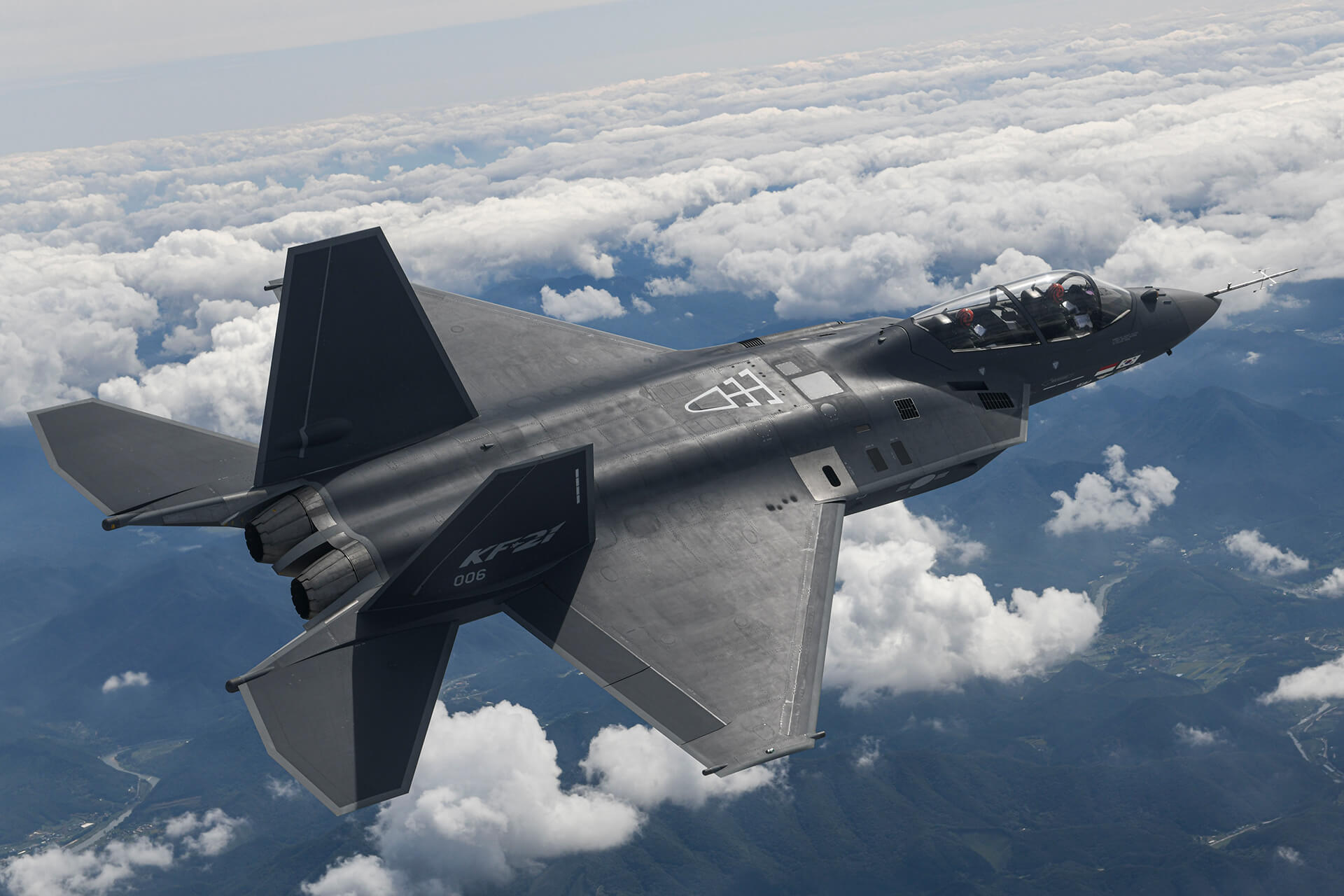
South Korea’s KF-21 Boramae fighter has entered mass production following a rollout ceremony attended by President Lee Jae Myung in March 2026, with GE Aerospace’s F414 engine providing the propulsion at the heart of the programme and Hanwha Aerospace building local assembly and support capability alongside its global partner.
KF-21 ROLLOUT MARKS A COMING-OF-AGE MOMENT FOR KOREAN AEROSPACE
The first mass-produced KF-21 Boramae was unveiled at a rollout ceremony on 25 March 2026 attended by South Korean President Lee Jae Myung, marking the programme’s transition from development into operational deployment and what GE Aerospace describes as a defining milestone for the Republic of Korea’s aerospace sector. The KF-21 is South Korea’s indigenous next-generation fighter, developed through Korea Aerospace Industries (KAI) and Hanwha Aerospace in collaboration with international technology partners, and its arrival represents years of national commitment to building a globally competitive aerospace ecosystem and strengthening domestic defence readiness.
Sun Kim, Executive Vice President and CEO of Hanwha Aerospace’s Aero Engine Business Group, said it was not every day a company celebrated the arrival of a state-of-the-art fighter jet that was initiated, designed, developed and built in Korea with support from expert partners around the world. He said Hanwha Aerospace was working closely with global partners including GE Aerospace to advance the ability to assemble and support advanced propulsion systems locally, describing this as an important foundation for building a more capable and competitive aerospace ecosystem in Korea.
THE F414 ENGINE: PERFORMANCE, ARCHITECTURE AND TRACK RECORD
The KF-21 is powered by GE Aerospace’s F414 engine, which delivers approximately 22,000 pounds (98 kN) of thrust. The engine is designed for rapid throttle transitions with zero throttle restrictions, enabling pilots to respond quickly to dynamic flight conditions — a characteristic that contributes directly to the KF-21’s operational effectiveness including extended combat radius. The F414 builds on the proven architecture of the F404 engine while incorporating advances that increase thrust by up to 35%, and is engineered for durability and maintainability across long operational cycles.
Since entering service in the late 1990s, more than 1,600 F414 engines have been delivered globally, accumulating millions of flight hours across a wide range of missions and environments. The engine has been selected to power several advanced fighter platforms including the Boeing F/A-18E/F Super Hornet, the E/A-18G Growler, the Saab JAS 39E/F Gripen NG and the NASA X-59 QueSST quiet supersonic research aircraft. GE Aerospace is expected to deliver 240 F414 engines to the Republic of Korea Air Force by 2032, alongside additional spare engines for long-term operational support.
ADVANCED MATERIALS, CMC TECHNOLOGY AND LOCAL CAPABILITY DEVELOPMENT
GE Aerospace has also demonstrated the use of ceramic matrix composites (CMCs) in the F414, completing 1,000 test cycles with rotating CMC components in the engine — validating the materials’ ability to withstand the extreme high-pressure environment inside a high-performance military engine. CMCs weigh one-third of their metal equivalents and can withstand up to 500 degrees Fahrenheit more heat than traditional metal alloys, enabling more efficient and durable turbine section design.
Youngje Kim, GE Aerospace’s General Manager of Asia Pacific Defence and Systems, said the F414 was a critical enabler of the KF-21’s performance, delivering the thrust, responsiveness and reliability required for next-generation operations. He said GE Aerospace was actively supporting local assembly in Korea through the provision of engine kits alongside training and close collaboration with Hanwha Aerospace, helping build in-country capability while ensuring the consistency and performance the programme required. The KF-21 programme builds on GE Aerospace’s long-standing presence in Korea, including its role powering the T-50 Golden Eagle trainer with the F404 engine.
Source and Images: GE Aerospace