
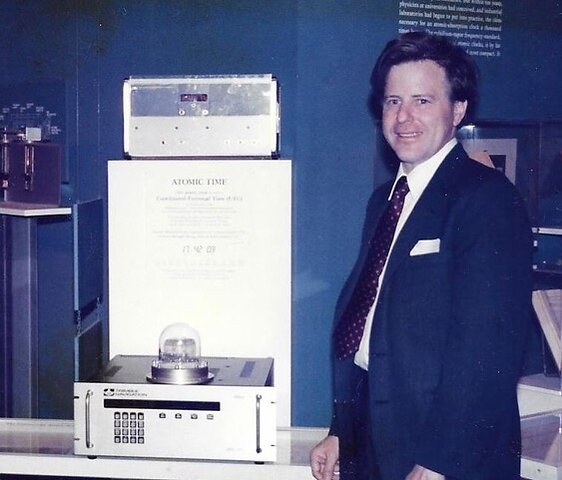
Charlie Trimble, who founded Trimble in 1978 and brought the world’s first commercially viable GPS receiver to market six years later, will receive the American Geographical Society’s O.M. Miller Cartographic Medal, in recognition for the commercialisation of a technology that now underpins satellite navigation and approach guidance across aviation.
A COMMERCIAL BET ON AN EXPERIMENTAL MILITARY PROGRAMME
The American Geographical Society has announced that Charlie Trimble, founder of the technology company that bears his name, has been selected to receive its O.M. Miller Cartographic Medal, one of the Society’s highest honours, recognising individuals whose contributions have significantly advanced cartography and the geographic sciences. The medal will be presented on 15 September 2026 during the AGS Globe Signing Ceremony at the Explorers Club in New York.
The decision being recognised was taken at a point when it looked considerably less obvious than it does now. In the late 1970s GPS was an experimental military programme and few believed it would become commercially viable. Trimble founded his company in 1978 on the conviction that precise positioning could solve real-world problems, and sold the world’s first commercially viable GPS receiver six years later. Lee Schwartz, Chief Executive of the American Geographical Society, said Trimble had helped transform GPS from an emerging technology into one of the defining innovations in modern geography, and that his early vision for the commercial potential of precise positioning laid the foundation for modern mapping, navigation and the many industries relying on geographic intelligence.
Trimble said that growing up, Sputnik had sparked his fascination with science and engineering, and that years later GPS represented one of those rare technologies with the potential to fundamentally change the way people worked. He said bringing that vision to life had taken an extraordinary team and that it had been rewarding to see the impact GPS had across so many industries.
WHY THIS MATTERS TO AVIATION SPECIFICALLY
The aviation relevance runs deeper than general navigation. Under Trimble’s leadership the company pioneered Real-Time Kinematic positioning, which delivers centimetre-level accuracy , a step change from the metre-level performance of standard GPS, and the technical foundation on which precision approach capability rests. Modern aviation’s dependence on satellite positioning is now near-total: area navigation and required navigation performance procedures, LPV approaches offering vertical guidance without ground-based infrastructure, ADS-B surveillance, and the datalink and performance-based navigation requirements that increasingly determine which airspace an aircraft may enter all assume the availability of accurate satellite position.
That dependence is the reason airports and air navigation service providers can now offer instrument approaches to runways that could never justify the cost of an instrument landing system, and the reason surveillance coverage extends across oceanic and remote airspace where radar does not reach. It is also, for the same reason, the source of aviation’s exposure to GNSS jamming and spoofing – a vulnerability that follows directly from how completely the technology succeeded.
Rob Painter, President and Chief Executive of Trimble, said Charlie Trimble had the courage to invest in GPS long before the world understood its potential, seeing an opportunity where others saw uncertainty and helping turn an experimental satellite system into technology that transformed industries. The American Geographical Society, established in 1851, is the oldest professional geographical organisation in the United States.
Source and Images: American Geographical Society / Trimble