

A Japanese Ministry of Defense evaluation document setting out a ¥5 billion research programme into stand-in jamming technology gives an unusually direct explanation of why the work must be done in-house: electronic warfare capability is highly classified, no information is disclosed from overseas, and the equipment has no civilian market. There is, in the ministry’s own assessment, no alternative to building it themselves.
A BUDGET DOCUMENT THAT EXPLAINS ITSELF
An ex-ante project evaluation published by Japan’s Acquisition, Technology and Logistics Agency sets out the case for a research programme titled ‘Research on Smart Radio-Wave Decoy Technology’. Prepared by ATLA’s Technology Strategy Department in August 2023, the document is a policy evaluation supporting a budget request rather than a capability announcement. This is a category of publication that is required to justify expenditure and therefore tends to state reasoning that would otherwise remain internal.
The project’s purpose is described plainly: research into the technology necessary to realise a stand-in jammer, defined in the document as a jamming device that operates within the threat zone and conducts various forms of electronic jamming, applying radio interference and false information to an adversary’s radar and other radio equipment in order to disrupt their use of the electromagnetic spectrum. The stated objective is the establishment of radio-wave deception jamming technology, and specifically technology to generate jamming signals capable of being used in a stand-in jammer.
THE ALTERNATIVES ASSESSMENT
Japanese policy evaluation documents of this type are required to address whether alternatives to government-funded development were considered. ATLA’s answer to that question is the most quotable passage in the document and is worth reading closely. It states that the electronic warfare capability of defence equipment is highly confidential, that there is no disclosure of information from overseas, and that electronic warfare equipment has no civilian demand — and that for these reasons the Ministry of Defense must conduct the research and development itself.
Each clause closes a different door. Purchasing a foreign system is unavailable because the capability is not exported in a form that would transfer the underlying technology; even allied nations do not disclose the parameters that make an electronic warfare system effective, since disclosure is what renders it ineffective. Licensed production would face the same constraint. And unlike propulsion, avionics, materials or sensors, where military requirements can be met by adapting technology developed for civil markets, electronic warfare has no commercial analogue to adapt. A country that wants the capability must develop it, or do without.
The document also sets out why the timing was fixed. It states that in order for a jamming device to be mounted on a UAV or similar platform and made operable as a stand-in jammer, the research must be completed by FY2028, and that starting the research prototype in FY2024 was therefore necessary.
COST AND SCHEDULE
The document gives a total project cost of approximately ¥5 billion for the research prototype, and records a FY2024 budget request of approximately ¥5 billion inclusive of future-year obligations. The schedule is set out in two phases. Research prototyping runs from FY2024 through FY2027. In-house testing by ATLA then runs from FY2027 through FY2028, verifying the results, with the test research costs for that phase budgeted separately.
DESIGN REQUIREMENTS: COMMERCIAL PARTS, OPEN ARCHITECTURE, MULTIPLE PLATFORMS
Under its efficiency assessment the document sets out four design characteristics that shape what the resulting device is intended to be. Cost reduction is to be pursued through extensive use of commercial off-the-shelf products. Versatility is to be improved through the use of open architecture. The device is to be easy to retrofit or add to a platform, and capable of operating as a standalone system, which the document states would allow early fielding. And it is to be usable across multiple platform types, enabling what the document describes as family-isation and commonisation.
Read together, these are the specifications of something intended to be produced in quantity and fitted to whatever is available, rather than a bespoke system integrated into a single airframe. The emphasis on standalone operation and retrofit is the clearest signal: a payload that does not require its host platform to be designed around it can be fielded on platforms that already exist.
The document’s effectiveness assessment states simply that the work would make possible the realisation of a stand-in jammer with a jamming device mounted on a UAV or similar platform. Its cost and effect assessment states that the research is expected to make it difficult for an adversary to select engagement targets, thereby improving Japanese survivability. The evaluation records that the expert panel raised no objection regarding the project’s necessity, and concludes that commencing the research is appropriate from every policy evaluation perspective.
WHERE THIS SITS IN JAPANESE DEFENCE POLICY
The document anchors the project in two Cabinet decisions of 16 December 2022. The National Defense Strategy passage it cites identifies cross-domain operations capability as a priority, stating that organically fusing capabilities across the space, cyber and electromagnetic domains with the land, sea and air domains (amplifying overall capability through synergy) makes it increasingly important to overcome inferiority in individual domains.
The Defense Buildup Program passage is more specific, and establishes that the stand-in jammer was conceived as one element of a set rather than in isolation. Alongside strengthening jamming, detection and identification capabilities and acquiring means of electromagnetic deception, it lists the deployment of a Network Electronic Warfare System with communication and radar jamming functions; the development of both stand-off electronic warfare aircraft, which conduct communication jamming from outside the threat zone, and stand-in jammers, which conduct various electronic jamming within it; improvement of signal detection and identification on vessels and fixed-wing patrol aircraft; and deployment of ground-based anti-air electronic warfare equipment. A separate passage under the strengthening of the defence technology base commits to research on deception device technology that gives false information to threatening radar so that multiple threats appear to exist, this is the specific line under which this project sits.
The evaluation document includes an operational concept diagram showing jamming signals being emitted toward surface vessels in a maritime scenario, with both crewed aircraft and small uncrewed platforms present. ATLA does not specify a launch method for the device in the document.
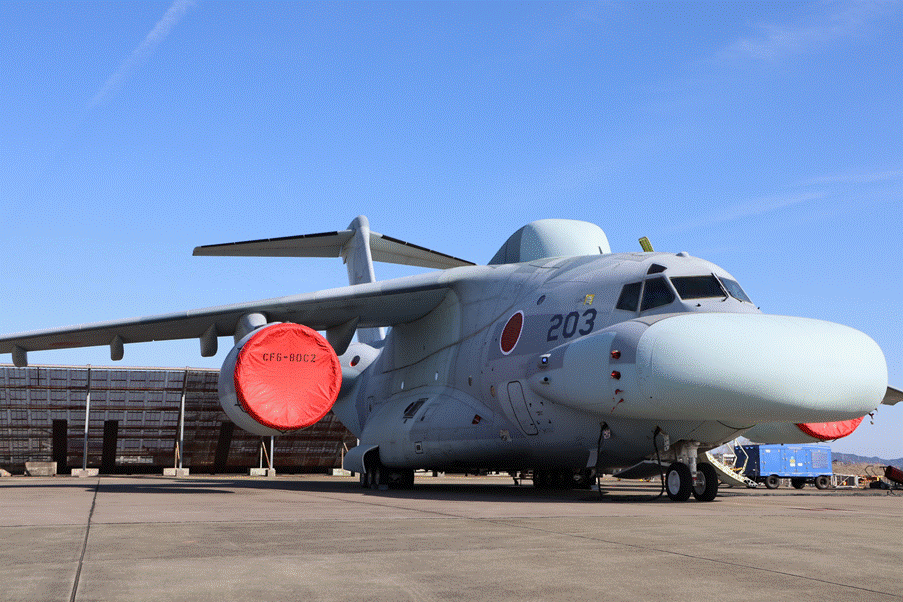
Note: the accompanying image supplied for this article shows the EC-2, a Japan Air Self-Defense Force electronic warfare aircraft. The stand-off and stand-in categories are distinct, and the ATLA document concerns the latter.
Source: Japan Ministry of Defense, Image: Japan Air Self-Defense Force