
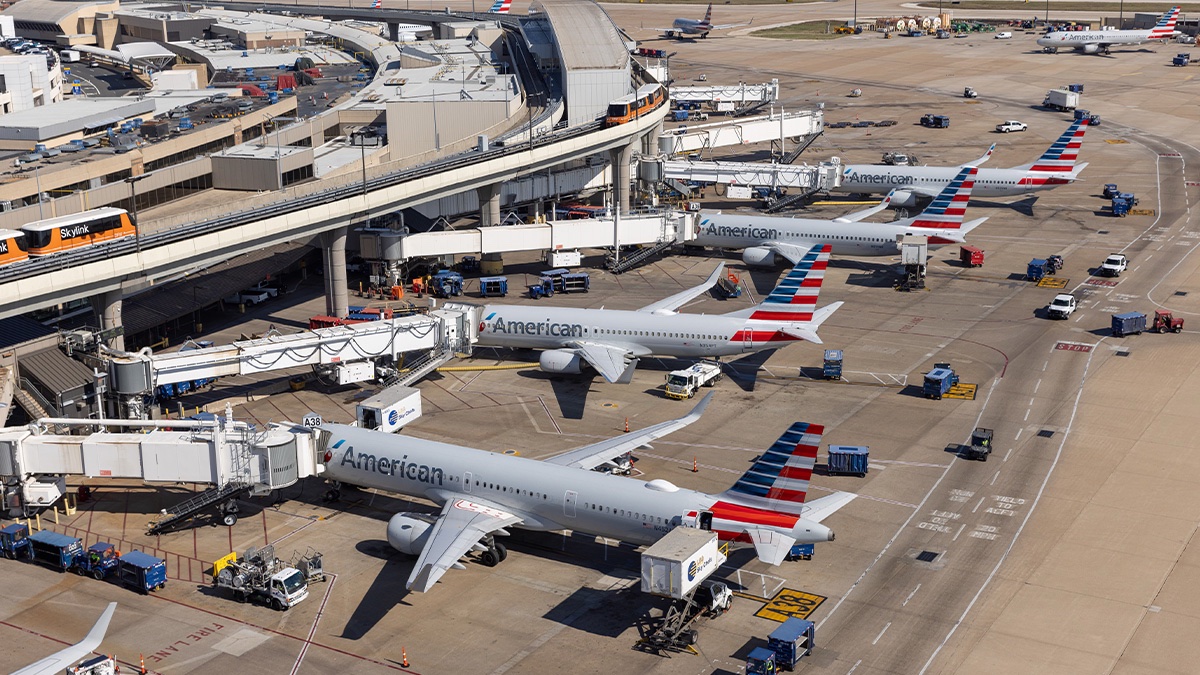
An analysis by Texas Christian University’s Center for Supply Chain Innovation finds that American Airlines’ hub at Dallas Fort Worth International Airport supports around $70 billion in annual economic output and an estimated 350,000 jobs across North Texas, and identifies its connectivity as a factor in the region’s corporate headquarters growth.
A HUB LARGER THAN LOCAL DEMAND WOULD SUPPORT
A new analysis from the Texas Christian University Center for Supply Chain Innovation in the Neeley School of Business finds that American Airlines’ hub at Dallas Fort Worth International Airport supports around $70 billion in annual economic output and 350,000 jobs across North Texas. The report identifies the role American plays in the regional economy through its network, global connectivity and continued investment in the area.
The study’s central finding is more interesting than the headline figures. It concludes that the DFW hub enables a scale of air service and connectivity far in excess of what local demand alone could support, which is the defining characteristic of a hub as against a large origin-and-destination airport. Connecting traffic passing through DFW to reach somewhere else pays for frequencies and destinations that North Texas by itself could not fill, and local passengers and businesses then get to use them. The economic benefit to the region flows from being the transfer point rather than from being the market.
American operates its largest hub at DFW, employing more than 37,000 people in the region, serving more than 69 million passengers annually and providing access to 230 destinations in 30 countries. It accounts for approximately 82 per cent of DFW’s commercial passenger traffic and serves 23 airports across Texas, more than any other commercial carrier.
CONNECTIVITY AND CORPORATE RELOCATION
The study also links the hub to the region’s success in attracting corporate headquarters, noting that Dallas-Fort Worth has attracted more than 100 headquarters relocations since 2018, leading all United States metropolitan areas. The report concludes that American’s network provides a competitive advantage for companies weighing where to locate and expand – a mechanism that is straightforward in practice, since a company headquartered where its executives can reach most of its markets non-stop incurs materially lower travel time and cost than one that cannot.
Robert Isom, American’s Chief Executive, said North Texas had grown alongside the DFW hub for decades and the study demonstrated how deeply interconnected that success had become, adding that the value of the hub extended beyond the airport by helping attract investment, support jobs and position the region to compete globally. Daniel W. Pullin, Chancellor of Texas Christian University, said the study reflected what TCU does best in bringing an independent eye to questions that matter to the region, and noted that the university’s aviation programmes would soon train aviation professionals close to American’s global headquarters.
GROWTH ON BOTH SIDES
The context is a region that has expanded from roughly 2.4 million residents five decades ago to more than 8.5 million today, making it among the fastest-growing metropolitan areas in the United States. American and DFW have unveiled plans for a nearly $4 billion expansion of Terminal F, doubling the number of planned gates and expanding international facilities, with further work underway at Terminals A and C.
Source and Images: American Airlines