
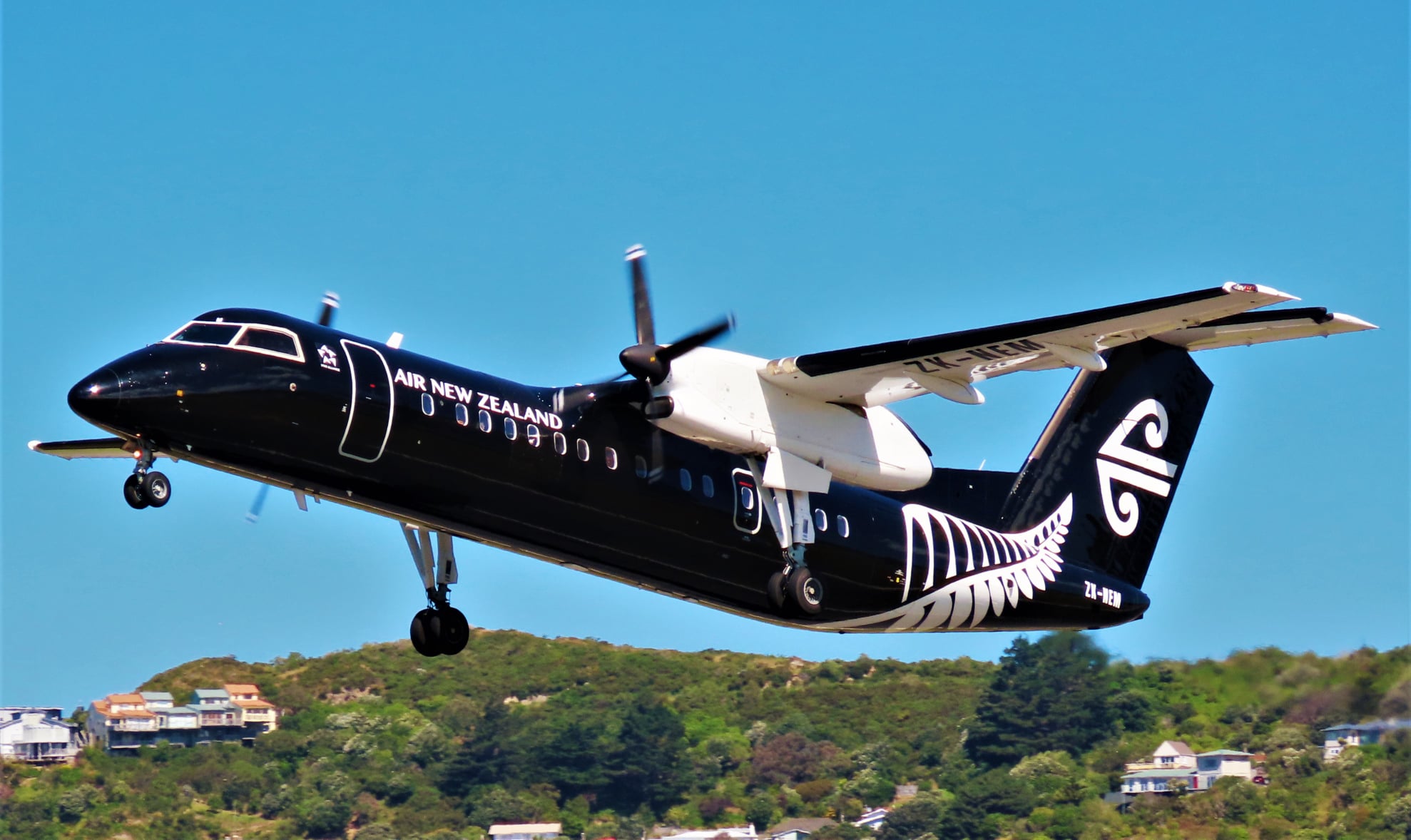
An Air New Zealand DHC-8 Q300 descended to 1,022 feet above ground approaching Timaru at night in June 2023 before the crew recovered and landed safely; the Transport Accident Investigation Commission’s final report also found shortcomings in the regulator’s own oversight of the aircraft type.
New Zealand’s Civil Aviation Authority (CAA) has responded to the Transport Accident Investigation Commission’s (TAIC) final report into an incident on 13 June 2023, in which an Air New Zealand De Havilland DHC-8-311 (Q300), registration ZK-NEM, descended below the minimum safe altitude at night while approaching Timaru. The aircraft, carrying 33 passengers and three crew, departed from its planned descent profile roughly 27 nautical miles from the aerodrome and continued down to a lowest recorded altitude of 1,156 feet, 1,022 feet above ground level, before the captain levelled off and climbed back to regain the approach profile. The aircraft landed uneventfully, with no damage or injuries.
WHY IT HAPPENED
TAIC’s investigation found the aircraft was descending in vertical speed (V/S) mode rather than the programmed VNAV mode after the captain, performing routine altimetry checks during the descent, did not reselect VNAV; this went unnoticed for several minutes. The crew’s attention became increasingly focused on visually identifying Timaru’s aerodrome lights at night, which TAIC said degraded their instrument scanning to the point that neither pilot recognised the aircraft had drifted significantly below profile. “I was comfortable that [they] could see the runway; I was uncomfortable that I couldn’t,” the captain later told investigators. TAIC found crew resource management in the cockpit was not effective, and identified deficiencies in Air New Zealand’s training and oversight of pilots with less multi-crew experience, as well as differences in safety culture between the Q300 fleet and the airline’s other fleets.
WHAT TAIC FOUND ABOUT REGULATORY OVERSIGHT
TAIC also examined the CAA’s own oversight of Air New Zealand’s Q300 fleet and found it was not effective in responding to known issues, citing deficiencies in how the regulator approved the integration of Air Nelson and Mount Cook Airlines onto Air New Zealand’s operating certificate in 2019 and recertified it in 2020. The Commission said the regulatory relationship between CAA and Air New Zealand appeared too close in nature, which it considered likely impeded the regulator’s ability to impartially oversee the airline’s safety management system. TAIC further found that most New Zealand-registered passenger and cargo aircraft carry cockpit voice recorders with only a two-hour recording capacity, which it said increases the risk that valuable safety evidence is overwritten and lost; in this case, the operator’s post-incident procedures did not ensure the CVR was preserved.
CAA’S RESPONSE
The CAA says it has carefully considered the report and the lessons it identifies, including for the regulator itself, and notes the report examines events and regulatory approaches from 2023 and earlier. Since then, the CAA says it has strengthened how it brings together safety intelligence, monitoring, certification and regulatory decision-making, moving to a more coordinated, risk-based approach to oversight. The CAA has accepted TAIC’s recommendation relating to cockpit voice recorder requirements and intends to raise the issue through the appropriate International Civil Aviation Organisation forum.
Note: This article summarises two official documents: the CAA’s public statement and TAIC’s full final report, which runs to detailed findings on crew performance, human factors and regulatory oversight. Readers who need the complete analysis, the full list of findings and safety issues, or the exact regulatory detail should consult the original sources at the links below.