
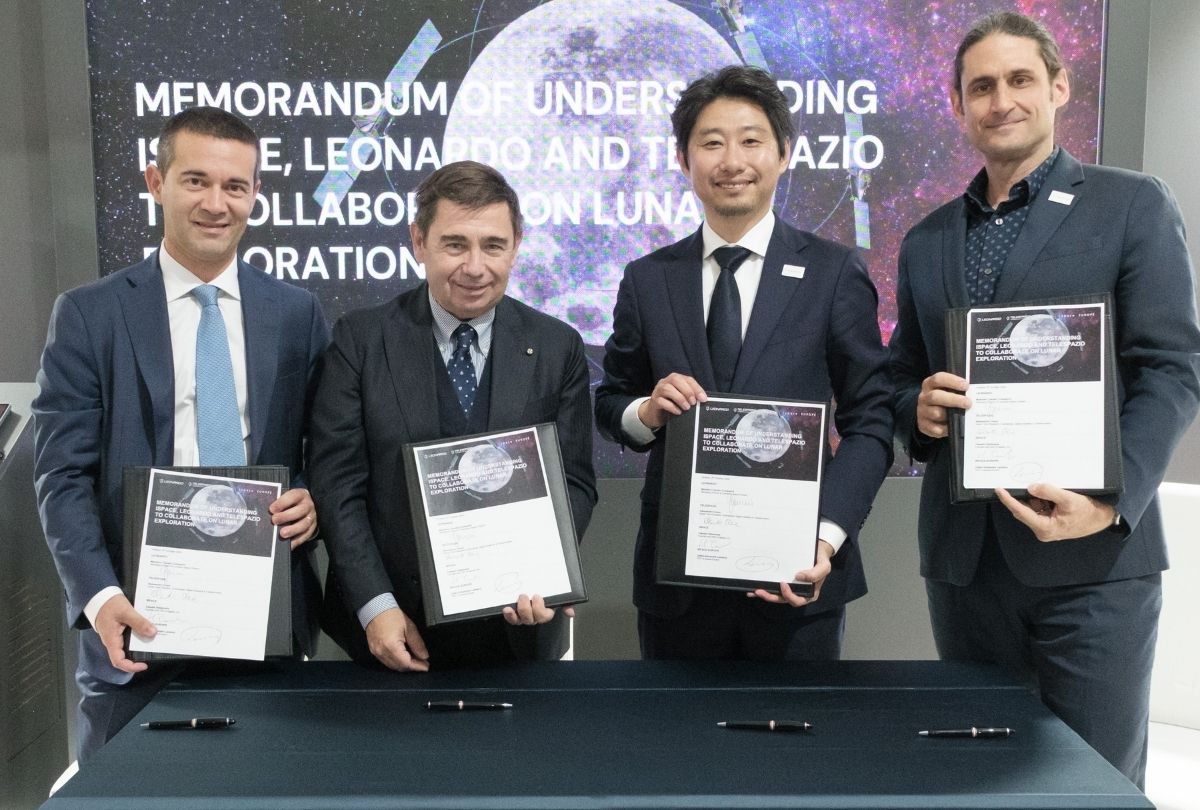
The agreement expands earlier cooperation between ispace and Telespazio to explore joint lunar infrastructure and services, with the European Space Agency’s Moonlight programme identified as a first opportunity to put it into practice.
ispace-EUROPE S.A. and ispace, inc. (together, ispace) have signed a Memorandum of Understanding with Leonardo and Telespazio, the joint venture between Leonardo (67%) and Thales (33%), to explore collaboration on lunar communications, positioning, navigation and timing infrastructure and services, as well as lunar transportation. The agreement expands on cooperation between ispace and Telespazio that began with a 2025 Letter of Intent, now broadening the scope to include Leonardo’s space robotics and artificial intelligence capabilities alongside interoperability, user access and service provision across lunar communications, navigation and transportation.
Together, the parties will evaluate how integrated service offerings could extend communications coverage on the lunar surface and in lunar orbit, expand navigation capabilities, increase data capacity and improve resilience for future lunar missions; the agreement also covers the potential transportation of Moonlight satellites to lunar orbit aboard ispace’s orbital transfer vehicle. The European Space Agency’s Moonlight programme, led by Telespazio, is identified as the first opportunity to implement the partnership.
“Through this collaboration with Telespazio and Leonardo we are bringing together complementary capabilities in transportation, communications and navigation to help build the foundations of a sustainable cislunar economy. We are proud to work alongside leading European partners to advance the infrastructure that will support the next generation of lunar missions,” said Takeshi Hakamada, founder and CEO of ispace.
“This collaboration is particularly exciting because it brings together some of the strongest lunar exploration capabilities across Europe and Japan to support a shared vision: enabling advanced lunar missions by both commercial and government actors that will achieve sustained exploration and long-term presence on the Moon. By combining European expertise in telecommunications, navigation and space systems with ispace’s experience in lunar transportation, communications and surface mobility, we have an opportunity to help shaping the infrastructure that future missions will rely upon,” said Julien-Alexandre Lamamy, CEO of ispace-EUROPE.
“The agreement with ispace marks a further step towards the development of an always more integrated and interoperable infrastructure capable of supporting the growing number of missions to the Moon. By bringing together complementary capabilities in communications, navigation and lunar transportation, robotics and AI, Leonardo, together with Telespazio and Thales Alenia Space, is contributing to the development of the services and technologies that will enable a sustained presence in the lunar environment, supporting the evolution of a global and interconnected cislunar ecosystem,” said Massimo Claudio Comparini, Managing Director of Leonardo’s Space Division.
“With this collaboration, Telespazio consolidates its leading role in lunar communication and navigation infrastructure, bringing together Moonlight’s expertise with ispace’s cislunar transportation and communication capabilities, mission interoperability and Leonardo’s technological depth. This step strengthens Italian and European industrial leadership, enhancing collaboration with ispace as primary industry in what is set to become a lunar economy, a strategic asset for science, industry, and institutional missions in the decades ahead,” said Gabriele Pieralli, Chief Executive Officer of Telespazio.
As global lunar exploration moves from individual missions toward a sustained operational ecosystem, the parties say communications, navigation and transportation infrastructure are increasingly recognised as critical enablers of scientific, commercial and governmental activity on the lunar surface and in lunar orbit, and that collaboration and interoperability between actors will be essential to building a resilient lunar ecosystem.
Source and Images: Leonardo