
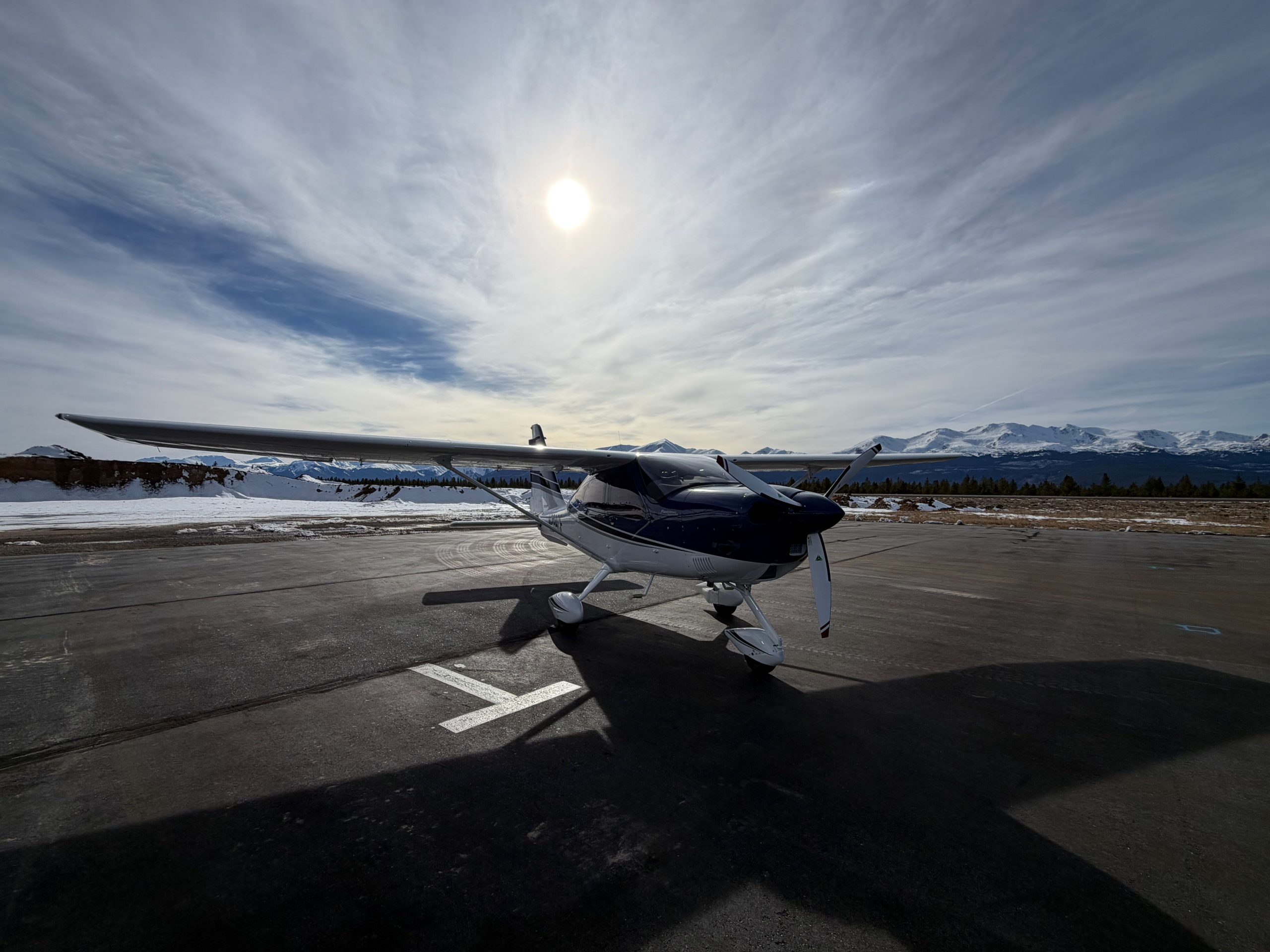
Tecnam US flew its diesel-powered P2010 TDI to Colorado’s Lake County Airport, the highest paved runway in North America, to demonstrate the aircraft’s turbocharged high-altitude performance with four people on board.
Tecnam US flew its P2010 TDI from Centennial Airport near Denver to Lake County Airport in Leadville, Colorado, the highest paved runway in North America, on 19 November, to demonstrate how the aircraft and its turbocharged Continental CD-170 engine perform at altitude. With four people on board, two in front and two in back, the P2010 TDI crossed the Colorado high country, landed at 9,934 feet, refuelled, and took off again using less than half of Leadville’s 6,400-foot runway.
THE FLIGHT
Tecnam US Chief Pilot Doma Andreka departed Centennial Airport, field elevation 5,885 feet, with three passengers on board. Carrying four people and 30 gallons of fuel, the P2010 TDI climbed out at over 800 feet per minute until levelling off at 13,000 feet for the 50-minute flight southwest to Leadville.
The route ran past the snow-capped peaks of the Rockies and over deep reservoirs, then turned north up the valley toward Leadville. In cruise, the Garmin G1000 NXi showed 86 per cent power and a 135-knot groundspeed, with the engine’s FADEC managing everything through a single power lever.
At that altitude, a normally aspirated engine would have lost a large part of its performance. The CD-170’s turbocharger, however, keeps the engine breathing, so the climb stays strong and the cruise stays fast, while the cabin enjoyed a smooth ride and a view of the Sawatch Range from the aircraft’s large windows.
FOUR ABOARD, ROOM TO SPARE
The P2010’s carbon-fibre fuselage gives it one of the widest cabins in its class. With three passenger doors and a separate baggage door, getting four adults in and out was straightforward, and the rear-seat passengers had real legroom and a high-wing view of the ground for the whole trip. Passengers aboard noted the comfort, easy access, stable handling and smooth controls; the release itself summed up the flight at altitude in a single word: a “beast.”
“We wanted to show what this airplane does where it counts: full seats, high altitude, and a real mountain runway,” said Doma Andreka, Chief Pilot, Tecnam US. “The P2010 TDI carried four of us in comfort, and after we refuelled at Leadville it took off using less than half the runway. Flying at that altitude in the mountains really tests and demonstrates the true capabilities of the P2010 and CD-170 combination.”
THE LEADVILLE TEST
Lake County Airport sits at 9,934 feet, where thin air means longer takeoff rolls and weaker climbs for most piston aircraft. The P2010 TDI landed on Runway 34 into a quartering headwind from the west, used about 3,000 feet of runway, and turned off at Taxiway D without difficulty. On the ground, the crew added Jet-A to bring the aircraft up to 40 gallons, about three-quarters full, and picked up a certificate from the airport manager marking their landing at North America’s highest airport.
Taking off again at that elevation with four people and the extra fuel is a demanding test for any four-seat single. The P2010 TDI handled it easily, using less than half of the 6,400-foot runway and climbing initially at 600 feet per minute on its way back up to 13,100 feet. Two local coyotes trotted across the runway well ahead of the aircraft during the takeoff roll, ignoring every radio call.
The 45-minute return flight from Leadville to Centennial burned a total of just 3 gallons of fuel.
BUILT FOR THE MOUNTAINS
The P2010 TDI is powered by the turbocharged Continental CD-170, a 170 horsepower, liquid-cooled, four-cylinder diesel engine that keeps its power at altitude, managed by a single-lever FADEC with no mixture or propeller levers to reduce pilot workload on mountain departures. It runs on widely available Jet-A diesel fuel, including at Leadville, with cruise burns of about 4.5 to 8 US gallons per hour, and is equipped with a Garmin G1000 NXi and GFC 700 autopilot offering terrain proximity mapping, synthetic vision and full autopilot coupling for mountain flying. Its carbon-fibre fuselage and metal wing give it a roomy four-seat cabin with three passenger doors and a high-wing view from every seat.
Tecnam says the aircraft’s combination of a roomy, comfortable airframe and Jet-A fuel efficiency suits both private owners and flight training operations, whether based at sea level or in the high country. For private owners, Jet-A is typically cheaper than avgas, reducing the cost of long cross-country flights, while single-lever FADEC operation lets the pilot focus on the flight rather than engine management. For flight schools, low fuel burn and Jet-A pricing lower the cost per flight hour, while the G1000 NXi and GFC 700 give students the same glass-cockpit tools they will use throughout their careers; the CD-170 delivers consistent performance from a sea-level training base to a mile-high airport like Centennial and on into the mountains.
The P2010 TDI is Tecnam’s four-seat, high-wing single powered by the Continental CD-170 Jet-A engine, pairing a carbon-fibre fuselage with a metal wing and stabilator, and comes standard with the Garmin G1000 NXi integrated flight deck. It received EASA certification in 2020 and FAA certification in 2021. Tecnam US, headquartered in Sebring, Florida, supports Tecnam’s dealer network and customers across the United States and Canada.
Note: Tecnam, founded in 1948 by brothers Luigi and Giovanni Pascale and headquartered in Capua, Italy, describes itself as one of the world’s leading general aviation companies, with more than 8,100 aircraft flying in over 65 countries and subsidiaries in Sebring, Florida and Brisbane, Australia.
Source and Images: Tecnam US