
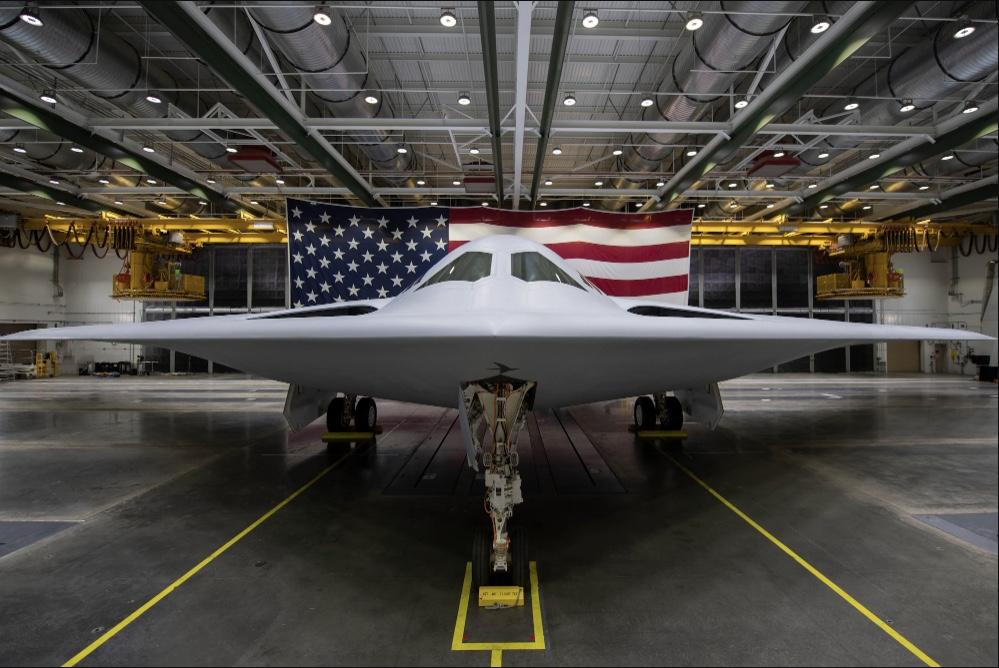
The unveiling of the B-21 Raider on 2 December 2022 marked a pivotal moment in military aviation. Presented by Northrop Grumman at its Palmdale, California facility, this sixth-generation stealth bomber is the first new American strategic bomber in more than 30 years — and a cornerstone of the United States Air Force’s (USAF) modernisation strategy.
Redefining the Long-Range Strike Mission
The B-21 Raider is designed to perform long-range, highly survivable missions in contested environments. Developed under the USAF’s Long Range Strike Bomber (LRS-B) programme, the aircraft is capable of delivering both conventional and nuclear payloads and is slated to replace legacy systems including the B-1B Lancer and B-2 Spirit. By mid-century, it may also succeed the enduring B-52 Stratofortress.
As the most advanced bomber ever built, the B-21 introduces unprecedented stealth capabilities, an open systems architecture, and state-of-the-art digital engineering — all aimed at ensuring adaptability, efficiency, and relevance in rapidly evolving threat landscapes.
Sixth-Generation Technological Leap
The B-21’s stealth design includes next-generation shaping, advanced radar-absorbent materials, and signature management to counter sophisticated enemy defences. Its open architecture allows for seamless integration of emerging technologies such as advanced sensors, electronic warfare systems, and autonomous mission capabilities.
Engineered with a full digital twin, the B-21’s development has leveraged extensive virtual flight testing — over 200 surrogate flights were completed before physical prototypes took to the air. The bomber’s sustainment model also embraces cloud-based diagnostics, predictive maintenance, and streamlined logistics, promising a low cost-per-flying-hour and increased availability.
Progressing from Prototype to Production
Flight testing of the first B-21 test aircraft, T-1, is underway at Edwards Air Force Base, California. This testing phase is critical in validating its flight characteristics, systems integration, and operational effectiveness. Two additional airframes are being used for structural and systems testing, and three more are in production.
In January 2024, Northrop Grumman received a low-rate initial production (LRIP) contract — a clear signal of USAF confidence in the platform. Manufacturing is taking place at a cutting-edge facility in Palmdale, integrating digital production tools such as AI-driven quality control and augmented reality-guided assembly.
The B-21 programme engages over 8,000 employees and more than 400 suppliers across 40 states, underscoring its strategic importance not only to national security but also to the U.S. industrial base.
Specifications Snapshot
While full capabilities remain classified, publicly released specifications include:
- Crew: Two
- Length: ~54 feet (16 m)
- Wingspan: ~132 feet (40 m)
- Engines: Two Pratt & Whitney PW9000s
- Speed: Subsonic, Mach 0.8+
- Ceiling: ~50,000 feet
- Payload: Up to 20,000 lb of munitions, including nuclear-capable LRSO missiles and precision-guided JDAMs
Deployment Outlook and Strategic Significance
Ellsworth AFB in South Dakota will serve as the B-21’s first operational base and training centre, while Tinker AFB in Oklahoma will host sustainment operations. Additional squadrons are planned for Dyess AFB and Whiteman AFB.
Designed for longevity and modular upgradeability, the B-21 is expected to serve well into the second half of the 21st century. Its integration into the nuclear triad reinforces its role in America’s strategic deterrence posture, while its adaptability ensures enduring relevance across shifting geopolitical and technological landscapes.
Honouring a Legacy, Embracing the Future
The B-21 is named in tribute to the Doolittle Raiders, the American airmen who conducted the daring 1942 bombing raid on Tokyo. Like its namesake, the B-21 is built for missions in the most challenging and contested airspaces, bringing a renewed philosophy of airpower to the forefront: flexible, survivable, and precise.
As a symbol of innovation and deterrence, the B-21 Raider is not just a bomber — it is a blueprint for the future of strategic aviation.
SOURCE AND IMAGE: AMERICAN AIR FORCE