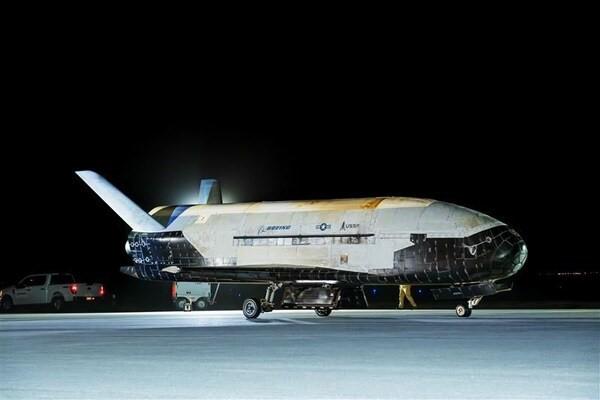
KENNEDY SPACE CENTER, Fla. – The Boeing-built X-37B Orbital Test Vehicle (OTV) is set for its eighth mission, with liftoff from Florida’s Space Coast scheduled no earlier than 21 August 2025. The milestone comes less than six months after OTV-7 successfully landed at Vandenberg Space Force Base on 7 March 2025, continuing the platform’s record of adaptability and technical advancement.
“Each successive flight demonstrates the X-37B’s flexibility in hosting diverse experiments and exploring new orbital regimes,” said Michelle Parker, vice president of Boeing Space Mission Systems. “OTV-8 will continue that legacy by deploying cutting-edge technologies to strengthen national space capabilities and future architectures.”
The OTV-8 mission will fly with an expanded service module, allowing greater capacity for experiments. Key partners include the Air Force Research Laboratory and the Defense Innovation Unit. This flight will feature high-bandwidth inter-satellite laser communications technology and the highest performing quantum inertial sensor ever tested in space.
According to Gen. Chance Saltzman, Chief of Space Operations for the U.S. Space Force, the laser communications demonstration will enhance the service’s ability to leverage commercial space networks. “It will improve resilience, adaptability, and the data transport speeds of satellite communications architectures,” he said.
The mission’s quantum inertial sensor aims to demonstrate precise navigation and timing in GPS-denied environments—a capability critical for deep space and cis-lunar operations. “This technology contributes to robust movement and manoeuvrability even when GPS is unavailable,” said Col. Ramsey Hom, Commander of Space Delta 9.
Boeing and U.S. Space Force teams are finalising launch preparations at Kennedy Space Center. Since its first flight in 2010, the reusable X-37B has accumulated more than 4,200 days in orbit, supporting experiments that push the boundaries of long-duration autonomous space operations.
SOURCE AND IMAGE: PR NEWSWIRE – KENNEDY SPACE CENTER