China is preparing to unveil a significant array of new air combat drones and advanced weapon systems at its massive upcoming military parade on 3 September — an event that marks the 80th anniversary of its victory over Japan in World War II.
Recent imagery emerging from parade rehearsals in Beijing points to the debut of at least five different ‘loyal wingman’-type drones — known in Western terms as Collaborative Combat Aircraft (CCA) — as well as improved versions of proven designs such as the GJ-11 Sharp Sword flying-wing UCAV and medium-altitude long-endurance models.
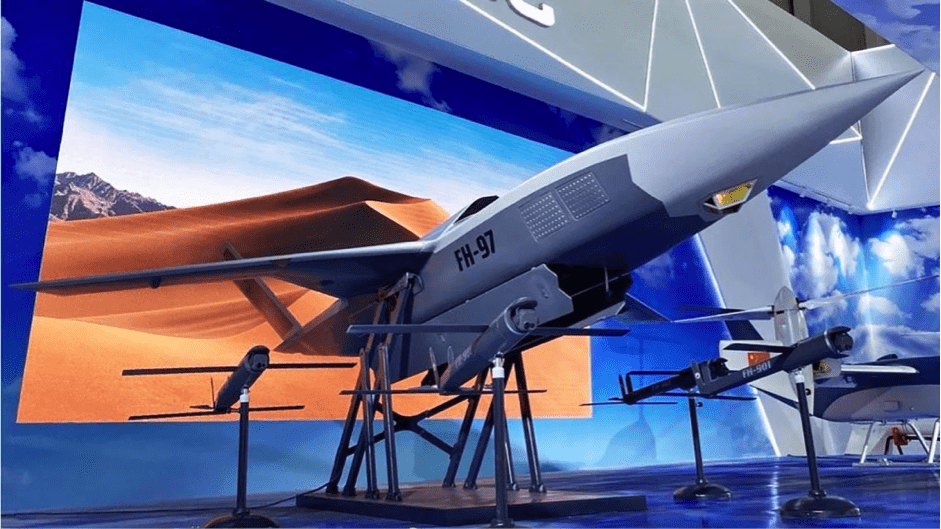
One of the new unmanned aircraft clearly resembles the FH-97 — itself heavily influenced by the American XQ-58A Valkyrie — with similar angular tail surfaces and overall shaping. Its appearance may represent a further evolution of the FH-97 line, which China first revealed at the Zhuhai Airshow in 2021. Aerospace Times Feihong Technology Corporation, the company behind the FH-97, previously unveiled a variant dubbed FH-97A – a near carbon-copy of Boeing Australia’s MQ-28 Ghost Bat – suggesting a broader family of platforms under development.
Alongside the FH-97-type aircraft, at least two other, significantly larger drones have been spotted on transporter trucks. Both are tailless, delta-wing designs featuring cranked-kite or modified diamond planforms, with the fuselages still partially covered. One of these airframes closely matches a mysterious drone seen earlier this year at Shenyang’s main aircraft plant — pointing to possible UCAV or carrier-capable strike drone development.
The larger size of these tailless drones suggests greater range, payload and endurance than the FH-97-style platform – moving China closer toward more autonomous, high-end UCAV capability and potential carrier-deck operations. The PLA’s two-seat J-20S stealth fighter is already being depicted acting as an airborne controller for such drones, while other assets – including the KJ-500 AEW&C and H-6 bomber fleet – are expected to play roles within a wider crewed-uncrewed combat network.
China’s broader uncrewed aviation ambitions are further underlined by the emergence of a large, flying-wing, high-altitude, long-endurance platform earlier this year, showing clear aspirations to rival American and European HALE designs.
Beyond drones, the parade will reveal several new missile systems. Images point to the YJ-17, a hypersonic ‘waverider’-type weapon, and the YJ-19, which is believed to use a scramjet engine, as well as another missile labelled YJ-20 featuring a long, conical shape seen previously being launched from a Type 055 destroyer. A possible new intercontinental ballistic missile, along with multiple ground-launched systems and directed-energy air defence weapons, will also be wheeled through Tiananmen.
As always with these high-profile displays, the distinction between operational systems and mock-ups remains blurred. Chinese military parades have long featured aspirational prototype hardware that may still be years away from service. However, several past debuts — such as the GJ-11 — have since transitioned into frontline capability. A more stealth-optimised version of this drone was famously revealed during the 70th anniversary parade in 2019.
The showcase forms part of the PLA’s sweeping modernisation drive, aimed at enabling both regional dominance and expanding power projection far beyond China’s borders. This includes sharpening its readiness for a possible confrontation over Taiwan and enforcing territorial claims in the South China Sea, while simultaneously growing its strategic deterrence posture.
With the September parade now days away, Beijing appears set to send a powerful signal to both domestic audiences and foreign observers: the era of China’s autonomous air combat capability has well and truly arrived — and it is evolving at pace.
IMAGE CREDIT: A model of the FH-97 on display at the Zhuhai Airshow in 2021. Chinese Internet