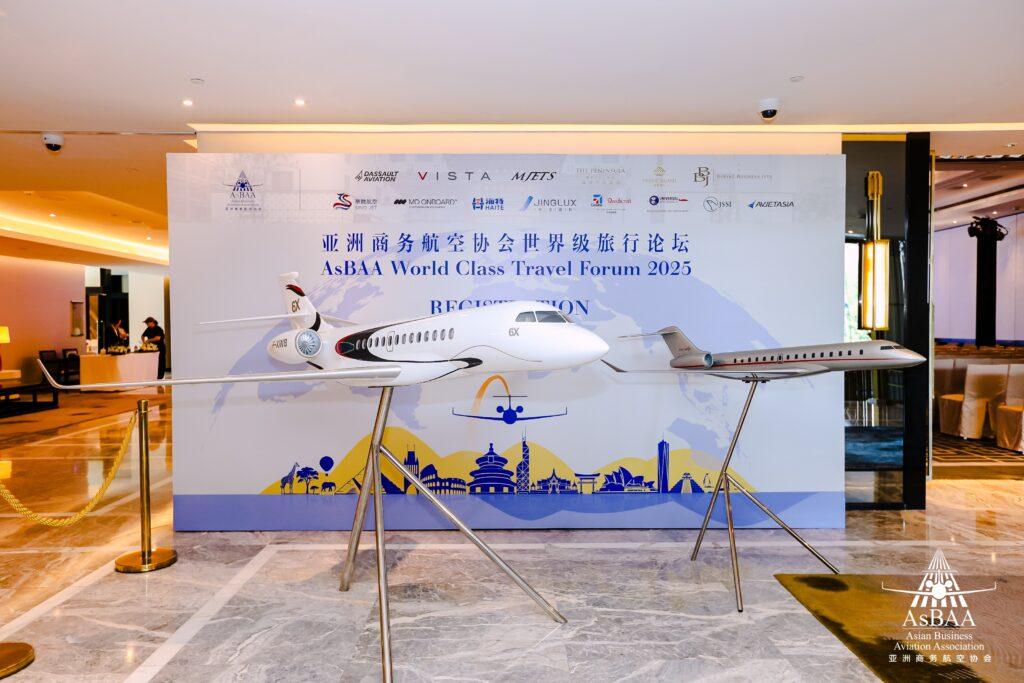
China’s business aviation market continues to grow, with rising flight activity, expanding charter fleets, and strong safety and regulatory collaboration highlighted at the 2025 AsBAA Symposium in Zhuhai.
The Asian Business Aviation Association (AsBAA) convened its 2025 China General Aviation and Business Aviation Safety International Symposium during the Aero Asia show in Zhuhai last week, drawing regulators, operators, and industry stakeholders to address safety, efficiency, and sustainable development across China and the wider Asia-Pacific business aviation market.
Opening the symposium, Rocky Zhang, vice president of government affairs at Textron China and chair of AsBAA’s Chinese Mainland Chapter, emphasised that safety remains the foundation for growth in the region’s general and business aviation sectors. AsBAA chairman Phil Balmer noted the impressive potential of the Asia-Pacific market, which now hosts more than 1,100 business aircraft, with China continuing to represent a major driver of expansion.
Fresh data from AsBAA China member Jet Master shows that business aviation activity in China increased by 6.2% year-on-year from January to October 2025, including movements at FBOs in Hong Kong and Macau. Foreign-registered aircraft have now grown for four consecutive years, pointing to deeper integration with global aviation networks. Cross-border operations—particularly with Southeast Asia—remain the fastest-growing segment, with flight activity peaking around major international events.
Further insights from Asian Sky Group’s Asia-Pacific Region Charter Report – 2025 reveal that the regional charter fleet reached 430 aircraft by mid-2025, an 18.8% jump from mid-2023. All subregions reported growth, with South Asia leading the surge. India’s fleet rose by 53.2% to 121 aircraft, overtaking Australia, which climbed to 107 aircraft. Steady gains were also recorded in Japan, Southeast Asia, Greater China, and Northeast Asia.
Fleet Composition and OEM Dynamics
The Asia-Pacific fleet continues to reflect varied mission profiles, with long-range jets remaining the most common at 23.7%. Large jets account for 21.2%, followed by light jets at 20%, medium jets at 19.3%, very light jets at 11.9%, and corporate airliners at 4%.
Textron, Bombardier, and Gulfstream dominate the regional fleet, making up about three-quarters of all aircraft. Textron retained the largest OEM share at 30.9%, driven by the enduring popularity of the Citation series, especially in India and Australia. Bombardier saw its charter fleet grow to 103 aircraft, bolstered by two new Global jets in India and Malaysia. Gulfstream experienced a 43.9% increase, rising from 57 to 82 aircraft, helped by more owners transitioning managed jets into charter operations.
Embraer’s fleet growth centred on India and Indonesia, with 34 preowned large jets added since mid-2023. Pilatus’ PC-24 also gained momentum, doubling from seven to 15 aircraft in the region, including four acquired by Karnavati Aviation under the Adani Group for short-range Indian operations.
Operator concentration remains diverse: TAG Aviation, Phenix Jet, Karnavati Aviation, and VSR Ventures each manage fleets of more than ten aircraft, while 23 other operators maintain three to four aircraft. Survey data continues to show robust demand for charter services, with safety, service quality, and reputation ranking as the primary factors influencing customer choices.
Safety Takes Centre Stage
Safety was a central theme throughout the symposium. Representatives from Textron Aviation China, Hong Kong Business Aviation Centre, ExecuJet Haite Tianjin, and Metro Jet highlighted that human factors account for over 80% of aviation incidents, underscoring the need for robust safety management systems (SMS) and threat and error management frameworks. They also identified emerging risks, including over-reliance on artificial intelligence, challenges posed by new energy ground vehicles, complexities in data management, and shortages of trained personnel.
Star Jet presented a comprehensive SMS model covering pre-flight planning, in-flight monitoring, and post-flight optimisation. Aeromedical operations were also spotlighted, with Lishui City in Zhejiang province reporting 93 patients transported over the past year, achieving a 100% success rate for routine cases and 91.6% for critical emergencies. The programme operates at a cost of roughly $6 per minute and leverages a coordinated network of helicopters, fixed-wing aircraft, and drones.
Additional perspectives came from Reignwood Asian General Aviation Beijing, Bell China, and Avion Pacific Group, who shared insights into fixed-wing and rotorcraft coordination, public-private partnership rescue models, and drone logistics for medical supply delivery.
On regulatory developments, Ingrid Lagarrigue, EASA’s chief representative for North Asia, outlined Europe’s GA Flightpath 2030+ initiative, focusing on regulatory simplification, digitalisation, and sustainable energy. Kyle James of the Bermuda Civil Aviation Authority emphasised global cooperation, life cycle safety oversight, and airworthiness standards. Joby Aviation provided remote updates on eVTOL progress and operational safety considerations.
In closing, Paul Desgrosseilliers, vice chairman of AsBAA and general manager of ExecuJet Haite China, called for breaking down data silos to promote wider safety knowledge sharing. Geoffrey Jackson, executive director of the U.S.-China Aviation Cooperation Program, echoed the message, stressing that collaboration and strong SMS frameworks are vital to resilience and operational excellence.
Co-hosted by AsBAA and Messe Frankfurt (Zhuhai) Airshow Co., with support from Bombardier, the symposium concluded with renewed emphasis on collaboration and data sharing to enhance safety and efficiency across the rapidly expanding Asia-Pacific business aviation market.
SOURCE AND IMAGE: ASBAA