

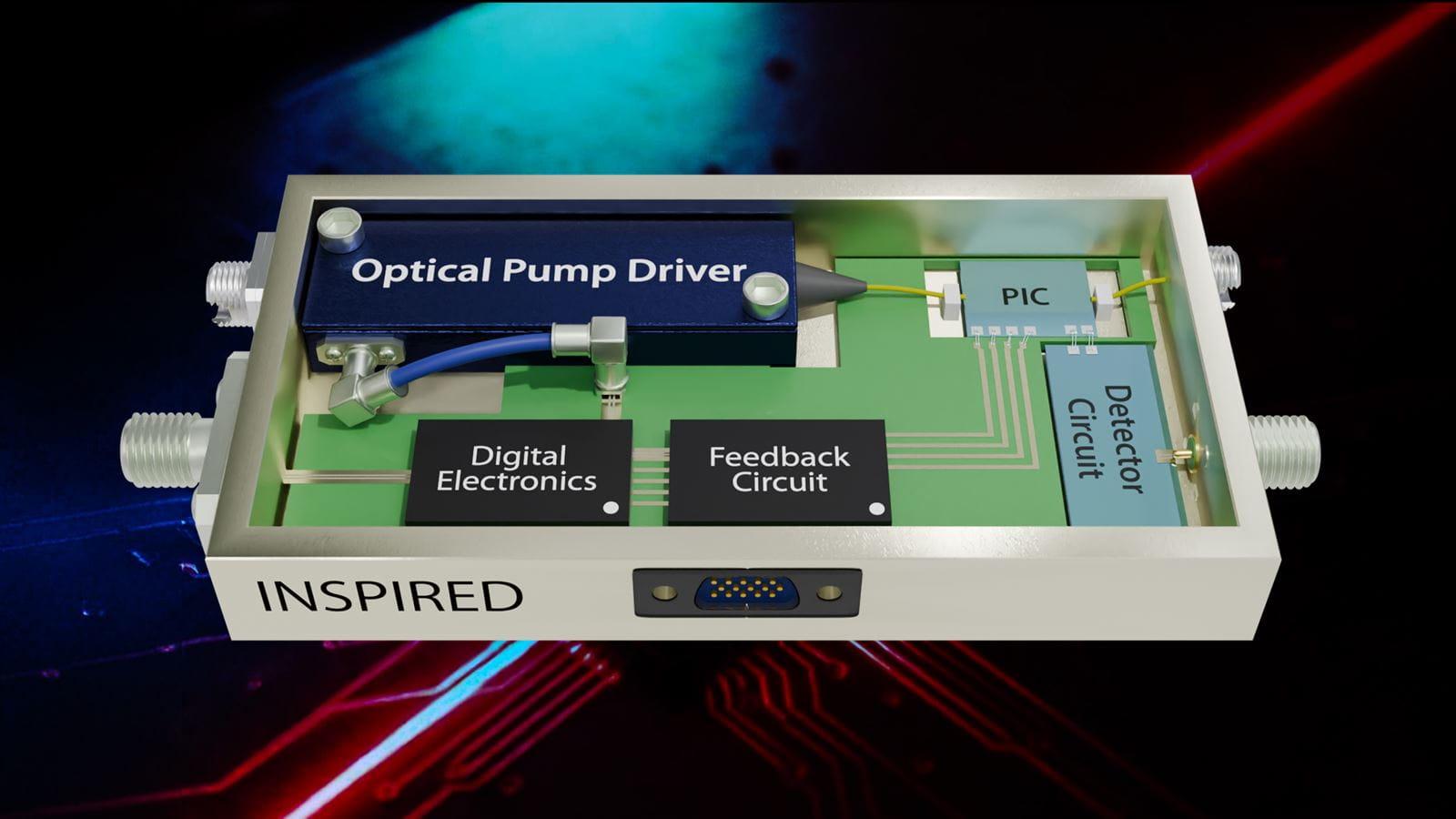
DARPA’s ambitious INSPIRED program has partnered with RTX’s BBN Technologies to redefine the boundaries of sensor technology. This initiative aims to deliver compact, low-power, photonic chip-scale quantum sensors capable of exceeding the precision of traditional sensors by more than tenfold. This breakthrough, which harnesses the exotic quantum properties of light, has the potential to revolutionise applications in both defence and commercial domains.
The photonic sensors, developed as part of DARPA’s Intensity Squeezed Photonic Integration with Revolutionary Detection (INSPIRED) program, promise exceptional performance enhancements in fields like LiDAR, biosensing, fiber-based systems, navigation, and communications. The cornerstone of this innovation is a prototype chip-scale photonic sensor designed to overcome the inherent randomness of light fluctuations, known as shot noise, which limits the precision of conventional sensors.
Harnessing Quantum Mechanics for Precision
Traditional light-based sensors face challenges due to the quantum nature of light, which creates unpredictable variations in photon counts—a phenomenon called shot noise. However, the RTX-led team has developed a groundbreaking solution using quantum mechanics to “squeeze” light, suppressing unwanted fluctuations and amplifying desired ones.
“Our device minimizes photon noise by suppressing specific quantum fluctuations while enhancing others, allowing us to extract critical information from photonic properties without the limitations of shot noise,” explained Dr. Michael Grace, a quantum information scientist at RTX BBN Technologies.
This innovation is not entirely new; squeezed light has previously been used in large-scale laboratory settings and gravitational wave detection. What sets this effort apart is the development of a millimeter-scale chip capable of achieving the same precision in fieldable applications.
Wide-Ranging Impact Across Industries
The implications of this sensor breakthrough extend well beyond defence. The enhanced accuracy and sensitivity will transform industries dependent on high-precision measurements, including autonomous navigation, environmental mapping, and system monitoring.
“Improving the accuracy, sensitivity, resolution, and efficiency of sensors makes them significantly more effective in real-world applications, enabling better decision-making and situational awareness,” noted Dr. Mo Soltani, principal investigator for the project.
Global Expertise Driving Innovation
The project is a collaborative effort involving quantum and photonic experts from Xanadu Quantum, the University of Maryland, and Raytheon’s Advanced Technology business. Leveraging advanced photonic integrated circuits, the team aims to deliver a prototype capable of operating across a broad frequency range of 100 MHz to 10 GHz, bringing unprecedented capabilities to a compact, deployable format.
With work being conducted in key innovation hubs, including Cambridge, Massachusetts; San Diego, California; College Park, Maryland; and Toronto, Canada, the project exemplifies global collaboration and cutting-edge research.
As DARPA and RTX continue to push the boundaries of sensor technology, the potential to revolutionise sectors from autonomous navigation to defence remains undeniable, paving the way for the next generation of precision sensing.
SOURCE AND IMAGE: RTX BBN Technologies