
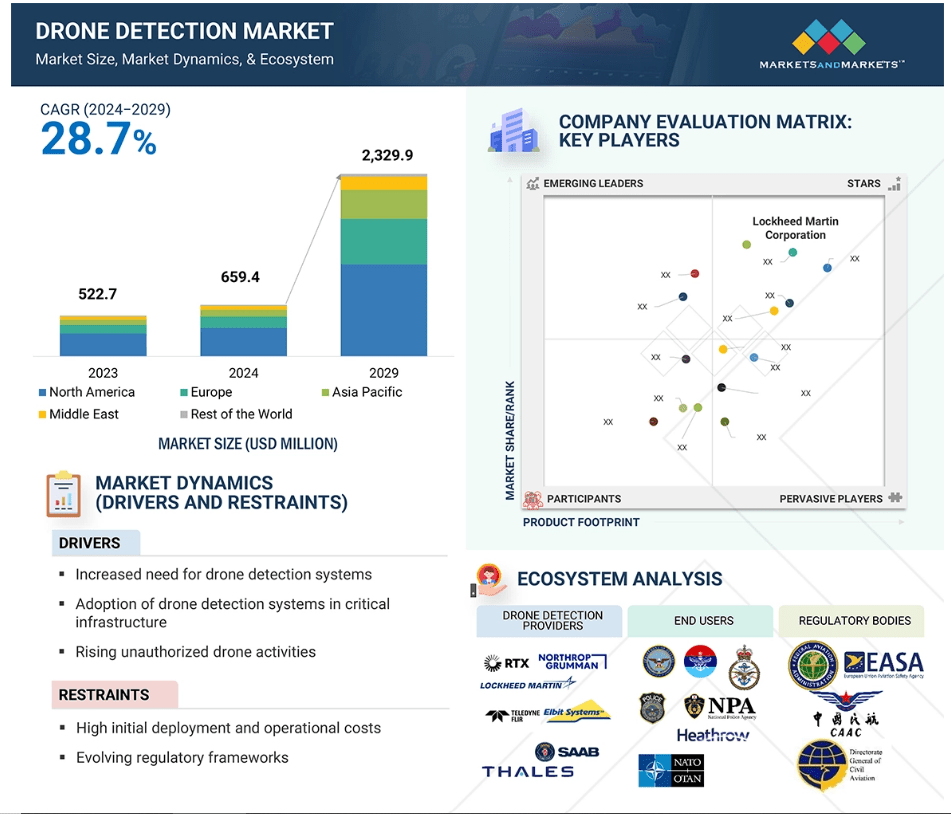
The Drone detection market is estimated in terms of market size to be USD 659.4 million in 2024 to USD 2,329.9 million by 2029, at a CAGR of 28.7%. The drivers for the drone detection market include the increasing need for drone detection systems, regional conflicts and geopolitical tensions, and rising unauthorised drone activities. The growing frequency of unauthorised drone operations is a significant factor driving the adoption of drone detection systems. These activities pose substantial risks to military facilities, critical infrastructure, airports, and public spaces, leading to heightened security concerns across various sectors. Drones are increasingly used for illegal surveillance, smuggling, and intelligence gathering, which can compromise national security and operational safety. Unauthorised drone activities are difficult to detect with conventional security systems due to their small size, low altitude, and high maneuverability, making it essential to deploy detection solutions that are specifically designed to detect drones.
“The radar technology will account for the largest market share in the Drone detection market during the forecast period.”
Radar technology is expected to dominate the drone detection market due to its ability to detect and track UAVs over long distances in all weather conditions. Unlike optical and infrared sensors, which are limited by visibility factors such as fog, rain, or darkness, radar systems provide continuous surveillance, making them highly effective for securing military bases, airports, power plants, and border areas. Additionally, radar can track multiple drones simultaneously and differentiate them from birds or other airborne objects using advanced signal processing and Doppler technology, reducing false alarms and improving detection accuracy. The integration of artificial intelligence (AI) and machine learning (ML) further enhances radar-based drone detection by improving classification accuracy and automating threat assessments. Modern radar systems are also designed to detect low-flying and small-sized drones that might evade traditional air defence systems. Furthermore, radar is often integrated with other detection technologies, such as radio frequency (RF) sensors and acoustic detectors, to provide a multi-layered security approach. These advantages make radar the most reliable and effective technology for drone detection, driving its dominance in the market during the forecast period.
“The ground-based segment will account for the largest market share in the Drone detection market during the forecast period.”
Based on type, the ground-based segment will account for the largest market share in the Drone detection market during the forecast period. Ground-based drone detection systems are expected to hold the largest market share in the drone detection market due to their cost-effectiveness, scalability, and ability to provide continuous surveillance. Unlike airborne or space-based detection systems, ground-based solutions are easier to deploy, maintain, and integrate with existing security infrastructure, making them the preferred choice for protecting airports, military bases, government facilities, and critical infrastructure. These systems utilize a combination of radar, radio frequency (RF) sensors, acoustic sensors, and electro-optical/infrared (EO/IR) cameras to detect, track, and classify drones in real time. Their ability to operate in all weather conditions and adapt to different threat levels further strengthens their market dominance. Another key advantage of ground-based drone detection is its ability to cover large areas with a network of strategically placed sensors, ensuring comprehensive perimeter security. Advanced ground-based systems can use AI and ML to enhance their detection accuracy, minimise false alarms, and automate threat response mechanisms. Additionally, these systems can be integrated with counter-drone solutions, such as jamming and spoofing technologies, to neutralise unauthorised drones. Given their reliability, affordability, and effectiveness ground-based drone detection systems are expected to lead the market during the forecast period.
“The North American market is estimated to lead the market.”
The North American Drone detection market is expected to account for the highest market share during the forecast period. This is due to the high adoption of advanced security technologies, increasing incidents of unauthorised drone activity, and strong government regulations. The region, led by the United States and Canada, has a well-established defence and homeland security infrastructure, which drives significant investments in drone detection systems for military bases, and airports. The rising concerns over drone-related security threats, including potential terrorist activities, smuggling, and airspace intrusions, have led to the widespread deployment of ground-based and radar-based detection solutions. The presence of leading defence contractors and technology firms in North America ensures continuous innovation and availability of advanced drone detection technologies. The increasing number of partnerships between defence organisations and private sector companies for developing and deploying counter-drone solutions enhances the market growth in the region. Due to these factors, North America is the leading market for drone detection systems during the forecast period.
Breakdown of primaries
The study contains insights from various industry experts, ranging from component suppliers to Tier 1 companies and OEMs. The break-up of the primaries is as follows:
- By Company Type: Tier 1–35%; Tier 2–45%; and Tier 3–20%
- By Designation: C Level–35%; Directors–25%; and Others–40%
- By Region: North America–20%; Europe–25%; Asia Pacific–35%; Middle East–10%; RoW–10%
Lockheed Martin Corporation (US), RTX (US), Northrop Grumman (US), Teledyne FLIR LLC, and Elbit Systems Ltd. (Israel) are some of the leading players operating in the Drone detection market.
SOURCE AND IMAGE: MARKET AND MARKETS