
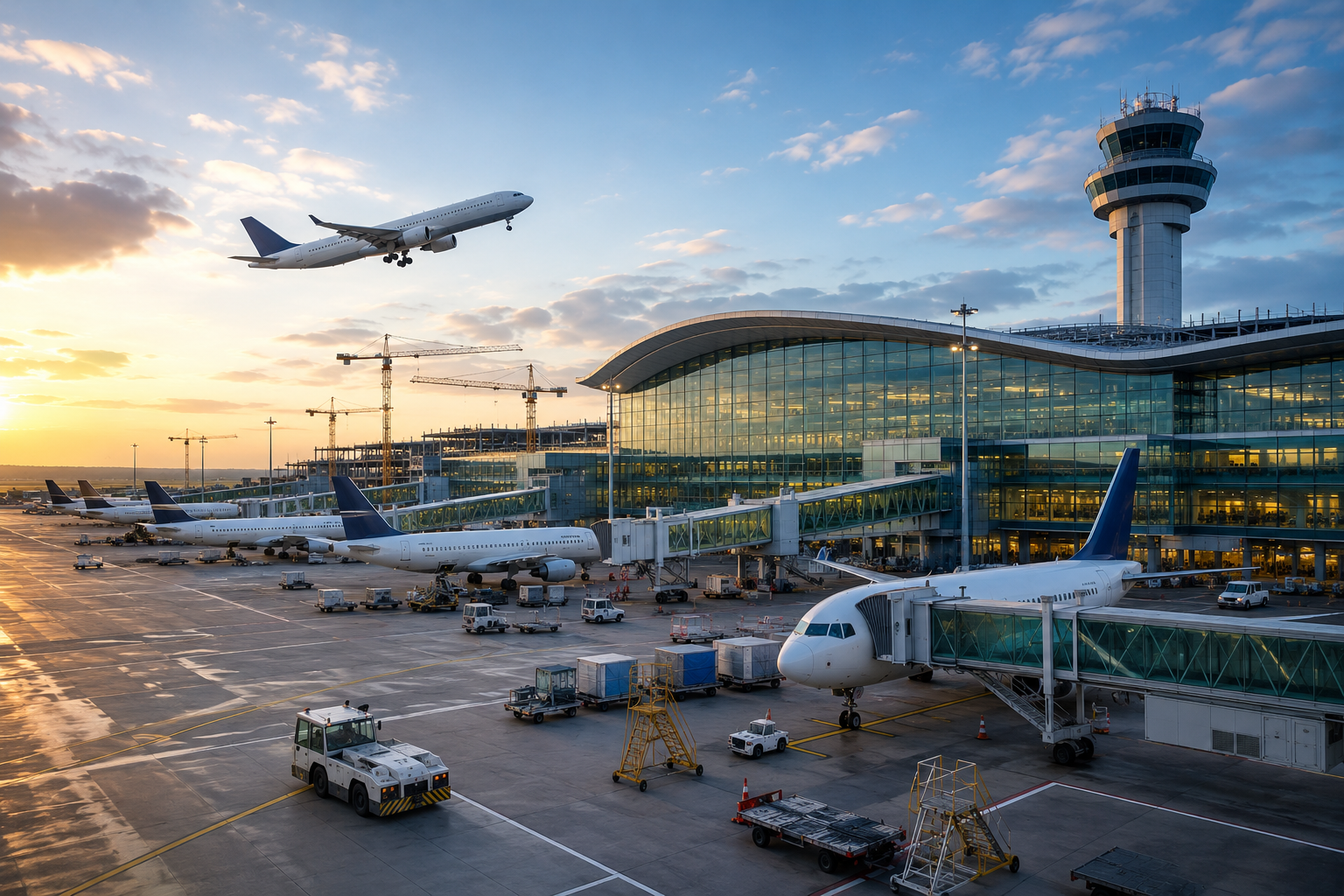
Global investment in airport infrastructure is projected to reach US$2.404 trillion by 2040, rising from approximately US$200 billion in 2021, according to a new industry outlook published by MarketsandMarkets.
The report, titled Future of Airport Industry to 2040, forecasts sustained long-term expansion driven by increasing passenger demand, infrastructure modernisation, technology integration and the growing strategic importance of airports as economic and transport hubs.
The research estimates the sector will expand at a compound annual growth rate (CAGR) of 14.4% over the forecast period.
A substantial share of future investment is expected to focus on terminal expansion and upgrades aimed at improving passenger flow and operational efficiency. Runway development also remains a priority as airports seek to accommodate larger aircraft and rising traffic volumes.
The report highlights accelerating adoption of digital technologies across airport operations, including biometric identification systems, self-service passenger processing, automated baggage handling and smart airport infrastructure designed to improve operational resilience and passenger experience.
Technology providers expected to play a significant role in the sector’s evolution include ABB, Siemens, SITA, RTX, Thales Group and Honeywell.
The report also points to Asia as the primary driver of future aviation growth, with India and China continuing to reshape the global aviation landscape.
India has already become the world’s third-largest aviation market, supported by economic growth, an expanding middle class and increasing accessibility to air travel. Meanwhile, China is expected to overtake the United States as the world’s largest aviation market within the coming years.
According to the report, the rise of both countries reflects the broader strategic shift of global aviation growth toward Asia, where much of the future passenger demand is expected to originate.
The study further identifies 5G connectivity as a critical enabler of future smart airport operations. The deployment of high-speed, low-latency networks is expected to support real-time operational communication, enhanced surveillance systems, advanced data sharing and more personalised passenger services.
Emerging passenger demographics are also expected to influence airport design and operational strategies. The report notes that future travellers will become increasingly socially, culturally and ethnically diverse, with airports needing to accommodate evolving travel behaviours and expectations.
New passenger “micro-personas” identified in the study include solo travellers, festival and event-focused passengers, and social media-driven travel groups, reflecting broader changes in global tourism and leisure travel patterns.