
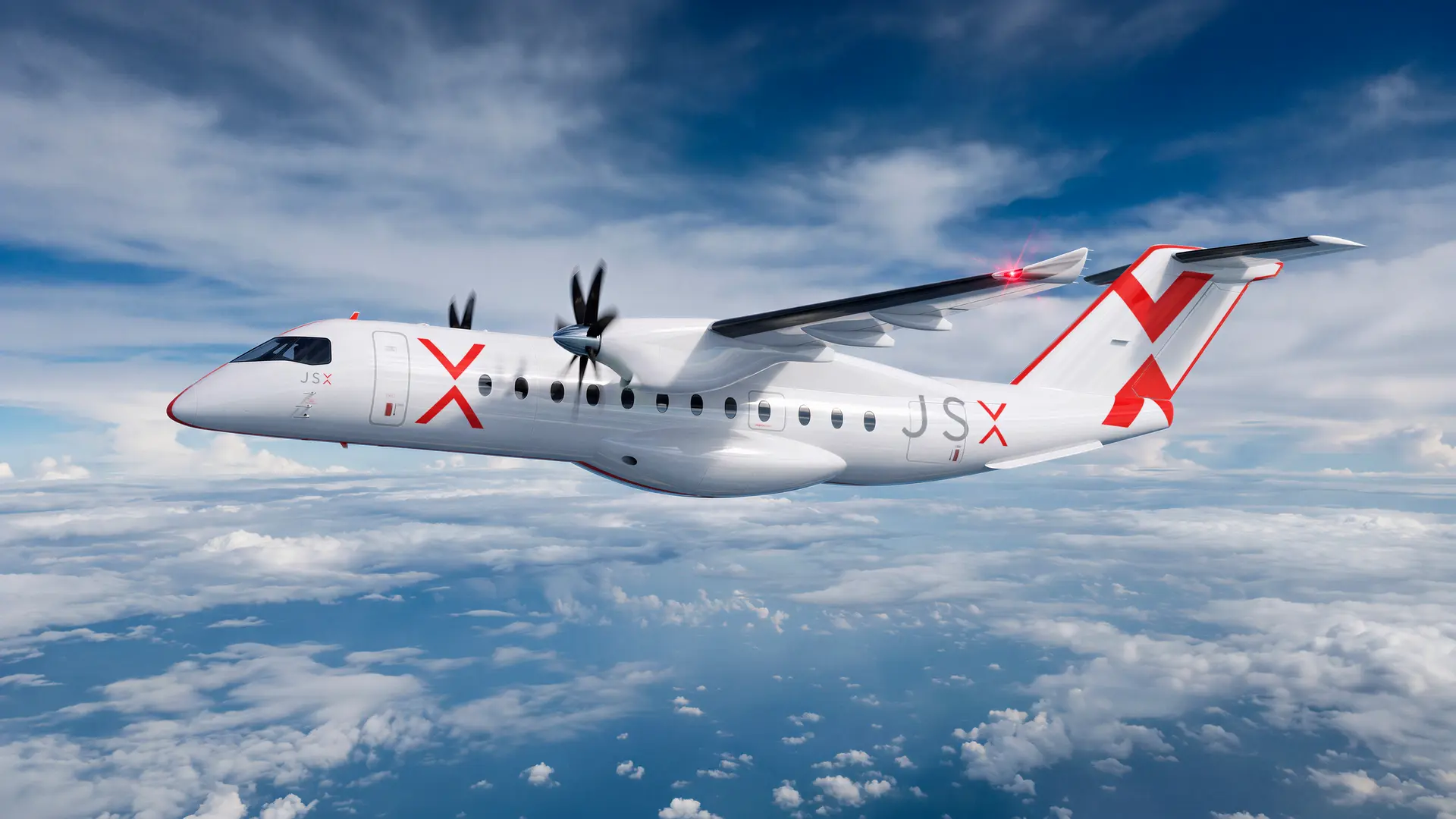
The 36-seat hybrid-electric regional airliner supersedes the earlier ES-30 design, and JSX has converted its 2023 letter of intent into a deposit-backed purchase agreement.
Heart Aerospace has unveiled the ES-36, a 36-seat hybrid-electric regional airliner and the company’s production aircraft, alongside a deposit-backed purchase agreement from JSX for 50 ES-36s with purchase rights for 50 more. The agreement converts JSX’s 2023 letter of intent into a firm commitment and secures the carrier early delivery positions as it moves from aircraft development toward fleet introduction. “JSX is proud to back the development of the next-generation aircraft that will deliver the best travel experience for our Customers, expand the destinations available to them, and strengthen our business,” said JSX CEO Alex Wilcox. “The hybrid-electric ES-36 will enable more nonstop routes from more convenient airports while further elevating the award-winning, no-middle-seat onboard experience that JSX Customers love.” Anders Forslund, Heart’s founder and CEO, said: “With the ES-36, Heart is bringing to market a more capable aircraft with an even stronger value proposition for air carriers, and JSX’s partnership underscores that opportunity.”
The ES-36 is intended to help JSX grow service at the convenient community airports it already serves, including Santa Monica, Westchester County, Naples and Napa Valley, with short-field performance suited to constrained airfields and a compact footprint that eases ramp, gate and hangar demands; its all-electric operation and lower noise are also aimed at easing the community concerns that can constrain new service. The companies will work together on cabin configuration, charging and turnaround procedures, route planning and airport readiness.
HOW THE ES-36 EVOLVES HEART’S DESIGN
The ES-36 builds on the previously announced 30-seat ES-30 with a simplified two-nacelle airframe, adding six seats and 1,415 pounds of payload capacity, a 20 percent increase in both, while keeping the same maximum takeoff weight and battery capacity; the shift from four nacelles to two also reduces the number of propulsion components operators must maintain. In place of the ES-30’s four independent-hybrid engines, the ES-36 uses twin series-hybrid powertrains, each pairing a 1.65-megawatt electric motor with its own compact gas turbine generator, giving the aircraft a ground-charged all-electric range of 125 miles plus reserves, or a hybrid range of 745 miles plus reserves when the turbogenerators are used to extend flight. “The ES-36 design is a direct result of what Heart learned designing, building, testing and flying our X1 demonstrator aircraft,” said Ben Stabler, Heart’s Chief Technology Officer. “The ES-36 carries more passengers and payload, creating greater revenue-generating potential for operators like JSX, while targeting operating costs at least 40 percent lower than legacy regional aircraft.”
The unveiling follows the mid-August first flight of Heart’s X1 demonstrator, which flew for 27 minutes at up to 1,100 feet from Plattsburgh International Airport in New York on 12 August, becoming the largest battery-electric aircraft ever flown; Heart is now building its first pre-production ES-36 at its pilot manufacturing plant in Los Angeles, targeting first flight in the second half of 2028 and entry into service in 2031 following FAA Part 25 certification. The company says it holds more than 9 billion dollars in customer commitments from carriers including United Airlines, Air Canada and JSX.
Source and Images: Heart Aerospace