
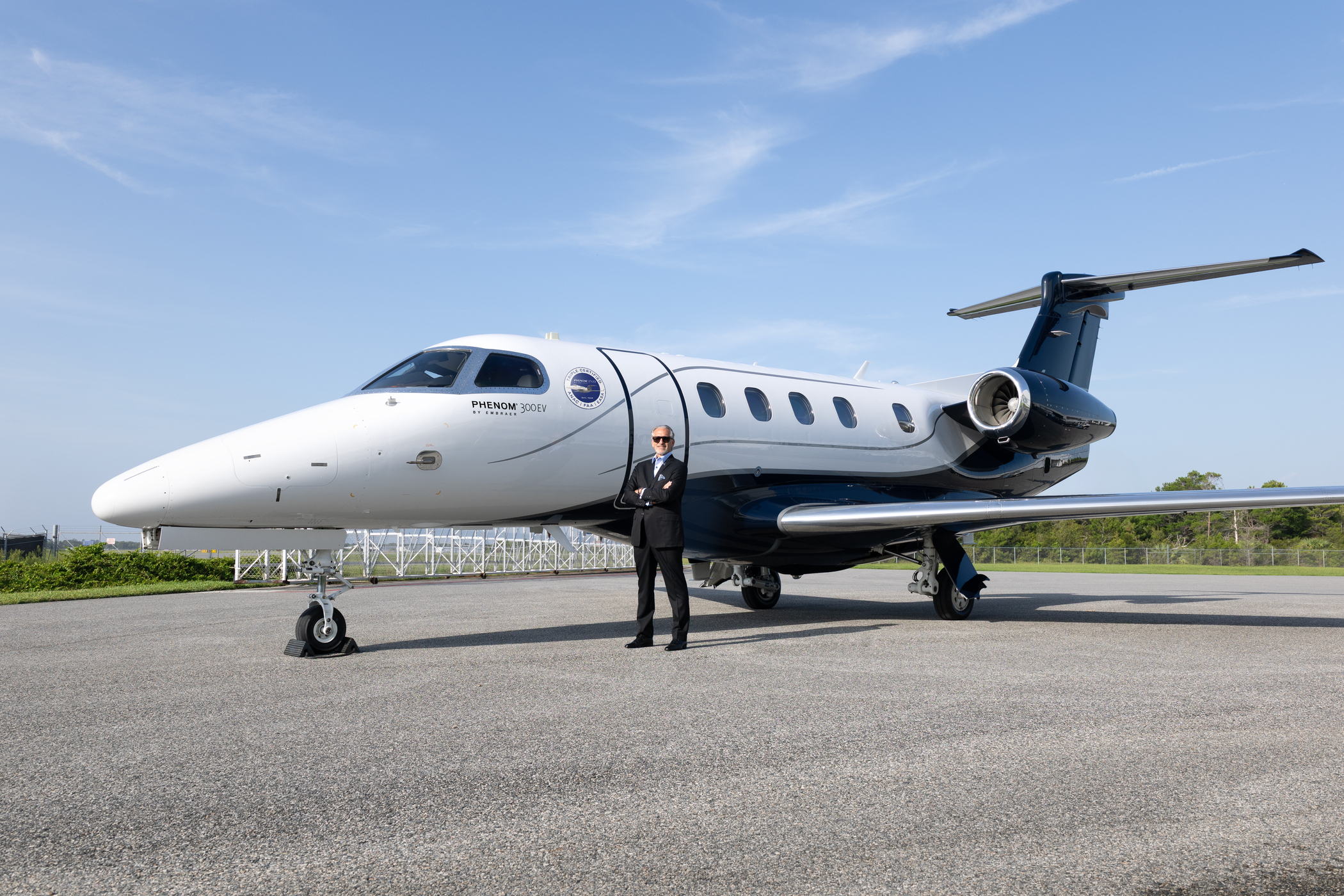
Embraer has secured simultaneous certification of the Phenom 300EV from ANAC, the FAA and EASA, making it the first light jet certified with Garmin Emergency Autoland and the largest business jet to offer the system. The aircraft was introduced in July; deliveries are expected from 2028.
ANNOUNCED IN JULY, CERTIFIED IN AUGUST
Embraer has announced that the Phenom 300EV has received certification from Brazil’s Agência Nacional de Aviação Civil, the United States Federal Aviation Administration and the European Union Aviation Safety Agency, approving the aircraft for operation across its principal markets. It is the first light jet certified with Garmin Emergency Autoland, and the largest business jet to offer the system.
The timing is worth noting. World Airnews Daily reported the launch of the Phenom 300EV on 15 July; triple certification followed six weeks later. A gap that short indicates that certification work was substantially complete at the point of public announcement rather than beginning from it – an ordering that has become more common among manufacturers introducing derivative models, where the aircraft is revealed once the regulatory path is effectively secured. It follows the same pattern as the Praetor 500E, which achieved simultaneous ANAC, FAA and EASA certification in June.
Michael Amalfitano, President and Chief Executive of Embraer Executive Jets, said the aircraft built on the legendary capabilities of the world’s best-selling light jet through purposeful innovations elevating safety technology, performance and customer experience, and described the triple certification as a testament to the dedication of the company’s teams and its disciplined approach to engineering excellence and execution.
WHY EMERGENCY AUTOLAND MATTERS ON THIS AIRCRAFT
Emergency Autoland executes a fully automated landing in the event of pilot incapacitation, navigating the aircraft to a suitable airport, communicating with air traffic control and completing the approach and landing without crew input. Its significance on the Phenom 300EV rests on the operating profile of the type: the Phenom 300 series is extensively flown single-pilot, and in a single-pilot operation there is by definition no second qualified crew member. Incapacitation is therefore the category’s most structural safety exposure, and Autoland is its most direct answer.
Enabling the system required work at the aircraft level rather than only in the avionics. Embraer designed and developed a Multi-Purpose Electronic Controller, which supports the electronically controlled functions Autoland depends on (including autobrake and rudder-by-wire) and which the manufacturer states also contributes to improved handling, reduced workload and simplified maintenance. An autonomous landing requires the aircraft to be steerable and stoppable by the system without a pilot’s feet or hands, which is a different requirement from displaying guidance to a pilot who will act on it.
RANGE, PAYLOAD AND CABIN
The Phenom 300EV offers a range of 2,055 nautical miles carrying four passengers with NBAA IFR reserves, and a top speed of Mach 0.80. Embraer identifies Aspen to New York, Dubai to the Maldives and São Paulo to Manaus as representative nonstop sectors. The aircraft carries the highest payload in its class and is flown on the Garmin G3000 Prodigy Touch flight deck, with avionics including class-exclusive autobrake, autothrottle, the Runway Overrun Awareness and Alerting System, Emergency Descent Mode, rudder-by-wire, runway and taxi situational awareness and Synthetic Vision Guidance System.
Cabin features include line-fit connectivity through Gogo Galileo’s low earth orbit satellite network, with Starlink to be available as an aftermarket supplemental type certificate solution. The cabin offers a maximum cabin altitude of 6,600 feet, the largest windows in the category, one of the largest baggage compartments among light jets, an entry airstair drawn from larger aircraft, a flexible refreshment centre and an odourless vacuum lavatory. Deliveries are expected to begin in 2028.
Source and Images: Embraer