
Rolls-Royce has selected Melbourne-based Marand Precision Engineering, following a competitive international tender, to build three additional gas turbine acoustic enclosures for the Type 26 Global Combat Ship programme, extending an Australian firm from domestic supply into export. The company has simultaneously opened a regional Defence headquarters in Canberra, inaugurated by the Deputy Prime Minister.
FROM DOMESTIC PROGRAMME TO EXPORT VENTURE
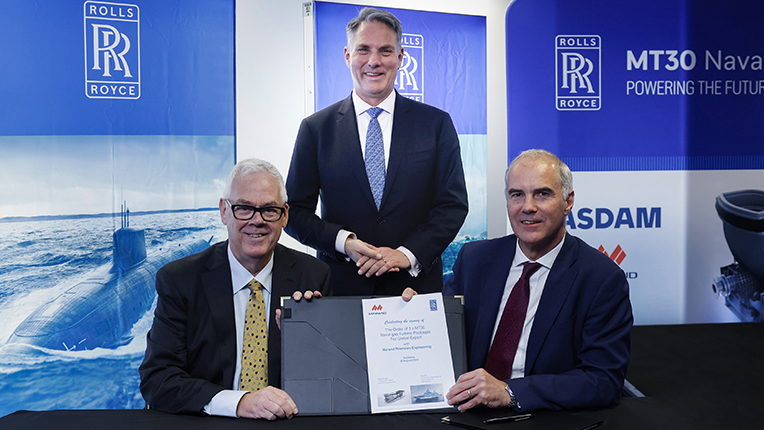
Rolls-Royce has announced it is expanding its partnership with Marand Precision Engineering into a new export venture, supplying naval gas turbine propulsion packages to the Type 26 Global Combat Ship programme. Following a competitive international tender, Rolls-Royce selected Marand to build three additional gas turbine acoustic enclosures and corresponding ship interface systems, which will be manufactured and assembled at the company’s Melbourne facility and supplied to Rolls-Royce.
The commercial shift is the substance of the announcement. Marand already supplies the same systems for the Commonwealth of Australia’s Hunter-class Frigate Programme, with completed propulsion packages delivered to shipbuilder BAE Systems Australia. Supplying into the wider Type 26 programme takes the company from serving a domestic requirement to competing internationally for work on a design also being built for other navies — and it did so, Rolls-Royce notes, by winning a competitive tender rather than through an offset arrangement. Alex Zino, Defence Director of Business Development and Future Programmes for the UK and International at Rolls-Royce, described it as a transformative step in the partnership, said Marand had been selected from an international field as a testament to the quality of Australian engineering, and that it underscored the company’s commitment to bolster Australia’s sovereign capability.
WHAT THE ENCLOSURE DOES
The acoustic enclosure is not a housing in any incidental sense. It provides mechanical support, noise suppression, controls, air intake, exhaust outlet, ventilation and auxiliary supplies required to ensure optimal performance of the MT30 gas turbine. Noise suppression carries particular weight on an anti-submarine warfare platform, where radiated noise determines how far away a submarine can detect the ship, making the enclosure a contributor to the vessel’s core mission capability rather than a piece of ancillary equipment. Rolls-Royce supplies the MT30 gas turbines under both the Hunter-class and Type 26 contracts, with mtu power generation solutions also supporting the Hunter-class programme.
Rolls-Royce engineers are co-located at Marand’s Melbourne facility, working alongside local manufacturing teams to support the design development, packaging and testing of the enclosures before final delivery. The company states that by localising the packaging and integration of the engine, the partnership is developing Australia’s sovereign industrial defence capability and growing skilled engineering roles in Melbourne. Rohan Stocker, Chief Executive of ASDAM Group and Marand, said it was a privilege for the team to manufacture and assemble the systems for Rolls-Royce, BAE Systems Australia and ultimately the Commonwealth, and that the partnership had been an opportunity to learn from and deliver an outstanding product with a global leader in defence engineering.
A PERMANENT BASE CLOSE TO THE DECISION-MAKERS
The Canberra facility was officially opened on 12 August 2026 by the Deputy Prime Minister and Minister for Defence, the Hon Richard Marles MP. It will serve as the strategic hub for Rolls-Royce Defence Pacific Rim operations, covering Australia, New Zealand, Japan and South Korea, with the company investing in the facility over the next five years. Rolls-Royce states it will streamline communication and support for multi-domain defence projects under way with the Australian Defence Force, regional partners and strategic frameworks including AUKUS.
Thijs Miedema, Senior Vice President for Defence Pacific Rim at Rolls-Royce, said establishing the regional headquarters in Canberra was a critical step forward, and that while the company had long maintained a strong footprint in Australia, a permanent base brought it closer to the heart of the Australian Government and Defence Force leadership, ensuring immediate collaborative engagement on the programmes that safeguard Australia and its regional partners. The choice of Canberra over Sydney or Melbourne is the point: it locates the business alongside the customer and the policy apparatus rather than alongside the manufacturing base. Rolls-Royce will continue to operate its Sydney office, with fleet services and technical personnel remaining embedded across several ADF bases.
Source and Images: Rolls-Royce plc