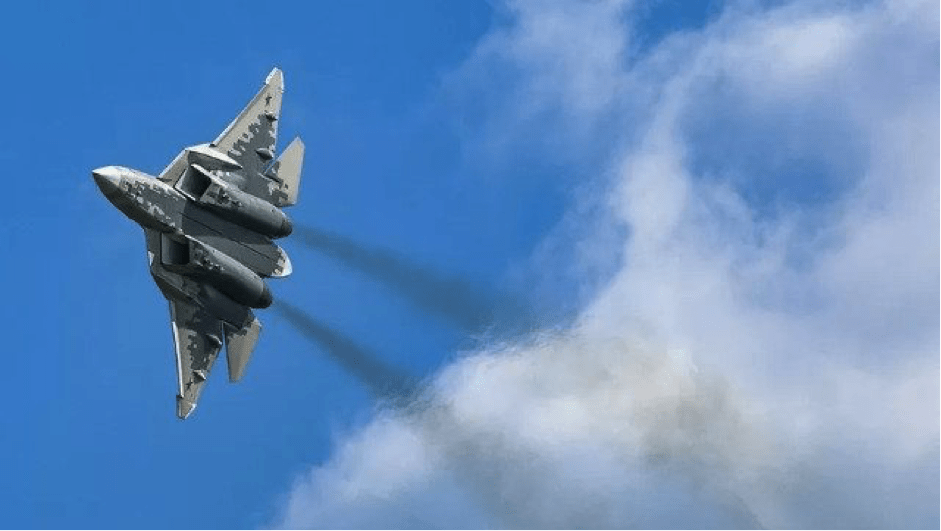
Russia has officially lifted the curtain on the Su-57M, a significantly upgraded variant of its fifth-generation stealth fighter, marking a major milestone in its aerospace ambitions. Unveiled during a presentation in Moscow by renowned test pilot Sergei Bogdan, the Su-57M reflects the country’s continued push to secure air dominance through indigenous technological development despite ongoing sanctions and production setbacks.
As the latest evolution of the baseline Su-57, known in NATO circles as “Felon,” the Su-57M integrates artificial intelligence-assisted systems, a re-engineered stealth airframe, advanced radar capabilities, and super-cruise propulsion. It is a key deliverable under Russia’s “Megapolis” program, designed to address prior limitations while reinforcing its military capabilities across air superiority, ground attack, and maritime strike roles.
Built on the PAK FA Legacy
The Su-57M stems from Russia’s PAK FA (Prospective Aeronautical Complex of Front-Line Aviation) program, initiated in 1999 to produce a stealth-capable successor to the MiG-29 and Su-27. The original Su-57 took its maiden flight in 2010 and entered limited service by 2020. However, geopolitical pressures and international sanctions, particularly following Russia’s involvement in Ukraine, severely hampered its production pace. By 2023, only 12 units had been delivered, with 20 more projected for 2024.
The Su-57M now aims to close the gap with Western fifth-generation fighters such as the U.S. F-22 Raptor and F-35 Lightning II, not just in stealth but across a broader spectrum of performance metrics.
Airframe and Propulsion: A Structural Overhaul
The Su-57M’s airframe features a wider fuselage and improved aerodynamics for better lift and stability at supersonic speeds. Constructed from composite materials including polymer and aluminium honeycomb fillers, the airframe achieves reduced radar cross-section and weighs 18,500 kg empty, with a maximum takeoff weight of 35,000 kg. The aircraft is capable of sustaining Mach 1.6 without afterburners, demonstrating true super-cruise capability.
Its propulsion system, powered by two AL-51F-1 (Izdeliye 30) engines, represents a significant upgrade over earlier AL-41F1 models. Offering a 15% boost in fuel efficiency and 20% increase in thrust-to-weight ratio, the engines support speeds of up to Mach 2.0 and ranges up to 3,500 km. Notably, Russia is also testing a flat nozzle variant to reduce thermal signatures and improve stealth, indicating a forward-looking design philosophy.
AI-Driven Cockpit and Advanced Avionics
One of the Su-57M’s headline features is its integration of AI to streamline cockpit operations. According to Bogdan, a single-button start sequence now replaces traditional multi-minute pre-flight procedures. AI further assists in navigation, targeting, and diagnostics, significantly reducing pilot workload.
The avionics suite is anchored by the Sh121 integrated radio-electronic system, led by the N036 Byelka AESA radar. This is flanked by two side-facing AESA arrays, providing 360-degree situational awareness. The radar system can detect air targets at ranges up to 400 km, track 60 simultaneously, and engage eight at once—all while operating in a low-probability-of-intercept mode.
Armament and Mission Versatility
The Su-57M carries its primary weapons in internal bays to preserve stealth. These include up to four K-77M long-range air-to-air missiles per main bay and R-74M missiles in side compartments for close-range engagements. Ground attack options include KAB-series precision-guided bombs and Kh-38 air-to-surface missiles. External hardpoints, used when stealth is less critical, can support a total payload of 7,400 kg, including the hypersonic Kinzhal missile.
Electronic warfare (EW) is managed by the L402 Himalayas suite, including radar warning and missile approach systems. An IRST system, the 101KS Atoll, provides passive detection capabilities up to 100 km. These layers of defence make the Su-57M highly survivable in contested airspace.
Combat Lessons and Export Ambitions
The Su-57’s limited combat use in Syria and reported standoff missile operations in Ukraine have influenced the Su-57M’s design philosophy. With improved stealth and AI, the upgraded model is now positioned for more assertive operational roles in complex theatres like the Arctic or Central Asia.
Internationally, interest in the Su-57M is mounting. Russia has offered co-production of the export-oriented Su-57E variant to India, though India remains focused on its indigenous AMCA project. Algeria has previously shown interest, but no deal has been formalised. The aircraft’s estimated $50 million unit cost could appeal to buyers seeking cutting-edge capability at a lower price point than the F-35.
A Strategic Pivot for Russian Aerospace
Despite persistent challenges—including sanctions and scaling production at the Komsomolsk-on-Amur facility—Russia is accelerating its efforts. In August 2024, UAC confirmed new infrastructure for mass production, aiming to commence full-scale delivery of the Su-57M in 2025.
Perhaps most intriguingly, the Su-57M’s open architecture allows integration with unmanned platforms like the S-70 Okhotnik UCAV. This step toward manned-unmanned teaming aligns with global trends and suggests a long-term vision for future warfare.
The Su-57M’s introduction signals a critical juncture for Russia’s airpower and its broader defence posture. With AI-assisted systems, improved survivability, and robust strike capabilities, it carves out a unique identity among fifth-generation fighters.
While still facing hurdles in production and international diplomacy, the Su-57M may well become a linchpin in Russia’s military aviation future—and a competitive player in the evolving global fighter market.