
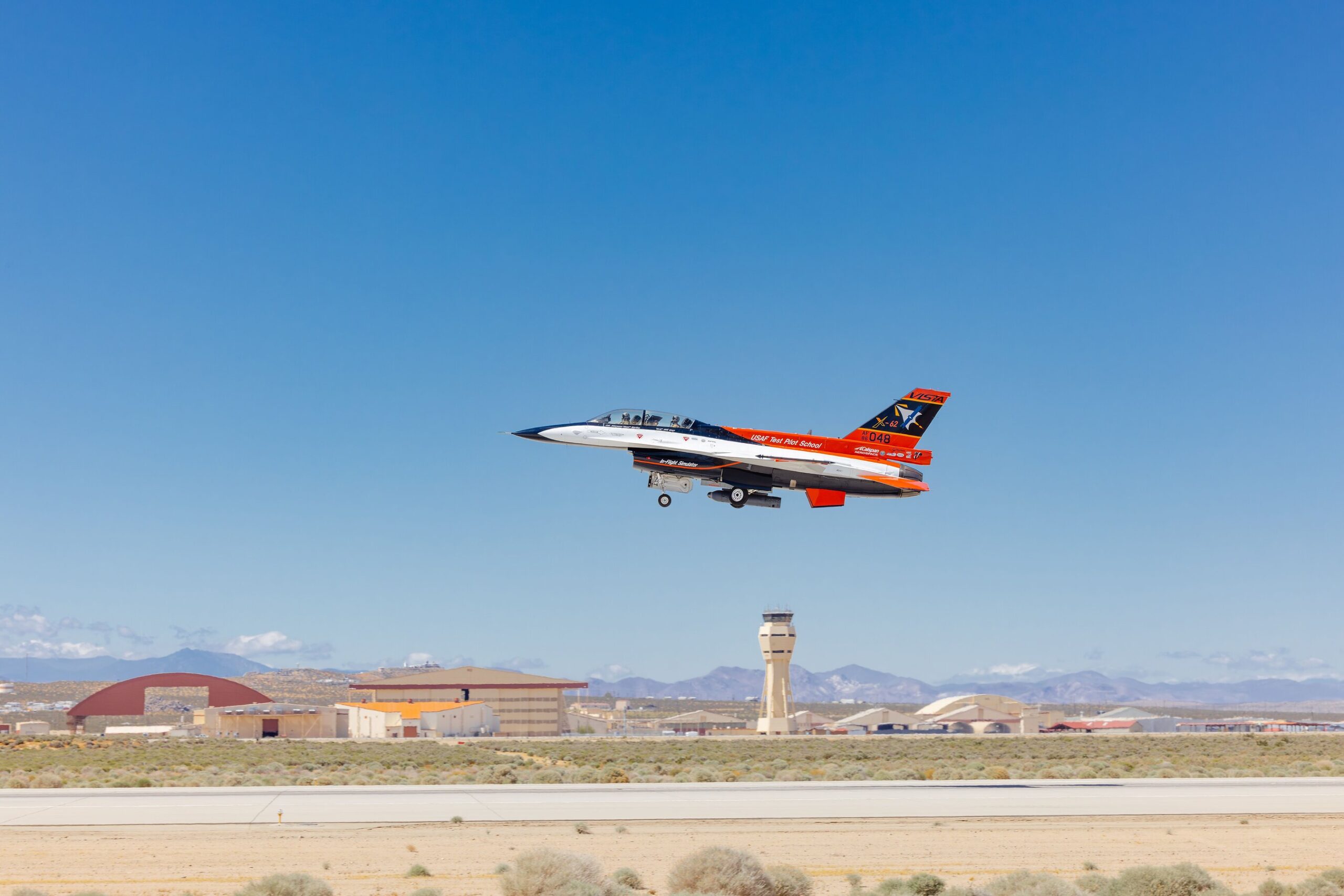
Lockheed Martin Skunk Works, the US Air Force Test Pilot School and industry partners have demonstrated sensor-driven autonomy on a fighter aircraft, with an AI agent aboard the X-62 VISTA using targeting information from an operational Legion Pod sensor to fly 27 intercepts against a live T-38 across eight flights.
CLOSING THE SENSOR-TO-ACTION LOOP IN FLIGHT
Lockheed Martin Skunk Works, the US Air Force Test Pilot School and industry partners have demonstrated sensor-driven autonomy aboard a fighter aircraft at Edwards Air Force Base, California. Across eight flights, the X-62 Variable In-flight Simulation Test Aircraft executed 27 AI-controlled intercepts, with an artificial intelligence agent using targeting information from an operational sensor to position the aircraft against a live target.
The technical distinction that makes this a step change rather than an increment is the source of the data. Previous autonomy flight testing has generally fed AI agents simulated or synthetically generated target information. In this series the X-62 carried a Lockheed Martin Legion Pod, which tracked a live T-38 and passed secure data to the agent, which then autonomously flew the aircraft into a tactical intercept position. Ron Fehlen, Vice President and General Manager of Lockheed Martin Skunk Works, said the agents consumed classified infrared search and track feeds and executed combat-critical manoeuvres in real time, and that the series demonstrated the AI could reliably close the sensor-to-action loop aboard an operational combat aircraft.
WHY REAL SENSOR DATA IS A HARDER PROBLEM THAN SIMULATION
An agent trained and tested against simulated target data operates on information that is, by construction, clean: the simulation knows where the target is and reports it accordingly. A real infrared search and track sensor produces a stream that is noisy, intermittent, subject to atmospheric and thermal effects, and occasionally wrong. An agent that performs well against the first and poorly against the second has not been shown to work; it has been shown to work in conditions that do not obtain. Moving the test onto live onboard sensor streams therefore mirrors the data environment pilots and future autonomous systems will actually face, and is the point at which autonomy testing begins to generate evidence relevant to fielding.
Stacy Kubicek, Vice President and General Manager of Lockheed Martin Sensors and Global Sustainment, said the ability to provide reliable sensor data was critical but the real advantage came when that data could connect seamlessly with AI to take action, describing sensing and autonomous AI together as a force multiplier for faster and more informed action in complex environments.
DEVELOPMENT CADENCE AND THE TEST PILOT SCHOOL PARTNERSHIP
Lockheed Martin identifies the speed of the development cycle as a distinct result of the programme. Its ‘Supermassive’ AI agent generation capability enabled full integration and ground testing of the agents with the X-62 in three months — a timescale that, in flight test terms, is closer to a software release cadence than to a conventional aircraft systems integration schedule. The partnership also expands the Test Pilot School’s AI and autonomy test portfolio to include mission-critical onboard systems rather than flight control autonomy alone, connecting the Air Force test community directly to industry capability.
The stated operational rationale is pilot bandwidth. By delegating complex tasks to an AI agent, aircrew gain capacity to focus on tactical information — a framing that positions the technology as augmenting the pilot rather than displacing them, and which addresses survivability by reducing the cognitive load under which decisions are made in contested environments. Skunk Works has been a partner and integrator on the X-62 for decades, providing the open software and hardware architectures that enable this class of flight test. The aircraft’s forthcoming Mission Systems Upgrade is intended to demonstrate integration of combat systems, sensors and airborne AI agents within a next-generation mesh network.
Source and Images: Lockheed Martin