
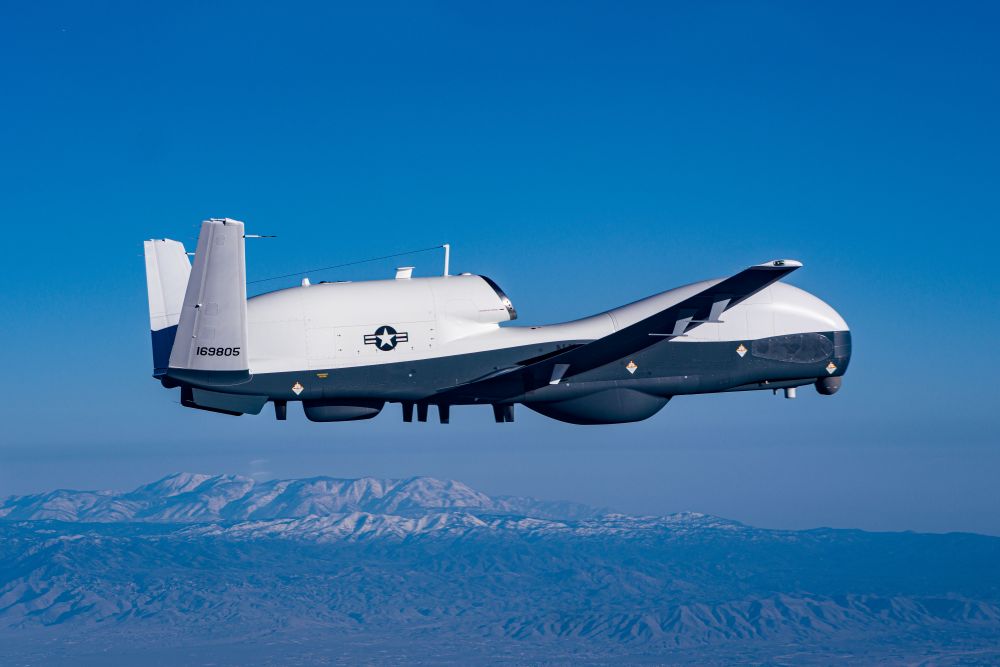
Northrop Grumman and Boeing have demonstrated enhanced interoperability between the uncrewed MQ-4C Triton and the crewed P-8A Poseidon in a jointly funded technology demonstration, with Triton’s system responding to a request from the Poseidon by using AI algorithms to collect, process and share maritime intelligence across a standardised interface.
A REQUEST SENT BETWEEN SYSTEMS RATHER THAN BETWEEN OPERATORS
Northrop Grumman and Boeing have demonstrated enhanced interoperability between the MQ-4C Triton and the P-8A Poseidon in a jointly funded technology demonstration, showing for the first time the ability of the two systems to collaborate and automate mission control over an open systems architecture. In the laboratory demonstration the two platforms exchanged maritime intelligence through a standardised interface enabling machine-to-machine mission planning and execution, with Triton’s system using AI algorithms to collect, process and share intelligence data with the Poseidon in response to a request sent by the Poseidon system.
The word doing the work in that description is ‘system’. The request originated from the P-8A’s mission system rather than from an operator typing a tasking message, and Triton’s response was generated by its own system rather than by a ground control crew interpreting a request and manually retasking the aircraft. Removing the human relay from a routine tasking exchange is what converts two separately operated platforms into a functionally teamed pair, and it addresses the specific bottleneck in maritime patrol operations: the time between a crew identifying an intelligence gap and the sensor capable of filling it being repositioned to do so.
THE INTERFACE AND WHY STANDARDISATION IS THE POINT
The exchange used the Universal Command and Control Interface, a machine-to-machine collaboration standard based on the Open Mission Systems and Autonomy Government Reference Architecture. Northrop Grumman states that through this standardised interface Triton can collaborate with other United States or allied assets sharing the same interface, cutting operator workload, accelerating commander decision-making and making integration across platforms quicker and more cost-effective.
The significance of a government reference architecture rather than a proprietary link is that it decouples interoperability from the manufacturer relationship. A bespoke Triton-to-Poseidon datalink would deliver the same capability for those two aircraft and nothing else; a standardised interface means any platform implementing the same standard — including allied aircraft from other manufacturers — can participate without a separate integration programme. For coalition maritime patrol operations, where P-8 operators now include several allied air forces, that distinction determines whether the capability scales.
TWO PLATFORMS ALREADY OPERATING AS A PAIR
Jane Bishop, Vice President and General Manager of the global surveillance division at Northrop Grumman, said Triton and the P-8A were the backbone of the United States Navy’s maritime patrol and reconnaissance force, delivering complementary capabilities, and that the demonstration underscored the flexibility of the systems and the strength of industry relationships. Tory Peterson, Vice President of Boeing’s P-8 Program, said the teaming demonstration unlocked real-world capability and interoperability for the United States and allies, and that the investment would allow current and future global P-8A operators to expand the scope and effectiveness of their missions through low-risk evolutionary enhancements.
Triton is built for the United States Navy and the Royal Australian Air Force at Northrop Grumman’s Palmdale, California facility, and supports maritime patrol, signals intelligence and search and rescue among other missions, providing persistent surveillance that enables early prediction of adversary behaviour and improved planning. The demonstration follows the Skunk Works and US Air Force Test Pilot School flight test series reported by World Airnews Daily on 5 August, in which an AI agent aboard the X-62 VISTA flew 27 intercepts using live onboard sensor data — the two results together indicating parallel progress on the two halves of the autonomy problem: what an agent can do with sensor data aboard a single aircraft, and how that data moves automatically between aircraft.
Source and Images: Northrop Grumman