
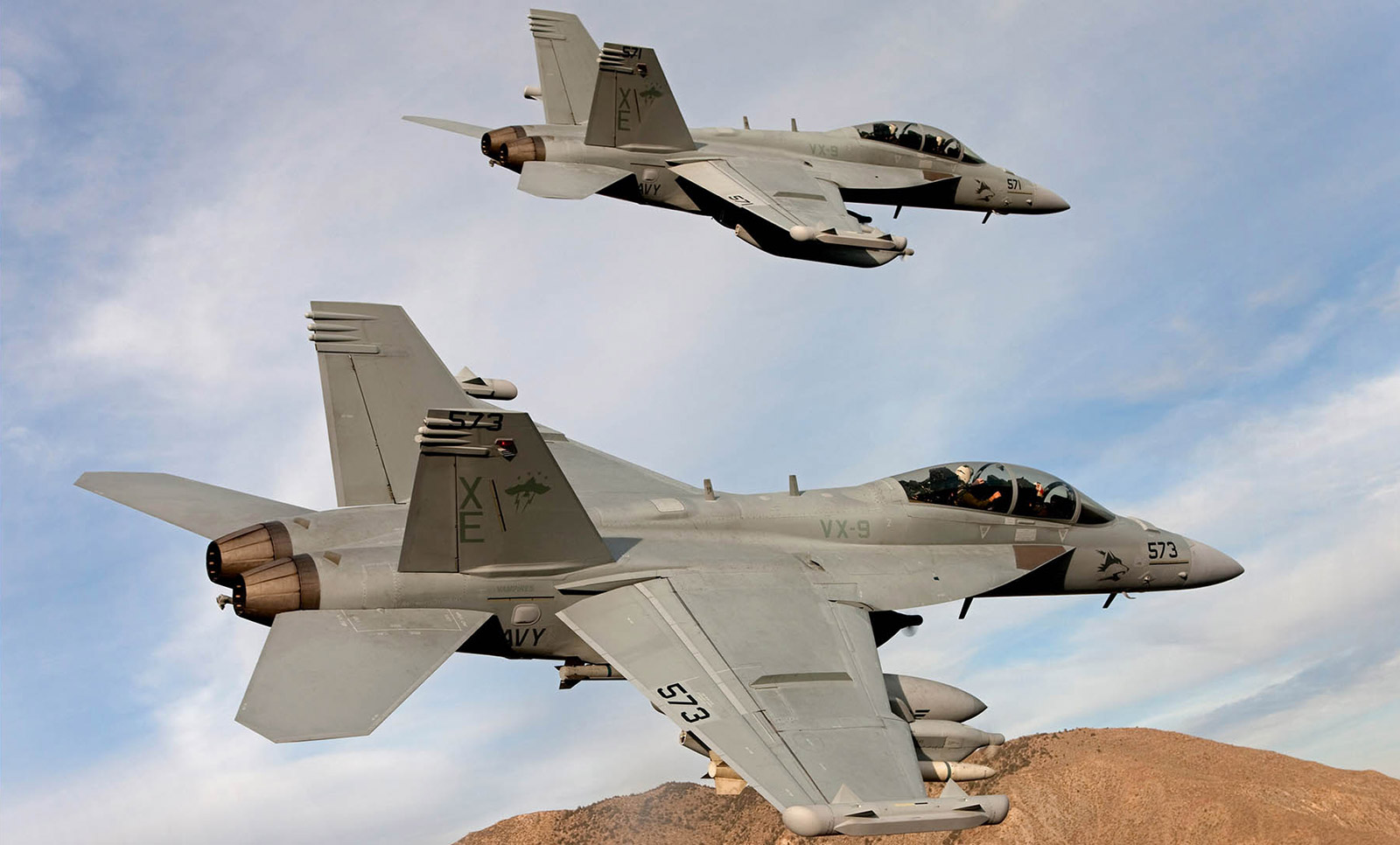
The EA-18G Growler made its first flight from St. Louis on 15 August 2006. Two decades on it remains the United States Navy’s principal airborne electronic attack aircraft, and is undergoing modification for Next Generation Jamming at a moment when several nations are researching uncrewed alternatives for part of the same mission.
A REQUIREMENT RATHER THAN AN AIRCRAFT
On 15 August 2006 the first EA-18G Growler, designated EA-1, made its maiden flight from Lambert International Airport in St. Louis, with Boeing test pilot Ricardo Traven and chief weapons system operator Rick Junkin at the controls. Traven has since said that from that first flight it was obvious to both of them what a capability and future the aircraft would open up in the years that followed.
The programme began in December 2003, when Boeing signed a five-year System Development and Demonstration contract with the United States Navy. The requirement it answered was the ageing of the EA-6B Prowler, which had served for decades and was becoming outdated. What the Navy specified was an aircraft able to perform the full spectrum of electronic warfare missions (surveillance, jamming and suppression of enemy air defences) while improving reliability, maintainability and operational flexibility. The aircraft was formally designated Growler on 8 November 2005, continuing a Navy naming tradition that has attached the name to vessels and submarines since the War of 1812.
The generational difference was apparent to those who flew both. Paul Ritter, a former United States Navy Growler pilot who began his career on the Prowler, has described the earlier aircraft as an amazing machine that flew like a farm truck, and the transition to the Growler as an upgrade to a Ferrari.
WHY BUILDING IT ON A FIGHTER MATTERED
The Growler’s defining design decision was to base it on the F/A-18 Super Hornet rather than develop a dedicated airframe. Its primary role is jamming the radars and communications of threat forces, denying their ability to detect and track friendly aircraft, and it can carry a range of jamming pods, weapons and other stores while executing both stand-off and escort jamming.
Escort jamming is the capability the airframe choice enables. An electronic attack aircraft that can only operate outside the threat envelope protects a strike package from a distance; one that can accompany it needs the performance and survivability of the aircraft it is escorting. Building the Growler as a carrier-capable Super Hornet variant gave it that, and gave the Navy an aircraft that shares maintenance, training and logistics with the fleet it flies alongside rather than requiring a parallel support structure.
Ritter, who flew the type for 15 years and logged more than 2,300 hours in it, has described the aircraft as providing added layers of protection for an entire air wing by gathering information on threats not seen in real time and passing target data, threat warning and protection to other aircraft including the F/A-18 and F-35. He has said that no other military aircraft does what it does, and that it has changed how the air wing operates and conducts strikes.
TWO DECADES OF MILESTONES
The first Growler was delivered to the Naval Air Test Center at Patuxent River on 22 September 2006, six weeks after first flight. Boeing opened a Growler Support Center at Naval Air Station Whidbey Island in May 2008, ahead of delivering the first fleet aircraft to Electronic Attack Squadron 129 on 4 June 2008, ahead of schedule and within budget. Growlers of VAQ-132 returned to Whidbey Island in July 2011 after the type’s first combat deployment. The 100th aircraft was delivered to the Navy on 5 May 2014, and in July 2015 Boeing unveiled the first Royal Australian Air Force Growler, making Australia the only nation outside the United States to operate the platform. In March 2021 the first aircraft entered the Growler Modification Program.
Boeing states the aircraft has recently played a role in jamming air defences and enabling United States and allied operations in the Red Sea, Venezuela and parts of the Middle East. Ritter has noted that the range of threats faced has increased substantially, and that the layered electromagnetic effects the Growler provides reduce the capability of those threats.
WHAT COMES NEXT, AND THE QUESTION BEHIND IT
Through the Modification Program, Growlers are receiving upgrades to processing power and detection capability and the ability to employ Next Generation Jamming pods, with Boeing continuing to develop enhanced capabilities as part of a Growler Block II suite. The stated intent is that the aircraft remains able to deny, degrade and dominate the electromagnetic battlespace.
The anniversary arrives at an interesting point for the mission itself. World Airnews Daily reported yesterday on a Japanese Ministry of Defense evaluation setting out research into stand-in jamming payloads intended for uncrewed platforms – devices designed to operate inside the threat zone, where a crewed aircraft cannot safely go. The Japanese Defense Buildup Program passage quoted in that document lists stand-off electronic warfare aircraft and stand-in jammers as complementary rather than alternative capabilities, and the distinction is the useful one. The Growler’s twenty-year record is in a role that requires an aircraft with the performance to accompany a strike package and a crew to exercise judgement in a contested electromagnetic environment. What uncrewed stand-in systems address is the part of the mission that requires being somewhere no crew should be sent. The two answer different halves of the same problem, and the Growler’s continued modification suggests its half is not the one being automated.
Source and Images: Boeing, feature by Jarrett Heckert