
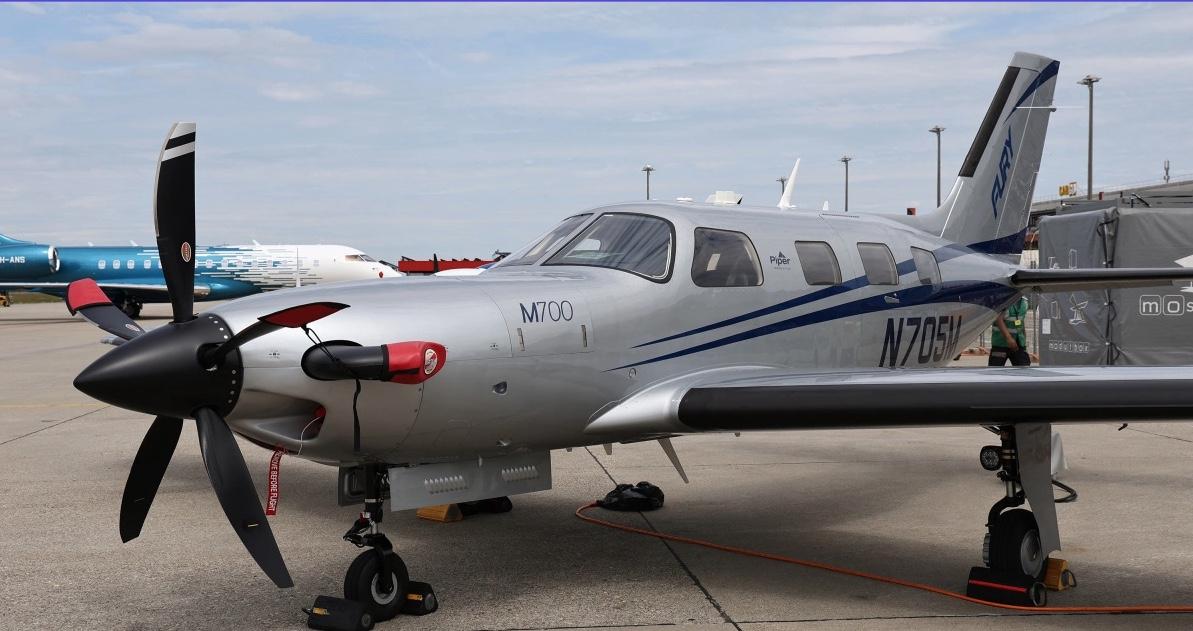
The Piper Aircraft’s new turboprop-single M700 Fury is the aircraft that enthusiasts and professionals alike have been eagerly anticipating. With an upgraded engine delivering 100 more shaft horsepower than its predecessor, the M600 SLS, the M700 Fury not only boosts performance but also maintains impressive efficiency.
This May, I had the opportunity to fly the M700 alongside Joel Glunt, Piper’s Manager of Engineering Flight Test, at their Vero Beach, Florida headquarters. Piper had just secured FAA approval for flight into known icing conditions for the M700, with unpaved runway certification expected to follow shortly.
The M700’s notable enhancement comes from its Pratt & Whitney Canada PT6A-52 engine and a five-blade composite Hartzell propeller, which was optional on the M600. To support the added power, the M700’s intake plenum has been redesigned for improved air recovery, and its exhaust stacks feature a flatter design to maximize residual thrust. The airframe and equipment remain unchanged from the M600, including six seats and Garmin touchscreen-controlled G3000 avionics, complete with autothrottle and Autoland.
Another significant addition is Garmin’s PlaneSync 4G LTE cellular datalink. This feature allows owners to monitor various parameters such as fuel quantity, aircraft location, oil temperature, battery voltage, and weather reports remotely. The upgraded engine not only improves performance during climbs and at high altitudes but also enhances takeoff and landing distances.
With a maximum takeoff weight of 6,000 pounds, the M700 demonstrates a climb rate of 2,048 fpm—a 32% improvement over the M600. The aircraft reaches FL250 in just 13.9 minutes, 34% faster than its predecessor. The M700 also boasts a shorter takeoff distance of 1,994 feet and a landing distance of 1,968 feet, compared to the M600’s 2,635 and 2,659 feet, respectively. Despite being 80 pounds heavier due to the larger engine, the M700 offers an extended maximum range of 1,852 nm and a higher maximum cruise speed of 301 ktas, 27 knots faster than the M600.
Market Position
The M700 stands out in the market as the second-lowest-cost pressurized single-engine turboprop, priced just over $4 million, with typical configurations around $4.3 million. While less expensive than competitors like the Epic E1000 GX, TBM 960, Pilatus PC-12, and the upcoming Beechcraft Denali, the M700 also competes in a different class regarding cabin size and performance. With its advanced features like autothrottle and Autoland, the M700 is poised to attract a wide range of buyers looking for a high-performance yet easy-to-fly turboprop.
Flying the M700
Flying the M700 provides a familiar yet enhanced experience for those accustomed to Piper’s M-class series. The G3000 avionics system simplifies operations, and the autothrottle adds a layer of safety, particularly during autopilot-coupled go-arounds. The M700’s handling remains crisp, with smooth bank angles and benign stall characteristics, making it a pleasure to fly.
During my flight, the M700 demonstrated its impressive climb performance, even at reduced fuel loads. The aircraft’s Garmin Electronic Stability & Protection (ESP) features added an extra level of confidence, allowing for smooth and controlled maneuvers. The return to Vero Beach for an RNAV approach showcased the precision of the G3000 system and the ease with which the M700 handled gusty crosswinds on landing.
IMAGE CREDIT: Piper’s M700 Fury climbs and cruises faster than its predecessor, the M600 SLS. © David McIntosh