
Flying from New York City to Los Angeles in less than an hour may sound like the stuff of science fiction, but aerospace engineers are steadily solving the problem of hypersonic flight. This revolutionary technology promises to allow aircraft to safely fly at five times the speed of sound, making long-distance passenger travel faster than ever before. However, while the prospect of bending time for passenger journeys is enticing, engineers are prioritising a more immediate concern: harnessing the extraordinary potential of hypersonics to enhance global security.
“Our adversaries have pushed the industry into an upswing,” says Dean Modroukas, General Manager for Hypersonics at GE Aerospace, speaking to the current geopolitical landscape. He emphasises that the race to develop hyper-efficient propulsion systems capable of travelling further and faster is critical. These systems will dramatically compress the time available for adversaries to react, improving national security.
GE Aerospace engineers are at the forefront of this race, working tirelessly to ensure that the United States and its allies remain competitive. After a successful year of ground-level tests, the team is poised to prove their groundbreaking technologies in the skies. Modroukas, who previously headed engineering at the Bohemia, New York-based hypersonic company Innoveering before it was acquired by GE Aerospace in 2022, is laser-focused on ensuring the engines will be mission-ready.
“You can do all the design, analysis, and ground tests you want,” Modroukas explains, “but getting to flight, and ensuring the system is fit for its mission? That’s where the rubber meets the road.” He adds that GE Aerospace has given the team the freedom and flexibility to move quickly, making the necessary investments to meet ambitious milestones.
A Match in a Hurricane
Understanding the nature of hypersonic propulsion reveals why it’s such a challenge. Ramjet engines, used in hypersonic flight, differ significantly from the turbojets and turbofan engines found on commercial aircraft. Unlike traditional engines that rely on moving components, ramjets depend on specially engineered air inlets to compress air to the right pressure for combustion. This system requires speeds greater than Mach 3, or three times the speed of sound, to ignite, which is why ramjets traditionally rely on rocket boosters or turbo-ramjets to achieve the necessary ignition throttle.
“The challenge of igniting the hypersonic engine is often compared to lighting a match in a hurricane,” says Modroukas. For over a decade, GE Aerospace has been collaborating with NASA and other research partners to solve this problem, working with pulsed detonation engine technology that burns fuel in waves of controlled explosions, rather than through standard combustion.
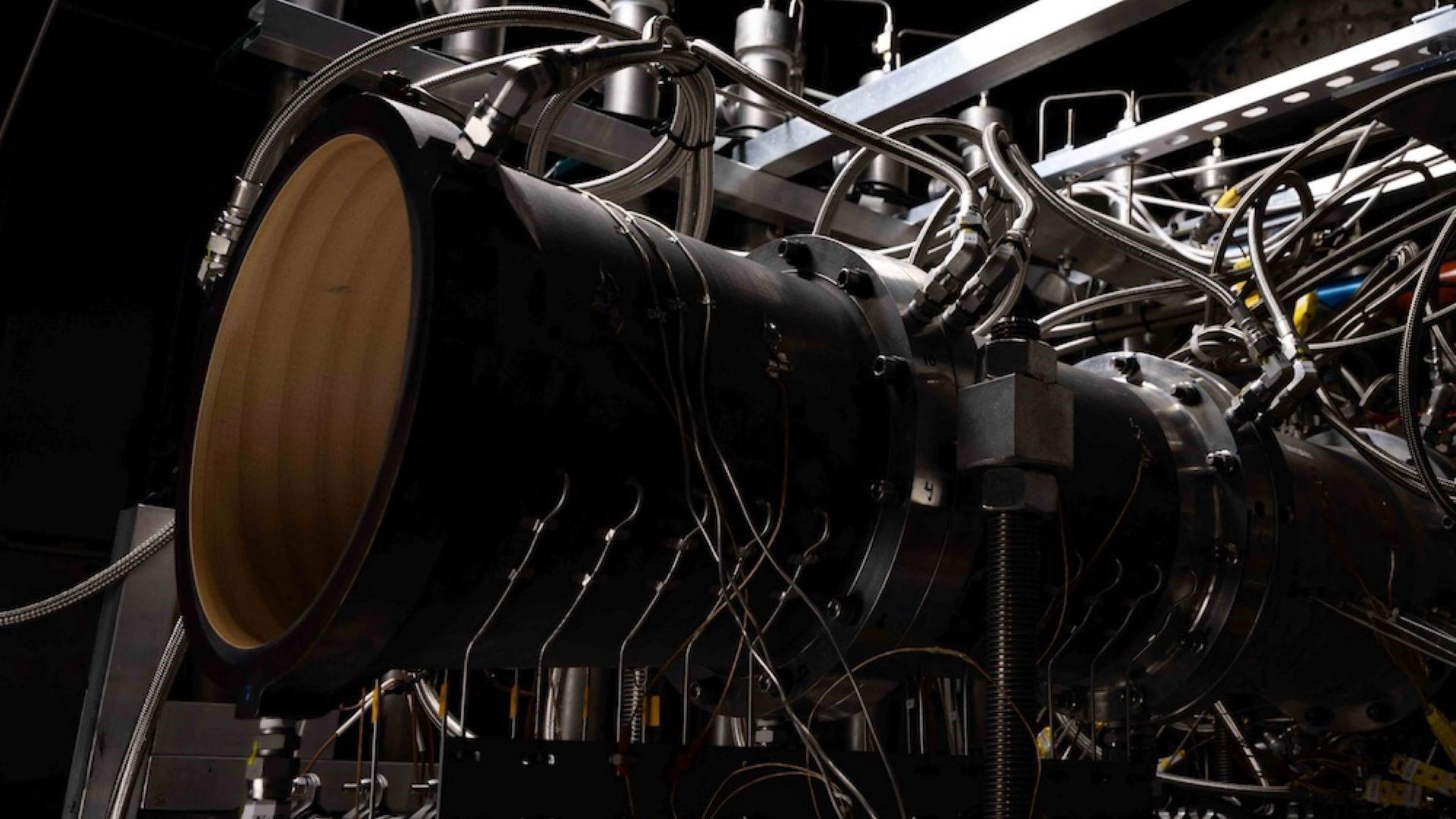
In late 2023, GE Aerospace achieved a breakthrough with the world’s first demonstration of a hypersonic dual-mode ramjet (DMRJ) rig, incorporating rotating detonation combustion (RDC) technology within a supersonic flow stream. This technology generates higher thrust from a smaller engine size, allowing for remarkable efficiency gains. The hypersonic propulsion technologies developed will allow air-breathing missiles and aircraft to fly at varying Mach numbers and take unpredictable, hard-to-track paths—critical capabilities sought by the U.S. Department of Defence.
Modroukas calls the team’s latest success at GE Aerospace’s high-speed propulsion testing facility in Evendale, Ohio, in mid-2024 a “tremendous success, both from a combustion performance and thermal structural perspective.” Achieved in just eight and a half months, this progress represents the rapid pace at which GE Aerospace is advancing. “We got that designed and built in eight and a half months, and achieved first fire within 11 months,” he adds. “That pace is going to continue for us, and we don’t expect it to slow down.”
Getting to Flight
The next key step is scaling up these innovations. By 2025, the team plans to integrate these developments into a full propulsion system. The focus will shift to fine-tuning advanced controls and applying cutting-edge materials from GE Aerospace’s jet engine technology.
“For flight testing, ground testing is just the beginning,” Modroukas explains. “It allows you to understand everything going on with your system in terms of aerodynamics and propulsion. But flight testing allows you to learn and improve after every activity.” With the resources available at GE Aerospace, Modroukas believes his team will continue to make rapid advancements.
Modroukas himself is no stranger to hypersonic testing. Having spent early years of his career at General Applied Science Laboratory in Long Island, New York, building test rigs and conducting ground tests, he knows the excitement of watching new technologies come to life. “There’s no better feeling than seeing the blue flame coming out of a well-performing engine,” he reflects.
As GE Aerospace’s hypersonic engines prepare for flight, Modroukas and his team are eager to continue pushing the limits of speed and performance, knowing that their work has the potential to change both the future of aviation and global security.
SOURCE AND IMAGE: GE Aerospace