
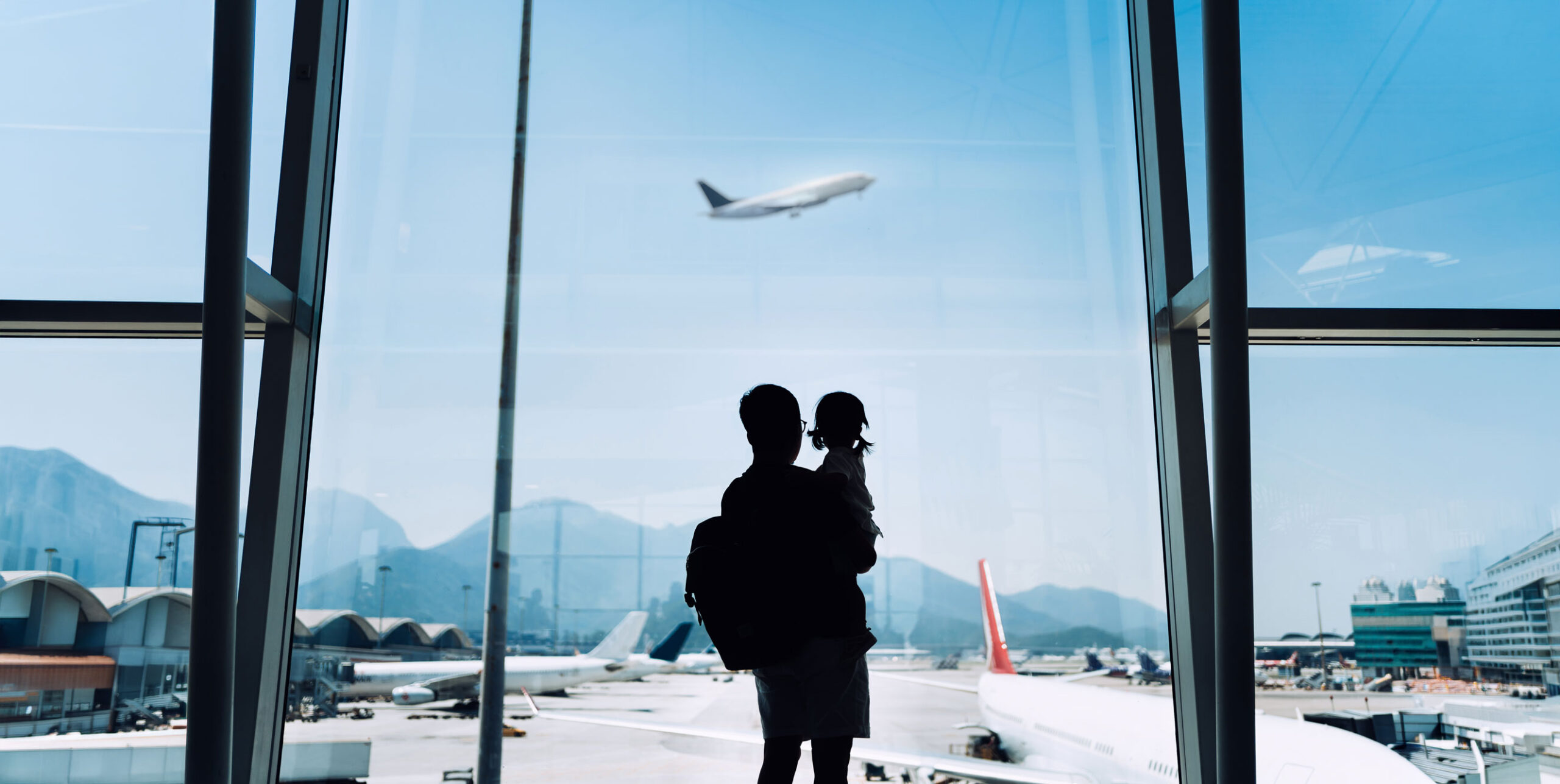
SITA’s Impact Report 2025 documents a year of measurable advances in airport biometrics, AI-driven operations and baggage management, as the aviation industry uses technology rather than physical expansion to prepare for a projected doubling of passenger numbers by 2050.
SOFTWARE, NOT CONCRETE, IS AVIATION’S NEW CAPACITY ANSWER
SITA has published its Impact Report 2025, drawing on a year of work with airlines, airports, governments and travel partners worldwide to document how aviation technology is becoming the principal mechanism for adding system capacity, managing disruption and reducing the industry’s environmental footprint. The report is framed around a central challenge: IATA projects the industry will carry eight billion passengers annually within 20 to 25 years and approach ten billion by 2050 — roughly double today’s volumes — without a corresponding doubling of airports, aircraft or border infrastructure.
David Lavorel, CEO of SITA, said the question was unavoidable: how to move twice as many travellers without doubling the infrastructure. He said SITA’s 2025 report showed how that shift was already under way, with airports scaling capacity within existing buildings, governments clearing borders before passengers ever reached a queue, and artificial intelligence moving out of pilot programmes and into the operations rooms where flights are actually managed. He described the transformation as a shared achievement across airlines, airports, governments and technology partners.
BIOMETRIC BORDERS: 10-SECOND CLEARANCE AND 271 MILLION RISK ASSESSMENTS
Some of the most tangible advances documented in the report relate to border management. Singapore has introduced what SITA describes as the world’s first passport-less border clearance, enabling residents to pass through immigration in ten seconds using combined face and iris biometrics, with no passport required. In Aruba, pre-cleared passengers complete border processing on arrival in as little as eight seconds — 78% faster than the previous process — through the combination of digital travel credentials and biometric verification. At the network scale, more than 271 million travellers per year now receive an advance risk assessment supported by SITA technology before arrival, with the majority of assessments completed in under four seconds.
AI IN LIVE OPERATIONS: FUEL SAVINGS, TURNAROUNDS AND REROUTING
Artificial intelligence is documented across the report as having moved from experimentation to operational deployment. SITA OptiFlight, which uses machine learning and digital-twin modelling to recommend fuel-efficient climb and cruise profiles to flight crews, processed 2.9 million flights for 59 airline customers during 2025, saving 127,732 tonnes of fuel and avoiding the equivalent of 403,633 tonnes of CO₂. At Toronto Pearson and Abu Dhabi airports, AI-driven Total Airport Management tools are delivering turnaround time savings that compound across the operating day. At Thai Airways, AI-driven routing within SITA WorldTracer Auto Reflight has reduced the time required to rebook mishandled bags from three minutes to one second.
A 2025 proof of concept at France’s Reims air traffic control centre demonstrated what SITA describes as a significant operational gain from giving controllers access to the same live weather picture already used by pilots and dispatchers. Over 21 days of weather-affected operations, the approach cut weather-driven delays by up to 65% and saved up to 105,000 delay minutes. The report also documents the system’s performance during the 2024 CrowdStrike software outage, which disrupted airline operations globally: more than 460 flights continued without interruption on SITA Maestro departure control systems. At Hajj 2025, SITA’s operational support kept airline and airport systems running through the pilgrimage period with zero downtime and zero major incidents.
LOST LUGGAGE DOWN 90%; FRANKFURT TERMINAL 3 DELIVERED ON DIGITAL INFRASTRUCTURE
In baggage, SITA’s partnership with Apple — now joined by Google — has produced a measurable result: for bags equipped with an Apple AirTag and with location sharing enabled through SITA WorldTracer, the number of truly lost bags fell by 90%. Frankfurt Airport’s new Terminal 3, designed for an initial capacity of up to 19 millIon passengers annually, was delivered around a digital-first common use infrastructure developed with SITA and CCM.
REVENUE GROWS 7% FOR FOURTH CONSECUTIVE YEAR
SITA’s own financial performance reflected the scope of its customer work in 2025. Revenue grew 7% to US$1.71 billion, the fourth consecutive year of 7% to 8% growth. The company continued R&D investment, completed the strategic acquisition of airport interior design firm CCM, and conducted multimillion-dollar co-innovation programmes with more than 30 customers through SITA Labs. On sustainability, SITA reduced its own emissions by 1.3% year-on-year, bringing total reductions to 32% against a 2019 baseline, and now sources 90% renewable electricity across its global offices.
Source and Images: SITA