
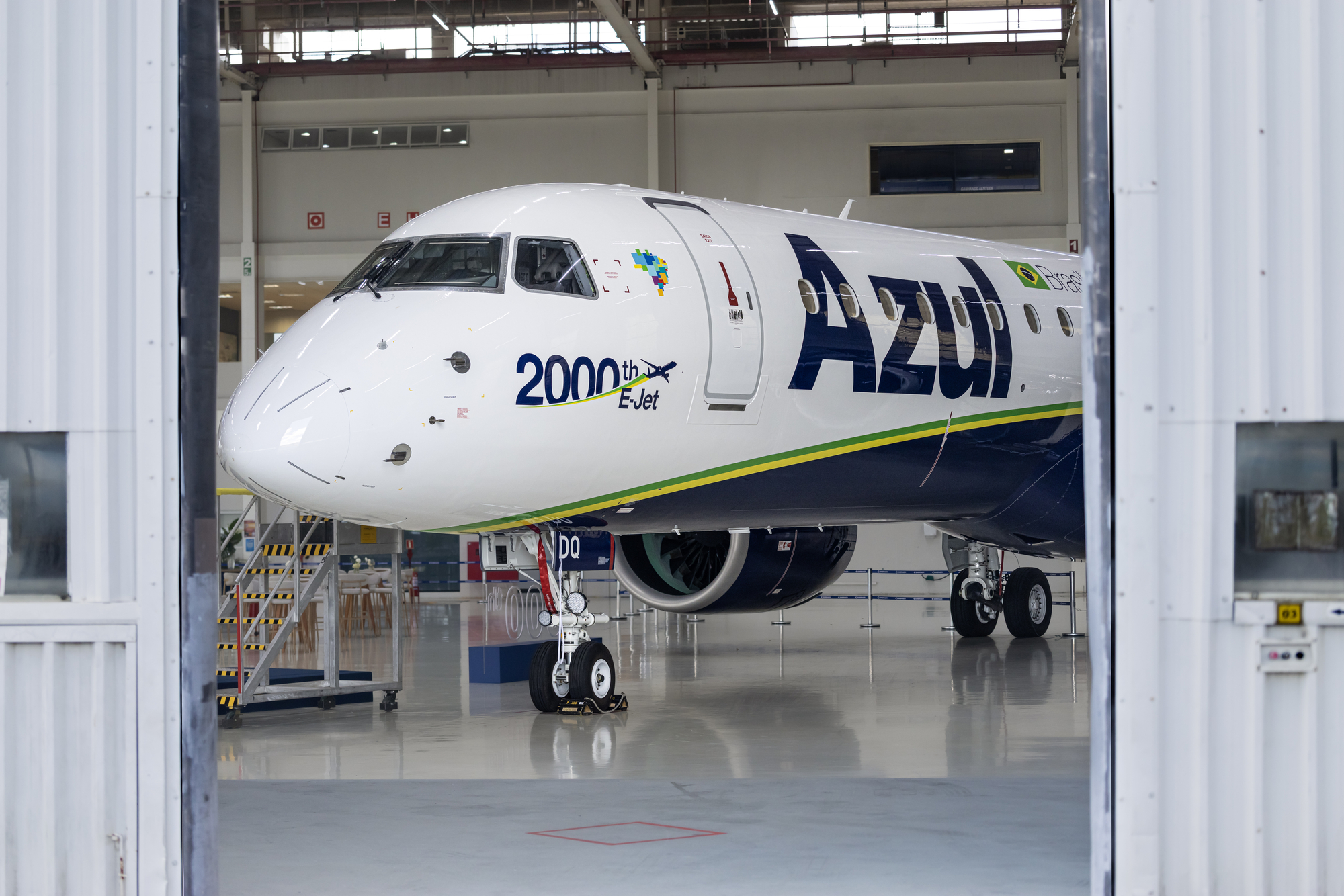
Azul Linhas Aéreas has taken delivery of Embraer’s 2,000th E-Jet, an E195-E2 that is also the airline’s 50th E2, as the two-decade-old programme consolidates its position among the world’s three largest commercial jet families.
A MILESTONE TWO DECADES IN THE MAKING
Embraer has delivered the 2,000th aircraft in its E-Jets family, an E195-E2 handed over to Azul Linhas Aéreas at the manufacturer’s São José dos Campos facility in Brazil. Azul, Brazil’s largest airline by number of destinations served, is also taking its 50th E2-generation aircraft with the delivery, having been the E195-E2’s launch customer when it entered service in 2019.
TWO DECADES OF SERVICE
Since the first E-Jet entered service in 2004, the family has been operated by more than 90 airlines in over 60 countries, accumulating approximately 48 million flight hours and carrying more than 2.85 billion passengers, according to Embraer. The lineup now spans four first-generation models, the E170, E175, E190 and E195, alongside the re-engined E190-E2 and E195-E2. Arjan Meijer, president and chief executive of Embraer Commercial Aviation, said the milestone reflected the programme’s role in “connecting communities, opening new markets and creating sustainable growth opportunities for airlines.”
WHAT CHANGED BETWEEN THE GENERATIONS
The E2 aircraft differ from their first-generation predecessors chiefly in their engines and wing design. Both the E190-E2 and E195-E2 are fitted with Pratt & Whitney’s PW1900G geared turbofan, which Embraer says cuts fuel burn substantially against the original models, alongside a newly designed wing and updated fly-by-wire flight controls. Those changes matter commercially because they extend the aircraft’s range and lower its trip cost on the short and medium-haul regional routes where the E-Jet has built its market position, without requiring airlines to move up to a narrowbody.
A FLEET WITH AFRICAN RELEVANCE
Although this delivery is a Brazilian story, the E-Jet family is a familiar sight on African route networks. South Africa’s Airlink has built much of its regional fleet around the E170 and E175 and has begun taking delivery of E195-E2s, while other E-Jet variants fly with carriers elsewhere on the continent. The programme’s scale, and its continued investment in the E2 generation, is directly relevant to the regional connectivity model much of Southern African aviation depends on.
Note: Forty-eight million flight hours across 2,000 aircraft works out to an average of roughly 24,000 flight hours per airframe, and 2.85 billion passengers works out to an average of about 1.4 million passengers carried per aircraft. These are WAN’s own calculations from Embraer’s published totals, offered as a sense of fleet-wide intensity rather than the experience of any single aircraft; they are not figures supplied by the manufacturer.
Source and Images: Embraer