

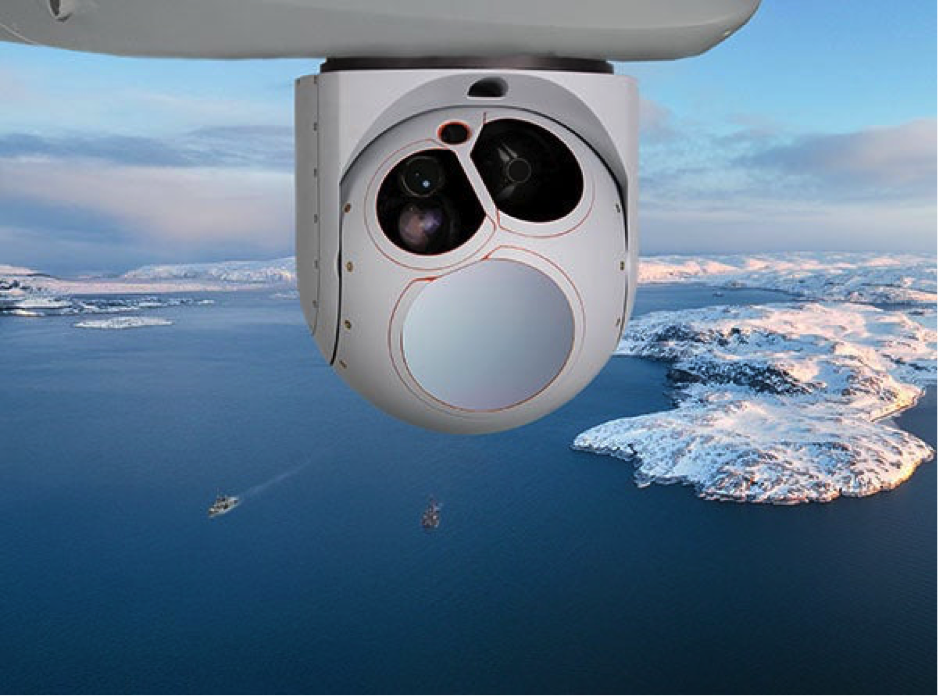
L3Harris outlines the growing demand for cold-hardened ISR and EO/IR systems as Arctic operations increase across contested northern regions.
As Arctic regions become increasingly contested operational environments, intelligence, surveillance and reconnaissance (ISR) capability is emerging as a strategic requirement for allied nations operating in extreme cold conditions. New shipping routes, territorial disputes and increased military activity across Arctic coastlines are contributing to renewed focus on domain awareness and persistent surveillance capability.
THE OPERATIONAL CHALLENGE OF THE ARCTIC
Arctic operations present significant technical and environmental challenges for surveillance systems. Extreme cold affects mechanical components, battery performance and optical systems, while snow-covered terrain and whiteout conditions reduce visual contrast and make target identification more difficult. Infrared systems are similarly affected, with compressed thermal contrast reducing differentiation between targets and background environments.
The operational environment is further complicated by limited connectivity, degraded navigation and remote operating conditions with minimal support infrastructure. In these circumstances, resilient sensors, platform flexibility and the ability to continue operating in denied environments become critical mission requirements.
MULTI-SPECTRAL ISR FOR ARCTIC OPERATIONS
According to L3Harris Technologies, Arctic ISR missions increasingly require long-range detection, stabilised multi-sensor payloads and all-weather imaging capability across maritime, airborne and land-based operations. These mission sets include maritime surveillance, sovereignty patrols, search and rescue, early warning and counter-unmanned systems operations.
The company’s WESCAM MX-Series electro-optical and infrared (EO/IR) systems combine high-definition electro-optical sensors with mid-wave infrared (MWIR) and short-wave infrared (SWIR) capability to support operations in degraded visual environments. The systems are designed for deployment across fixed-wing aircraft, rotary-wing platforms, unmanned systems, maritime vessels and ground vehicles.
L3Harris states that the systems incorporate advanced stabilisation, geo-pointing accuracy and AI-enabled edge processing to support object detection and multi-target tracking in low-contrast environments. The company also highlighted emerging capabilities aimed at identifying extremely small objects, including drones operating at minimal pixel thresholds.
COUNTER-UxS CAPABILITY INCREASES IN IMPORTANCE
The article also notes the growing relevance of counter-unmanned systems (C-UxS) capability in Arctic operations as low-cost drones proliferate across increasingly remote operational theatres. L3Harris said its WESCAM systems have supported counter-UxS detection, identification and engagement operations since 2023.
The company’s VAMPIRE system integrates EO/IR sensors with AI-enabled detection software and both kinetic and non-kinetic effectors to support counter-drone operations in degraded and denied environments. According to L3Harris, the system is designed to operate from austere platforms while maintaining performance in extreme cold, high winds and low-light conditions.
L3Harris concluded that operational effectiveness in Arctic environments increasingly depends on surveillance and targeting systems capable of maintaining reliability and situational awareness under extreme environmental conditions.
SOURCE: L3HARRIS TECHNOLOGIES