
NASA’s Artemis II mission has successfully launched from Kennedy Space Center, marking the first crewed journey towards the Moon since the Apollo era and a significant step in the agency’s long-term lunar exploration programme.
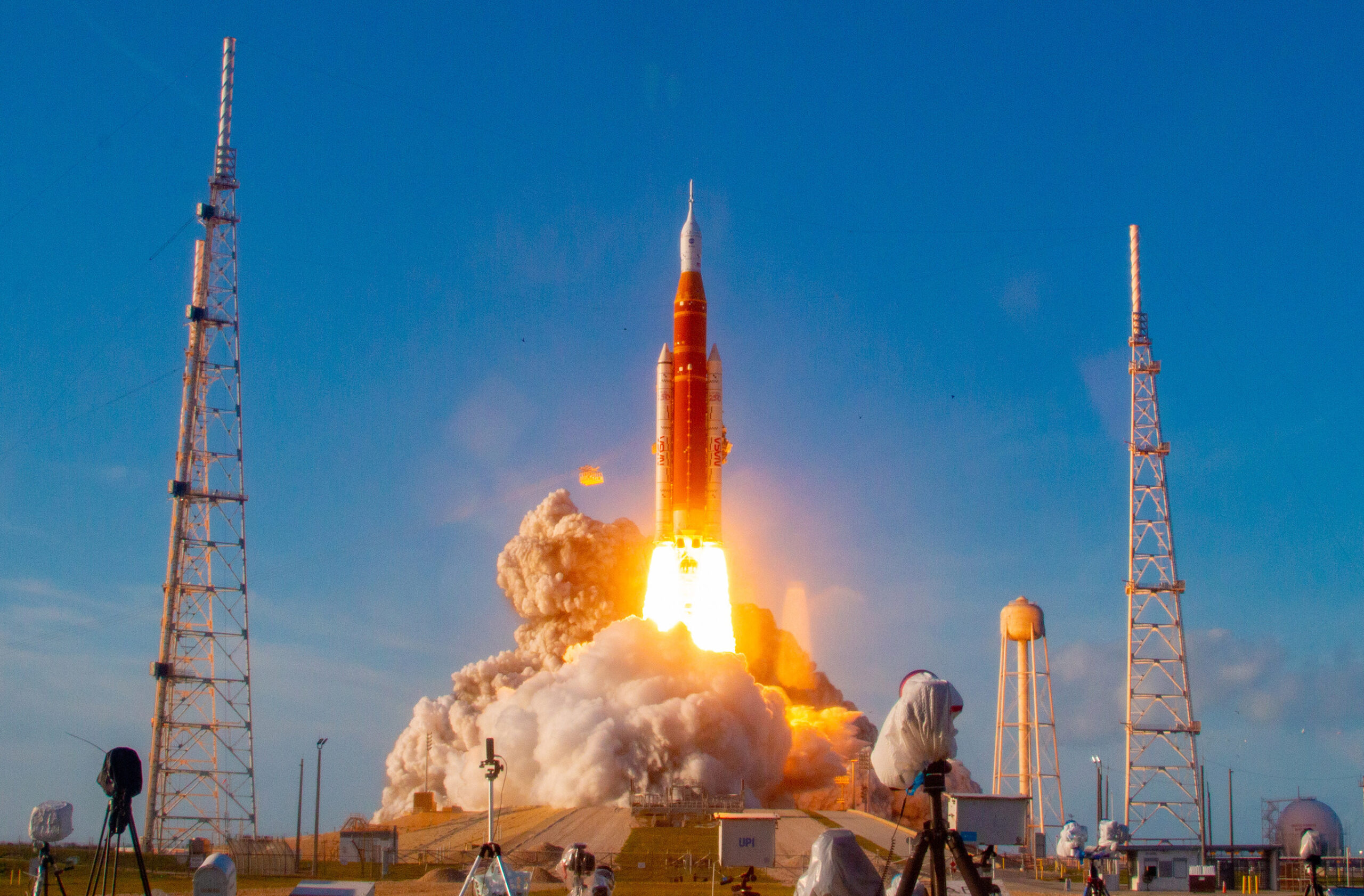
Lift-off occurred at 18:35 ET on 1 April 2026, with the Space Launch System (SLS) rocket performing as planned during the critical early phase of flight.
CORE STAGE PERFORMANCE ENABLES LUNAR TRAJECTORY
The Boeing-built core stage played a central role in the launch sequence, completing its primary mission approximately eight and a half minutes after lift-off before separating from the upper stage.
During ascent, the core stage executed a full sequence of operations, including propellant loading, engine ignition, thrust vector control, and controlled shutdown prior to separation.
This phase enabled the Orion spacecraft, named Integrity, to continue its trajectory, carrying the crew on a planned 10-day mission around the Moon.
CREWED MISSION MARKS INTERNATIONAL COLLABORATION
The Artemis II crew comprises NASA astronauts Reid Wiseman, Victor Glover and Christina Koch, alongside Canadian Space Agency astronaut Jeremy Hansen.
Hansen becomes the first Canadian—and the first non-American—to fly around the Moon, marking a milestone for Canada’s participation in human spaceflight and positioning the country as the second to send an astronaut on a lunar mission.
In a message released following the launch, Hansen acknowledged the role of Canadian expertise and support in enabling the mission.
VEHICLE DESIGN AND TECHNICAL CAPABILITY
The SLS core stage is a critical structural and propulsion element of the launch system. Standing approximately 65 metres tall, it incorporates:
- A 196,000-gallon liquid oxygen tank
- A 537,000-gallon liquid hydrogen tank
- An intertank structure connecting the propellant systems
- A forward section linking to the upper stage
- An engine section housing four RS-25 engines
Together, the engines generate approximately 2.2 million pounds of thrust during ascent.
Manufacturing of the core stage takes place at NASA’s Michoud Assembly Facility in New Orleans, supported by a nationwide supplier network.
PROGRAMME CONTINUITY AND FUTURE MISSIONS
Artemis II is positioned as a precursor to future lunar landing missions, with hardware for Artemis III through V already in production.
The programme is designed to establish a sustained human presence on the Moon, while also serving as a foundation for deeper space exploration initiatives.
The successful performance of the launch vehicle and its systems provides validation for upcoming missions, where increased operational complexity, including lunar surface operations, will be introduced.
OPERATIONAL SIGNIFICANCE
The Artemis II mission restores a human capability not demonstrated for more than five decades: crewed lunar flight.
Beyond its symbolic value, the mission serves as a systems-level validation of launch vehicle performance, crew integration, and mission architecture under real operational conditions.
Its outcome will directly inform subsequent mission planning, risk management, and the development of long-duration lunar infrastructure.
SOURCE AND IMAGE: Boeing
Canadian Space Agency – Jeremy Hansen Artemis II message and Canadian Space Agency – The start of a historic journey to the Moon