
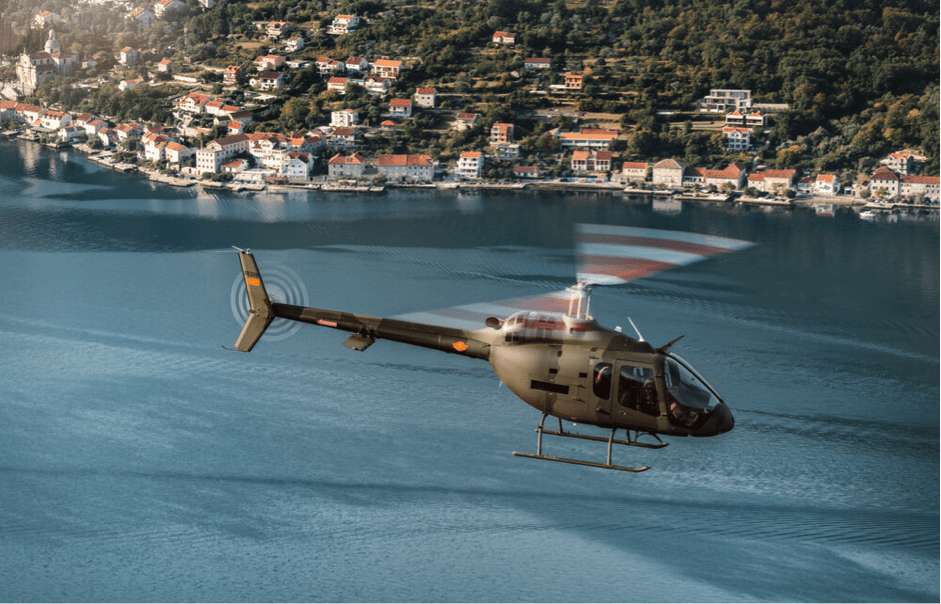
Bell continues to position the Bell 505 as a military pilot training platform, with the helicopter currently supporting training operations across multiple international defence forces.
According to Bell, the company has trained more than 130,000 pilots and mechanics over its 90-year history, including early U.S. Army pilot training programmes dating back to 1946. Today, the Bell 505 is used by military operators in countries including Jordan, Bahrain, the United Arab Emirates, Montenegro, Indonesia, Iraq and South Korea.
Since entering service in 2017, the Bell 505 has accumulated more than 300,000 flight hours and is operating in more than 55 countries across six continents. The aircraft is based on the Bell 206L-4 drivetrain architecture, combined with updated avionics, handling characteristics and fuel efficiency performance.
The platform is designed to support early-stage pilot training, with handling characteristics intended to support predictable performance and stable flight behaviour. Bell states that the rotor system provides longer pilot reaction time, while metal rotor blades with high inertia support autorotation performance. The helicopter is powered by a Safran Arrius 2R engine equipped with dual-channel FADEC.
The aircraft cabin configuration allows for single-pilot operations from either front seat position and provides space for training operations using helmets, headsets and night vision goggles. The open cabin layout and stadium-style rear seating are designed to allow students to observe cockpit activity during training flights.
The Bell 505 features an all-glass cockpit incorporating the Garmin G1000H flight deck. The system presents primary flight and navigation data in an integrated display format intended to support pilot workload management and situational awareness.
Bell states that the platform is designed to be cost-effective across its operational lifecycle. Predictive maintenance capability is supported through onboard avionics data monitoring, allowing maintenance teams to identify and resolve technical issues. Global parts support and dedicated product support teams are intended to support aircraft availability.
Bell also offers complementary simulation training through TRU Simulation. The Veris Virtual Reality Flight Simulator, paired with the Bell 505 platform, is FAA Level 7 qualified and incorporates a six-degrees-of-freedom motion system and full G1000H avionics simulation environment. The system is intended to allow students to experience complex operational scenarios in a controlled training environment prior to live flight training.
SOURCE AND IMAGE ©: BELL