
Eve Air Mobility has completed hover and low-speed flight testing of its eVTOL prototype, advancing the programme toward transition flight testing later in 2026.
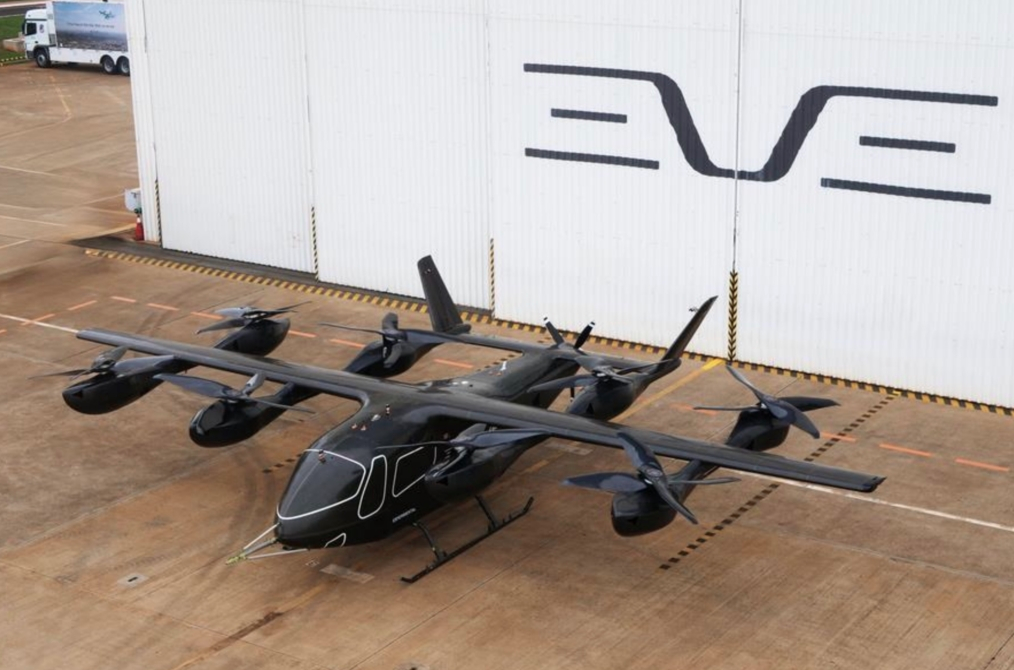
Eve Air Mobility has completed the hover and low-speed flight testing phase of its full-scale eVTOL engineering prototype, marking another milestone in the company’s ongoing flight test campaign.
The company said the completed test block generated operational and aerodynamic data that will support the next phase of development as the programme advances toward transition flight testing and eventual wingborne flight operations.
59 FLIGHTS COMPLETED
According to Eve, the prototype completed 59 flights during the test phase, accumulating a total flight time of 2 hours, 27 minutes and 33 seconds. The campaign focused on validating aircraft control laws, propulsion behaviour, aerodynamic loads and energy management systems under progressively expanding flight conditions.
Initial testing concentrated on low-speed operations below 15 knots before progressing to approximately 20 knots ground speed, including simultaneous four-axis manoeuvres designed to further validate aerodynamic and load models.
Johann Bordais, CEO of Eve, said the phased testing strategy was intended to systematically validate simulation models and aircraft behaviour before progressing to more demanding operational conditions.
AUTOLAND AND FLY-BY-WIRE TESTS COMPLETED
Eve said more than 100 individual flight test points were completed during the campaign, including demonstrations of autoland capability and a simplified fly-by-wire mode designed as a secondary operational layer should the normal system become unavailable.
The aircraft also achieved an altitude of 215 feet above ground level and completed a maximum flight duration of 3 minutes and 48 seconds during the test phase. The company reported that propulsion and battery system performance exceeded expectations while recorded noise levels remained within projected parameters.
Marcelo Basile, Head of Tests at Eve, said the programme would now move into planned ground testing ahead of transition flights, which are expected to begin during the northern hemisphere summer of 2026.
NEXT STEP TOWARD TRANSITION FLIGHT
The upcoming transition phase will focus on validating synchronisation between the aircraft’s lift and cruise propulsion systems while continuing to expand the flight envelope.
Eve Air Mobility, backed by Embraer, is developing an integrated urban air mobility ecosystem that includes eVTOL aircraft, support services and air traffic management systems.
SOURCE AND IMAGE: EVE AIR MOBILITY