GE Aerospace’s Pune factory reports major productivity and quality gains through FLIGHT DECK, its lean operating model. Improvements include a 30% boost in tube-line output, a redesigned HPT-ACC model line, and expanded efficiencies site-wide.
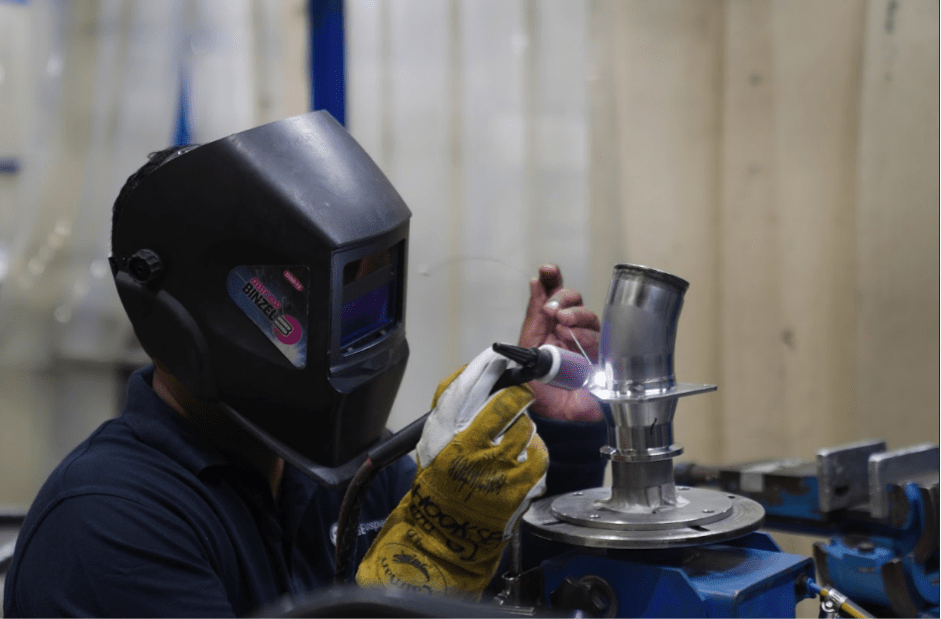
At GE Aerospace’s vast manufacturing campus on the outskirts of Pune, Deputy Engineer Sachin Bhagat is focused on a task that has occupied him for weeks. In a quiet corner of the factory, he bends a three-inch-diameter tube across two dimensions to test its limits under shear, compression, and twisting stress. These trials, combined with support from supervisors and managers, led Bhagat and his colleagues to a breakthrough last year: removing the welding stage from a recurring production process.
Previously, joining two tubes required a four-stage manual operation, and each weld took about an hour. The manual process slowed the output of a high-demand part. Bhagat’s team proposed a shift to an automated bending operation, supported by a newly designed clamp, dies, and more robust press machinery. The change did more than eliminate a bottleneck. Replacing the weld stage with a bend operation improved part quality and longevity, increased productivity by 30%, removed non-value-added work, freed welders to focus on other tasks, and generated cost savings exceeding $150,000 a year. The method has since been adopted as a best practice on six additional parts requiring similar welds.
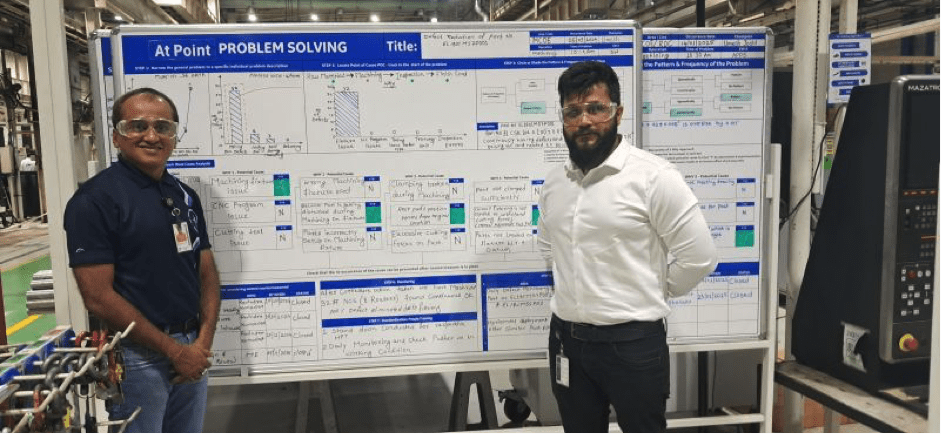
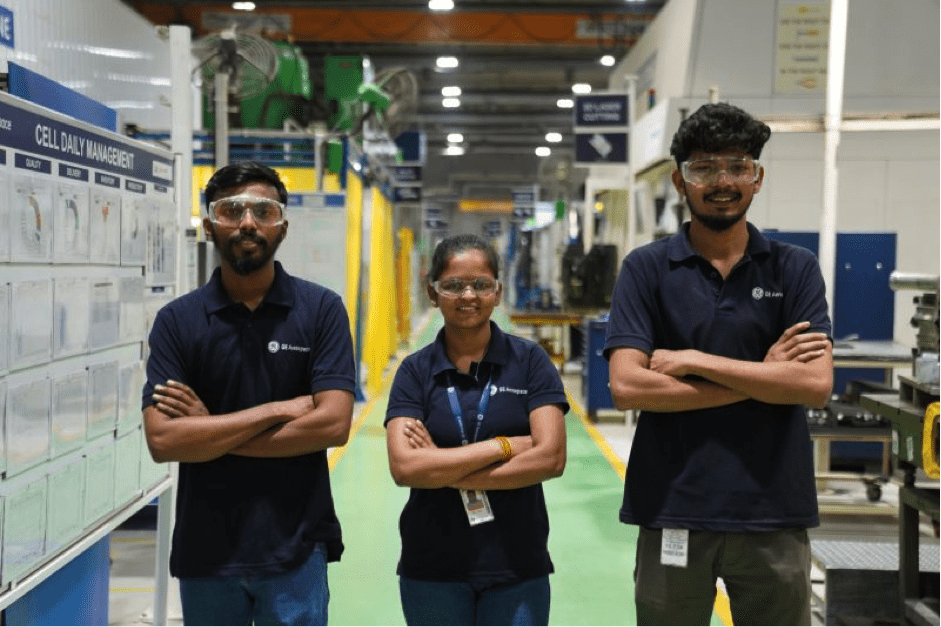
The improvement is one of many introduced at GE Aerospace through FLIGHT DECK, the company’s proprietary lean operating model. As described in the company’s 2024 annual report, “FLIGHT DECK is how we translate strategy into operational and financial outcomes, as well as strategic breakthroughs, while advancing our culture.”
At Pune, FLIGHT DECK has accelerated operational efficiency across the factory. Abhijit Khandekar, head of operations management, said that predictability and cadence are central to the model. “Predictable business is very important, operating cadence is very important, daily inputs and improvements are very important. FLIGHT DECK enables this.”
Safety First, Then SQDC
Safety is always the priority at GE Aerospace. The injury and illness rate is a key performance metric, and every employee is empowered to “stop work” the moment an issue is detected. When one person stops work, the entire line stops, allowing the team to identify root causes and apply countermeasures. This culture is deeply embedded across the Pune site.
Beyond safety, FLIGHT DECK strengthens quality, delivery, and cost performance. This focus is demonstrated on the model line created for the high-pressure turbine active clearance control (HPT-ACC) manifold. Since establishing the model line, the team has reduced lead times, cut downtime, raised productivity, and doubled output compared to early 2023.
The transformation began in spring 2023 through three kaizen events. Subject matter experts from other GE Aerospace sites provided fresh input. The first action was to streamline what FLIGHT DECK leader Shashidhar Pai describes as a “standard work chart” — a visual map of the movement of materials, parts, and work-in-progress. Once the bottlenecks were clear, the team designed a new layout that enabled single-piece flow.
Automation was then introduced selectively to support human operators. Enhancements included toggle clamping to allow one operator to do the work of two, reorganised fixtures in the weld booth to eliminate changeovers (a change that reduced changeover time by 20%), and a cap-bending machine that eliminated the five daily defects common under manual processing.
Junior engineer Komal Datir welcomed improvements to ergonomics. Her tooling workstation now adjusts to operator height. “Earlier, I had to lift it down to my level after someone else had used it. It’s heavy and it would strain my back,” she said. “Now I just need to press a button.”
Unlocking Factory-Wide Transformation
The HPT-ACC model line delivered gains in three stages: a 67% increase in daily output following layout improvements, a further 33% through design advances, and an additional 2.5% after the third kaizen huddle.
Its success is now being replicated across the factory, which also produces components for the GE90, GEnx, and GE9X engine programmes. FLIGHT DECK Specialist Pankaj Thakur said lead-time reductions have strengthened the site’s ability to meet demand. “Our lead-time targets have come down significantly, meaning we can respond better to demand. We are going to transform the entire factory.” Work continues on the fuel manifold and bracket production lines, with all remaining lines — including the tube line and press shop — planned for redesign by 2030.
FLIGHT DECK’s influence extends beyond the shop floor. Even the canteen, which serves more than 1,000 people daily, now measures its performance using SQDIP metrics: safety, quality, delivery, inventory, and productivity. “That’s the real thing,” Pai said with a laugh after lunch. “Even our caterer is measured by SQDIP. After all, he’s a vendor.”
The LEAP engine is a product of CFM International, a 50-50 joint company between GE Aerospace and Safran Aircraft Engines.
SOURCE AND IMAGES: GE AEROSPACE