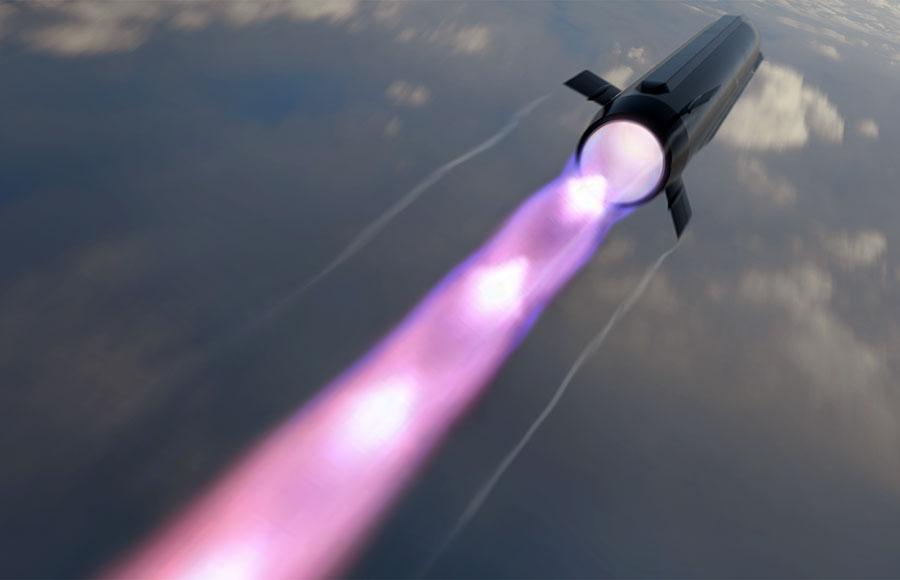
GE Aerospace and Lockheed Martin have completed a series of engine tests demonstrating the viability of a liquid-fuelled rotating detonation ramjet for hypersonic missile applications. The work marks the first initiative under a broader joint technology development arrangement between the two companies.
Conducted at the GE Aerospace Research Center in Niskayuna, New York, the tests confirmed the operation of an air-breathing rotating detonation ramjet across ignition and cruise conditions. The propulsion concept is intended to enable missiles to fly faster and farther, including at hypersonic speeds, while reducing costs compared with existing ramjet alternatives.
The rotating detonation ramjet differs from conventional ramjet engines by combusting fuel and air through detonation waves rather than traditional combustion. This approach delivers high thrust for super- and hypersonic flight while allowing for a more compact engine design. According to the companies, the reduced size and weight increase available space for fuel or payload, extend range through improved fuel efficiency and thrust generation, and enable ignition at lower speeds, allowing the use of smaller boosters.
From a strategic perspective, GE Aerospace said the programme represents continued progress in advancing its hypersonic capabilities. Mark Rettig, vice president and general manager of Edison Works Advanced Programs at GE Aerospace, said testing of both the rotating detonation ramjet and inlet exceeded expectations, describing the collaboration with Lockheed Martin as an important step in maturing advanced air-breathing hypersonic propulsion technologies.
Lockheed Martin highlighted the role of collaboration and sustained internal investment in achieving the demonstration. Randy Crites, vice president and general manager at Lockheed Martin Advanced Programs, said the compact ramjet leverages the company’s expertise in ramjet inlets and offers extended range at extreme speeds. He added that the programme is focused on delivering affordable propulsion capability suited to demanding operational environments.
Technically, the demonstrator combines GE Aerospace’s rotating detonation combustion system with Lockheed Martin’s tactical inlet, designed to manage high-speed airflow into the combustor. During testing, engineers injected air to replicate supersonic flight conditions across a range of speeds and altitudes, including high-altitude cruise scenarios where reduced air density presents significant combustion challenges.
GE Aerospace and Lockheed Martin confirmed that ramjet maturation activities will continue throughout 2026 as the partners advance the propulsion system towards future missile applications.
SOURCE AND IMAGE: LOCKHEED MARTIN
CAPTION: Lockheed Martin And GE Aerospace Have Demonstrated A Liquid-Fueled Rotating Detonation Ramjet Engine To Enable Missiles To Fly Faster And Farther, While Costing A Lot Less To Build Compared To Other Ramjet Options.