
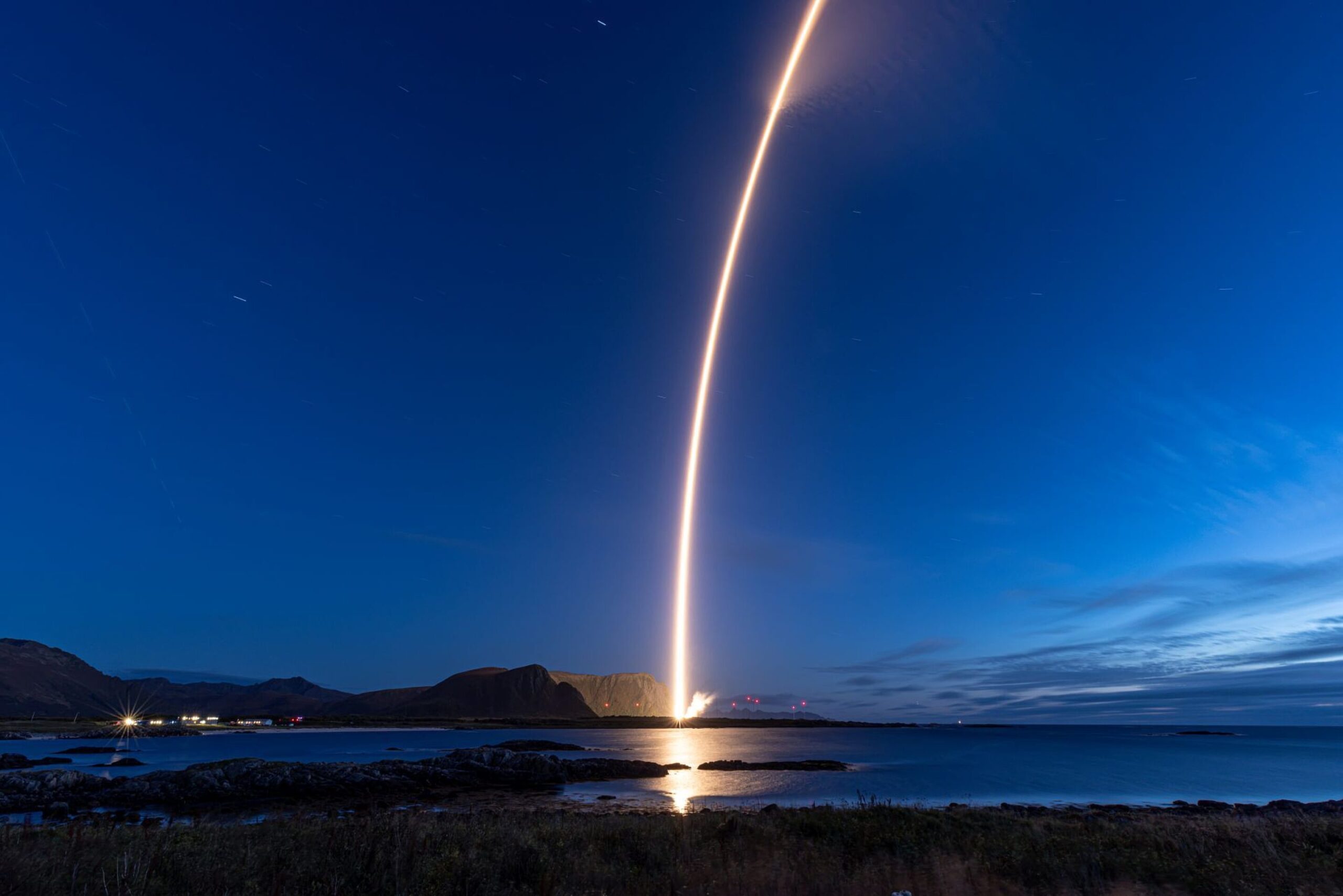
German launch company Isar Aerospace delivered satellites to orbit from its Andøya launch site in Norway on 5 September, becoming the first commercial space company from Europe to do so and giving the continent what its chief executive called sovereign access to space.
SECOND FLIGHT REACHES ORBIT FROM CONTINENTAL EUROPE
Isar Aerospace became the first commercial space company from Europe to successfully deliver satellites into orbit on 5 September 2026, on only the second flight of its Spectrum launch vehicle. The mission, named “Onward and Upward,” lifted off from Isar Aerospace’s dedicated launch complex at Andøya Space in Norway at 10:12pm CEST. “Today, Isar Aerospace opened space from Continental Europe. Launch continues to be the largest bottleneck for the global space industry and from today on, there is a true alternative for commercial and institutional customers,” said Daniel Metzler, chief executive and co-founder of Isar Aerospace.
The achievement addresses a gap that has widened over the past several years: Ariane 5’s retirement in 2023, repeated delays to its Ariane 6 successor, the grounding of the Vega C after a 2022 launch failure, and the loss of access to Russian Soyuz launches from French Guiana following Russia’s invasion of Ukraine had together left Europe, for the first time in decades, without reliable independent access to space. Isar’s approach differs from the continent’s existing heavy-lift vehicles: Spectrum is a small-to-medium microlauncher designed for speed and flexibility of production rather than large payload capacity, and Andøya gives Europe an orbital launch site on its own mainland for the first time.
Metzler struck a similar note in a fuller statement issued with the mission results: “We achieved within a few years what had taken the European space industry decades before. Europe now has sovereign access to space. We have entered into a new chapter for European spaceflight. I am incredibly proud of our team, that has made this success story from Europe possible. We will now focus on rapidly scaling launch vehicle production, deliver on our order pipeline, and meet surging global demand.”
THE FLIGHT PROFILE
Isar Aerospace said the vehicle successfully transited maximum dynamic pressure, known as MaxQ, completed main engine cutoff and stage separation, and ignited its second stage as planned. It crossed the Kármán line, the 100-kilometre altitude internationally recognised as the boundary of space, before jettisoning its payload fairing ahead of reaching orbital velocity, then completed a circularisation burn and separated its payloads successfully. The company said it was still working with customers to confirm the satellites’ status. The payloads were selected through the Microlauncher Competition run by the German Space Agency at DLR, which gives educational institutions and start-ups low-cost access to space and is funded through ESA’s Boost! programme.
SCALING UP PRODUCTION
Isar Aerospace is building a second launch complex, in Nova Scotia, Canada, to cover the mid- to high-inclination orbits used for Earth observation and communications, in addition to its Andøya site. The company is also nearing completion of what it describes as Europe’s largest integrated production facility for launch vehicles, a 40,000-square-metre site where it says it will eventually have the capacity to manufacture up to 40 Spectrum vehicles a year; vehicles three to seven are already in production.
Founded in 2018 and headquartered near Munich, Isar Aerospace has grown to more than 400 employees across five international locations, developing, manufacturing and testing its launch vehicles almost entirely in-house with private funding from international investors.
Note: The figure of up to 40 vehicles a year is Isar Aerospace’s own capacity target for the new facility rather than a confirmed production rate, and should be read as the company’s stated ambition.
Source and Images: Isar Aerospace