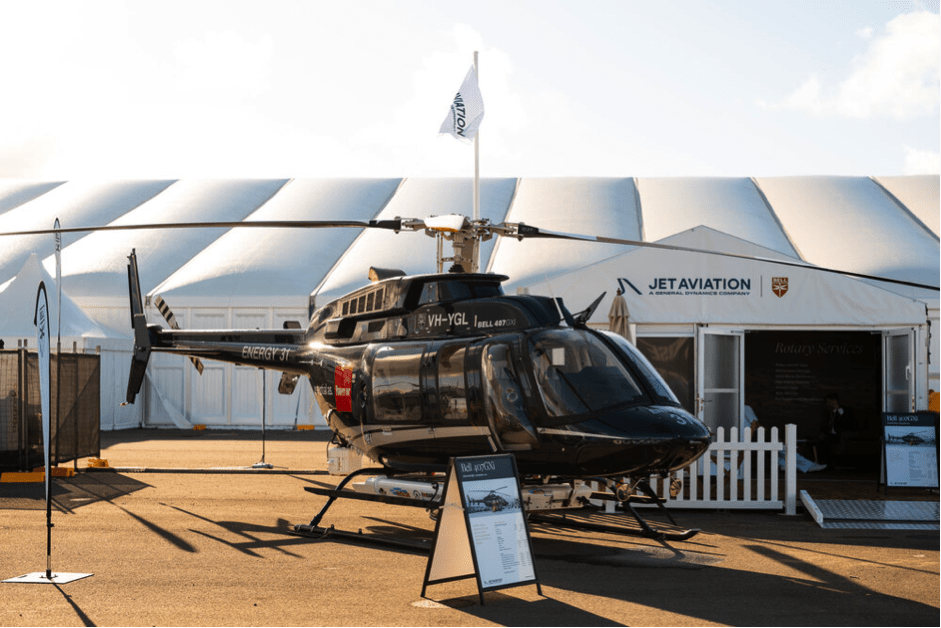
Victoria, Australia – November 2025 — As summer unfolds across Victoria, the sound of rotor blades cutting through the air signals more than just a seasonal shift. For Powercor, one of Australia’s leading power distribution companies, it marks the start of a crucial mission — inspecting and maintaining over 77,000 kilometres of overhead powerlines and surrounding vegetation to keep homes, businesses, and communities safe.
In a country where bushfires are a natural yet devastating force, this work is vital. Between 2016 and 2021, nearly 47 million hectares — around 35% of Australia’s total forest area — were burnt, according to the Department of Agriculture, Fisheries and Forestry. For Powercor, the challenge is clear: to find better, faster, and more accurate ways to identify and mitigate vegetation-related fire risks before disaster strikes.
Traditionally, inspections were carried out from the ground — crews using binoculars, cameras, and endurance to cover thousands of kilometres over rugged terrain. But delays, data gaps, and the sheer scale of 750,000 spans to inspect each year demanded a smarter solution.
That solution took flight.
Powercor has become Australia’s first network provider to implement a fully aerial, LiDAR-based inspection model. Led by Chief Pilot and Head of Operations Ian Wallace, and Head of Vegetation Management Ayce Cordy, the company’s helicopter fleet — a Bell 407GXi and two Bell 505s — has transformed how inspections are conducted.
Equipped with RIEGL cameras carrying built-in LiDAR sensors, the aircraft generate real-time 3D scans as they fly between 500 and 1,200 feet above the ground. These high-resolution images provide centimetre-accurate data showing exactly where vegetation encroaches on powerlines, how fast it’s growing, and where trimming is most urgently needed.
“The results were immediate,” said Wallace. “We were able to complete in eight months with helicopters what used to take 12 months on the ground. That time efficiency gives us a critical head start in planning and clearing vegetation because the annual task of managing the 13 to 15 million trees along our network is enormous.”
At the heart of this success is the Bell 407GXi — a high-performance, single-engine aircraft powered by a Rolls-Royce Model 250-C47E/4 turboshaft engine. Its four-bladed rotor system delivers smooth, stable flight even in the challenging and changeable conditions typical of Victoria. “You would think turbulence is a big concern for us,” Wallace noted, “but it rarely is, and I put that largely down to the 407GXi’s four-bladed rotor head, which gives us peace of mind.”
Complemented by two agile Bell 505s, Powercor’s aerial fleet allows teams to navigate the state’s complex terrain efficiently — from mountains to coastal plains — covering every inch of the power distribution network.
As climate pressures intensify, this aerial inspection program represents more than technological progress. It is a proactive defence, designed to protect lives, land, and infrastructure from one of nature’s most persistent threats.
“Keeping Victorians and Victoria safe and powered is at the heart of what we do,” Cordy affirmed. “The bushfire fight in Australia never stops – and neither will we.”
SOURCE AND IMAGE: POWERCOR