
NASA astronaut Chris Williams and Roscosmos cosmonauts Sergey Kud-Sverchkov and Sergei Mikaev have landed safely in Kazakhstan aboard Soyuz MS-28, concluding a 241-day mission that covered 3,856 orbits and more than 102 million miles — and produced research spanning cancer drug delivery, in-space semiconductor manufacturing and two spacewalks including the Canadarm2 robotic arm repair.
PARACHUTE-ASSISTED LANDING ON THE KAZAKH STEPPE ENDS EIGHT-MONTH MISSION
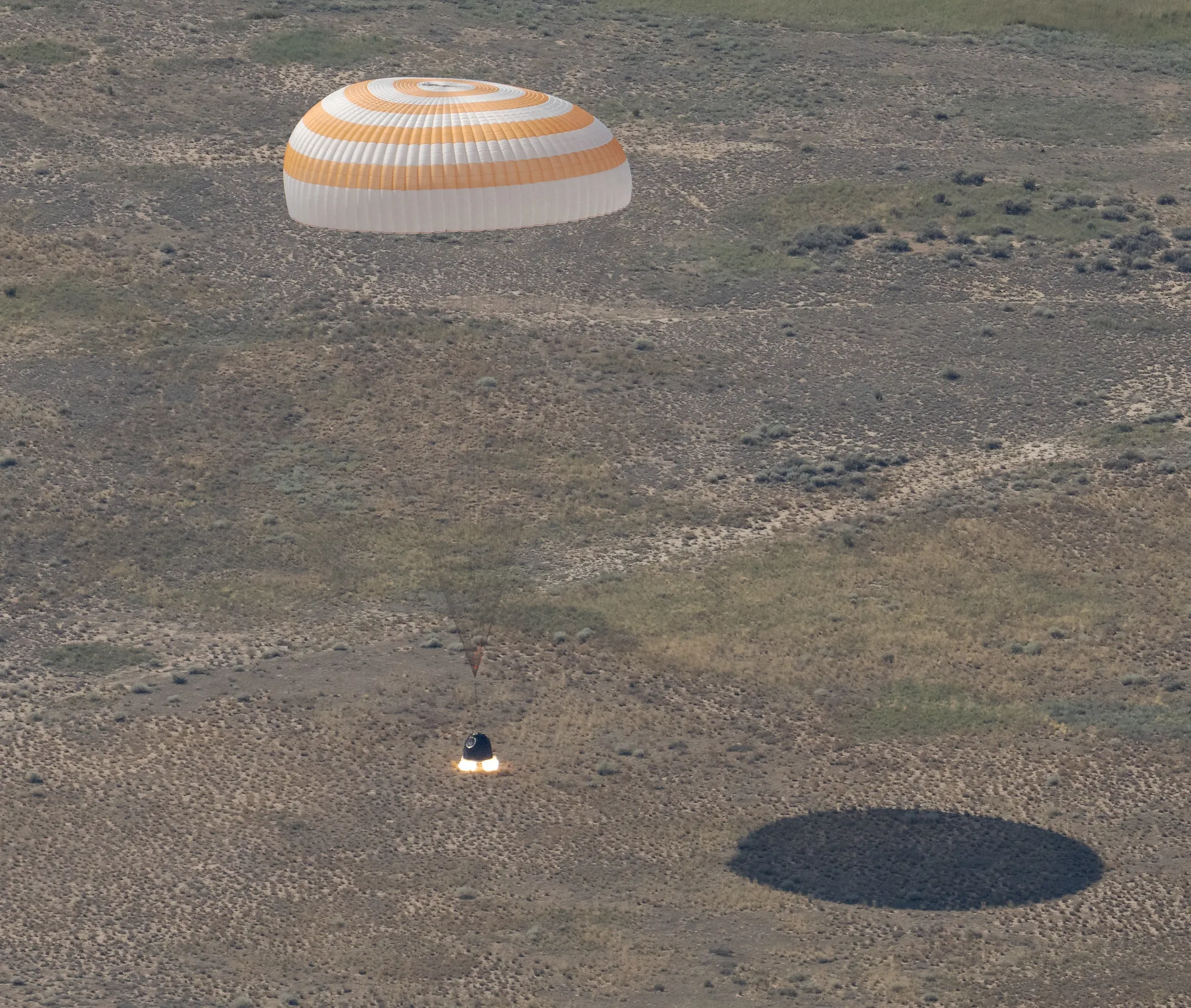
NASA astronaut Chris Williams returned to Earth on Sunday 26 July 2026 alongside Roscosmos cosmonauts Sergey Kud-Sverchkov and Sergei Mikaev, concluding an eight-month science mission aboard the International Space Station. The crew made a parachute-assisted landing at 5:27am CDT (3:27pm Kazakhstan time) southeast of Dzhezkazgan, having departed the space station at 2:03am aboard the Soyuz MS-28 spacecraft. The crew spent 241 days in space, orbiting Earth 3,856 times and travelling more than 102 million miles since launching on 27 November 2025. The mission was the first spaceflight for both Williams and Mikaev, and the second for Kud-Sverchkov.
Following post-landing medical checks, the crew flew by helicopter to Karaganda in central Kazakhstan where recovery teams are based. Williams then boarded a NASA aircraft bound for the agency’s Johnson Space Center in Houston. Before the crew’s departure from the station, NASA astronaut Jessica Meir assumed command of the orbital complex on Saturday 25 July, and a fresh crew comprising NASA astronaut Anil Menon and Roscosmos cosmonauts Pyotr Dubrov and Anna Kikina arrived earlier in July aboard Soyuz MS-29.
CANCER THERAPEUTICS: DNA-INSPIRED CONSTRUCTS AND ENGINEERED FRUIT FLIES
The most prominent thread of Williams’s research programme concerned advancing new cancer treatments — an area to which the microgravity environment offers specific advantages that cannot be replicated on Earth. Williams worked on Space Cancer Therapeutics, an investigation delivered aboard a SpaceX Dragon cargo mission in May 2026, setting up the research hardware inside one of the Kibo laboratory module’s research racks to observe microgravity’s effect on an anti-cancer drug and its molecular mechanisms. He also worked with ESA astronaut Sophie Adenot to process DNA-inspired materials with potential applications in new cancer treatments — nanoscale constructs whose self-assembly behaviour in the absence of gravity-driven sedimentation differs measurably from their behaviour in terrestrial laboratories.
A separate strand of the cancer research involved treating samples of fruit flies genetically engineered to carry the genetic profile of pancreatic cancer, conducted inside the Kibo module’s Saibo research rack. Fruit flies are widely used in cancer genetics because their relatively simple genome shares substantial functional overlap with human disease pathways, allowing researchers to observe tumour development across multiple generations within timescales compatible with a station increment. The value of conducting these studies in orbit lies in the accelerated changes that microgravity induces in cellular behaviour, which can reveal mechanisms that develop too slowly to observe on Earth.
SEMICONDUCTOR CRYSTALS: LAYING GROUNDWORK FOR IN-SPACE MANUFACTURING
Williams’s second major research area concerned the in-space production of materials used in high-performance computers and electronics. He conducted research growing semiconductor crystals in microgravity through the SUBSA-InSPA-SSCug investigation — In-Space Production of Semimetal-Semiconductor Composite Bulk Crystals in Microgravity. The scientific basis is that in the absence of gravity-driven convection and sedimentation, researchers can grow a greater number of crystals at the desired size than terrestrial processes permit, and previous research indicates that space-grown crystals can deliver increased performance in applications including high-performance computing, artificial intelligence hardware and medical devices.
The commercial significance of this work extends beyond the scientific result. NASA describes the research as laying groundwork for commercial semiconductor manufacturing in space — an application category that has attracted growing private-sector interest as the performance ceiling of terrestrially manufactured semiconductors becomes an increasingly binding constraint on computing advancement. Williams also worked on research examining the molecular and chemical interactions between beneficial microbes and their animal hosts, work directed at preserving astronaut health during long-duration missions beyond low Earth orbit.
TWO SPACEWALKS: SOLAR ARRAY PREPARATION AND THE CANADARM2 REPAIR
Williams completed two spacewalks during his increment, both alongside Jessica Meir. The first, on 18 March 2026, lasted 7 hours and 2 minutes and involved installing a solar array modification kit in preparation for station power system upgrades. The second, on 30 June 2026, lasted 7 hours and 20 minutes and was dedicated to replacing a failed joint on the Canadarm2 robotic arm following a fault identified during routine operations on 27 May 2026 — an operation World Airnews Daily covered at the time. Canadarm2 played a central role in assembling the International Space Station more than 25 years ago and continues to perform essential maintenance, cargo handling and visiting-vehicle capture operations a decade beyond its original design life.
For more than 25 years, people have lived and worked continuously aboard the International Space Station, advancing scientific knowledge and enabling research breakthroughs not possible on Earth. The station is currently scheduled for controlled deorbit at the end of 2030, giving the research programmes conducted aboard it a finite remaining window — a consideration that gives increasing urgency to investigations such as the semiconductor and cancer therapeutics work, which are explicitly intended to establish the scientific and commercial foundations for continuation in successor orbital platforms.
Source and Images: NASA