
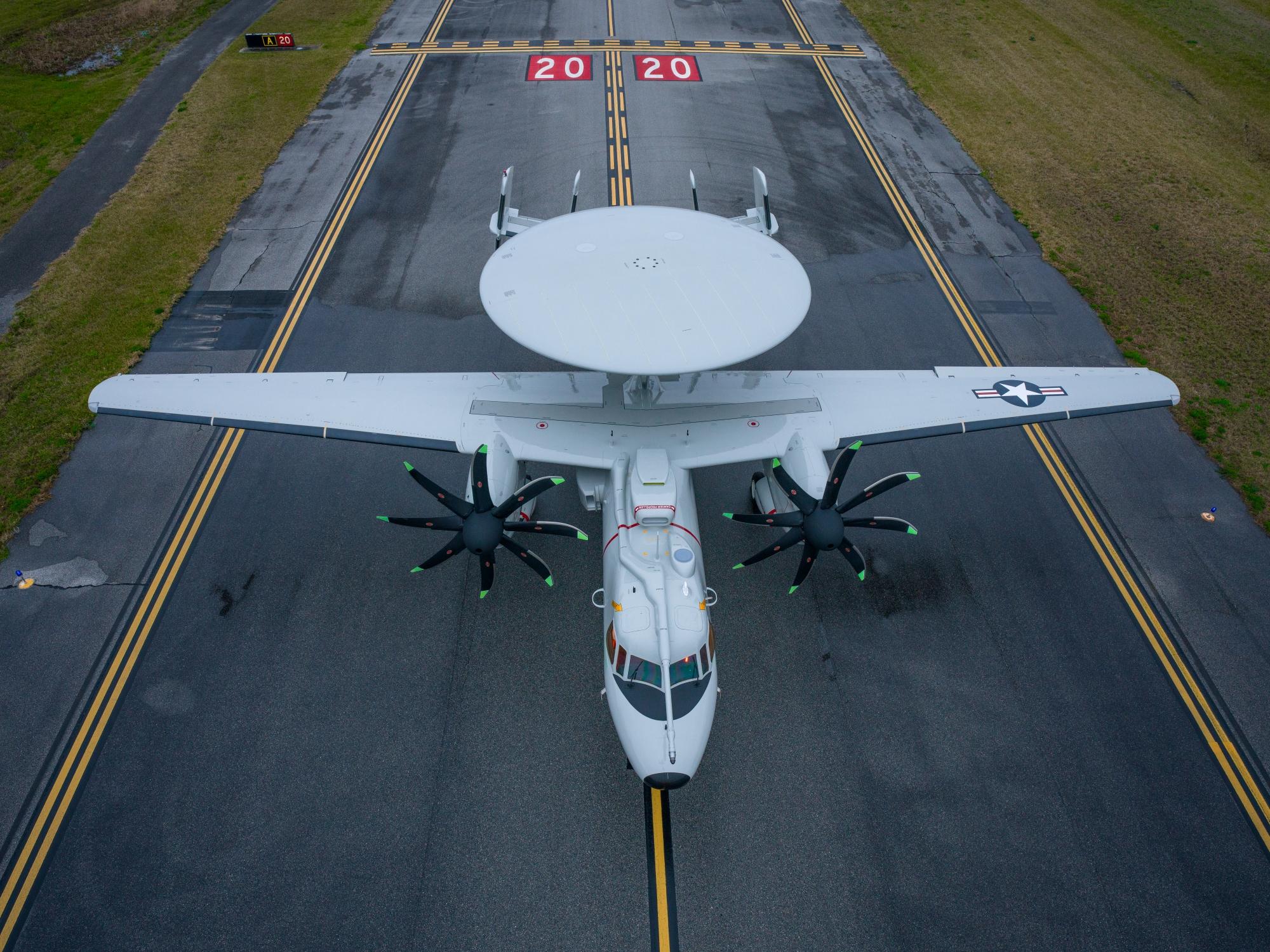
Identified as one of the U.S. Navy’s top five acquisition programmes, Northrop Grumman’s E-2D Advanced Hawkeye is setting new standards in airborne command and control through continuous modernisation. Built on a legacy platform that has served for over 60 years, the E-2D delivers a 360-degree surveillance picture across land and sea, and its evolution reflects the growing complexity of global threats and mission demands.
Operational Reach and Global Deployment
The E-2D is currently active in eight of the nine deployable U.S. Navy squadrons, moving straight from the production line to fleet deployment. These aircraft are fully operational across the U.S. and Japan. The legacy E-2C is operated by France, Egypt, and Taiwan, with France preparing to transition to the E-2D by 2027, the same year the U.S. Navy will phase out its final E-2C squadron.
Open Architecture for the Future
The E-2D’s open systems architecture supports scalable, modular technology upgrades. The upcoming Block II variant will enhance connectivity and enable seamless integration of future technologies like artificial intelligence (AI) and machine learning (ML).
Digital Development and AI Integration
Modernisation is being driven by a shift to model-based systems engineering, allowing the aircraft to evolve in digitally engineered environments. Mission computers and displays are being restructured to accommodate open mission systems architecture, ensuring rapid integration of AI/ML-driven capabilities.
Radar and Situational Awareness
A key feature of the E-2D is the AN/APY-9 radar, offering wide-area surveillance under all weather conditions. With real-time air and surface tracking, the radar delivers a precise common operating picture vital for battle management and control.
Ongoing Upgrades and Future Relevance
Over the past decade, the platform has undergone five major upgrades, including aerial refuelling capability, improved satellite communications, and counter-electronic attack systems. The Block II upgrade will improve cybersecurity, reliability, pilot workload, and human-machine interface systems, ensuring mission relevance well into the future.
Fast-Tracked Innovation
Northrop Grumman demonstrated remarkable agility by fielding a significant upgrade within two and a half years, delivered to the Navy in December 2023. This included improved command and control, enhanced sensor integration, and beyond-line-of-sight communications.
Versatile Mission Capability
The E-2D is no longer confined to carrier-based operations. It now supports a wide array of missions, including missile defence, electronic warfare, combat search and rescue, border security, and counter-narcotics operations.
Advanced Sustainment and Predictive Maintenance
Through predictive maintenance technologies, Northrop Grumman enhances fleet readiness and reduces operational costs. Remote diagnostics and analytics provide proactive insights into system health, keeping E-2Ds mission-ready at all times.
With nearly 100,000 employees and over 30 million square feet of manufacturing space, Northrop Grumman’s capacity to deliver at scale ensures it remains a cornerstone of U.S. and allied airborne defence strategies.
SOURCE AND IMAGE: NORTHROP GRUMMAN