
Phelan Green outlines its strategy to supply electro-sustainable aviation fuel from South Africa into European markets, aligned with upcoming EU and UK blending mandates.
By Robin Rabec
As regulatory pressure accelerates across Europe, Paschal Phelan, CEO of Phelan Green Group, outlines a long-term, privately funded strategy to produce electro-sustainable aviation fuel (eSAF) at scale from South Africa—positioning the business to supply mandated markets from 2028.
REGULATION DEFINING THE MARKET
European and UK policy frameworks are now shaping the commercial reality of aviation fuel. Mandates requiring minimum sustainable fuel blends, backed by significant financial penalties for non-compliance, are already legislated and tightening toward 2030 and beyond.
Phelan is direct on the implications: the shift is no longer theoretical. Airlines operating into the European Union and the United Kingdom will be required to meet blending targets or face escalating penalties measured in thousands of euros per tonne.
While conventional sustainable aviation fuels (SAF), derived from biological feedstocks, remain part of the mix, policy direction is increasingly favouring electro-sustainable aviation fuel—produced from water, carbon capture, and renewable energy.
ESA F: CHEMICALLY IDENTICAL, ECONOMICALLY DIFFERENT
A key operational advantage of eSAF lies in its compatibility. The fuel is chemically identical to conventional Jet A-1, enabling direct “drop-in” use within existing aircraft and infrastructure without modification.
However, cost remains a constraint. Current projections place eSAF at multiple times the cost of conventional jet fuel. In the near term, this impact is mitigated through low initial blending ratios—beginning at approximately 2% and scaling upward on a defined regulatory trajectory.
For operators, this translates into a gradual cost increase rather than an immediate structural shift, but one that is locked into long-term compliance frameworks.
EXPORT-LED STRATEGY FROM SOUTH AFRICA
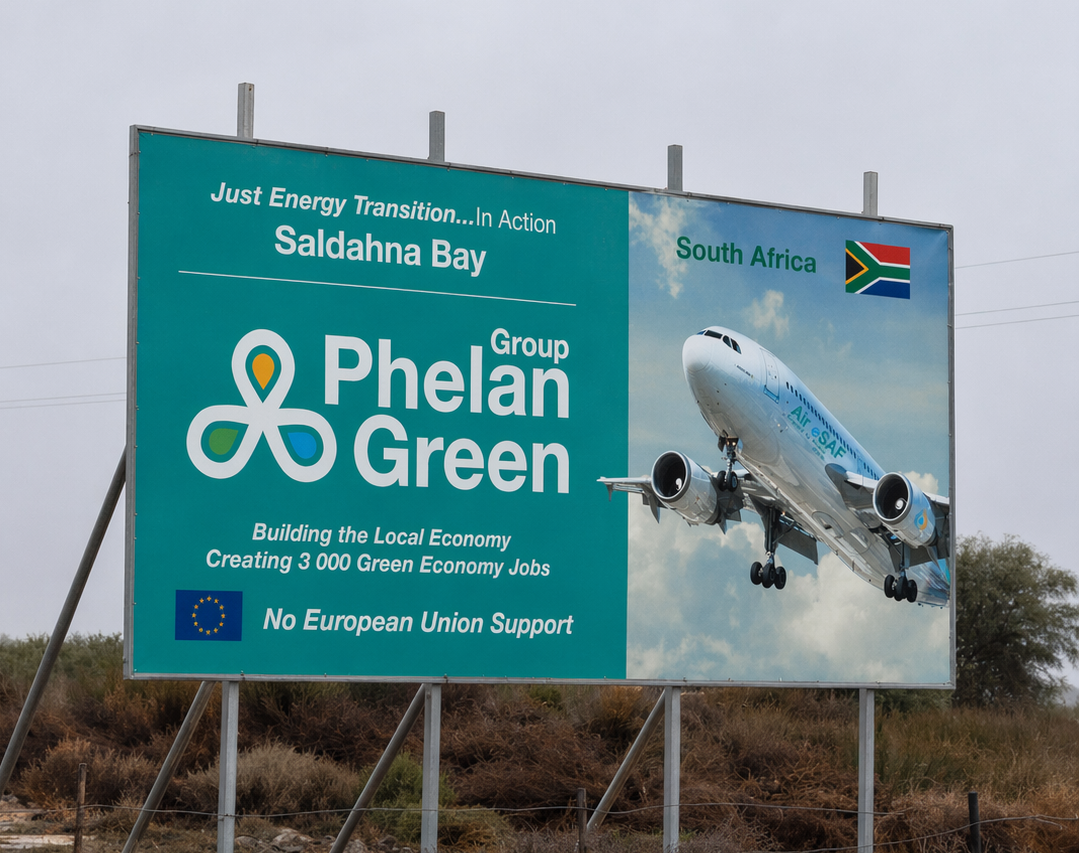
Phelan Green’s production model is export-focused. Its planned facility at Saldanha Bay is positioned to supply European markets directly, aligning with mandated demand rather than domestic consumption.
South Africa’s role, as described by Phelan, is not yet that of a primary user, but rather a potential large-scale producer. Local airlines operating into European airspace will still be required to comply with blending mandates at destination, irrespective of where fuel is uplifted.
This dynamic reinforces the commercial logic of exporting fuel into regulated markets where demand is guaranteed by legislation.
INFRASTRUCTURE WITHOUT SUBSIDY
Unlike many European projects supported by public funding, Phelan Green is proceeding without external grants or state backing. The company’s position reflects a broader tension between policy ambition and capital allocation.
Despite repeated commitments from European institutions to support global decarbonisation efforts, Phelan notes that funding has not materialised at project level in South Africa.
The result is a privately financed development model, backed by long-term family investment and a strategic view extending decades rather than funding cycles.
TECHNOLOGY PARTNERSHIP AND INDUSTRIAL SCALE
To deliver at scale, Phelan Green has partnered with Honeywell, leveraging established refining and process technologies. The integration of proven industrial systems reduces technical risk in what is otherwise a capital-intensive and complex value chain.
Securing this partnership required demonstrating financial credibility and execution capability early—an essential step in gaining the confidence of global engineering providers.
A LONG-TERM ENERGY TRANSITION PLAY
Phelan frames the project not as a speculative venture, but as a response to an inevitable shift in global energy systems. Fossil fuels, particularly coal, are expected to decline structurally as decarbonisation targets tighten toward mid-century.
Within that context, aviation fuel—alongside shipping and heavy industry—represents a critical segment where electrification alone is insufficient, reinforcing the strategic importance of synthetic fuels.
EARLY-MOVER POSITIONING
The company aims to begin supplying eSAF into the UK market by the third quarter of 2028, aligning with the first phase of enforceable mandates. Timing is central to the strategy.
Early production not only enables compliance supply but also establishes cost and market positioning ahead of competitors entering the sector later. Phelan emphasises that early participation carries long-term commercial and reputational value that cannot be replicated retrospectively.
INDUSTRY IMPLICATIONS
For airlines, the message is pragmatic: compliance will come at a cost, but also presents an opportunity to secure supply partnerships early in the transition cycle.
For South Africa, the opportunity lies in production rather than consumption—leveraging land availability and renewable energy potential to participate in a global supply chain driven by external regulatory demand.