
A week-long kaizen at GE Aerospace’s Lynn Component Manufacturing site in Massachusetts has taken preventive maintenance compliance on a critical 2,400-degree heat-treat oven from around 15 per cent to 100 per cent, and lifted the number of reliably operating ovens from four to six – with the operators who run them credited as the source of the improvement.
TEN OVENS, AND ONLY FOUR OF THEM DEPENDABLE
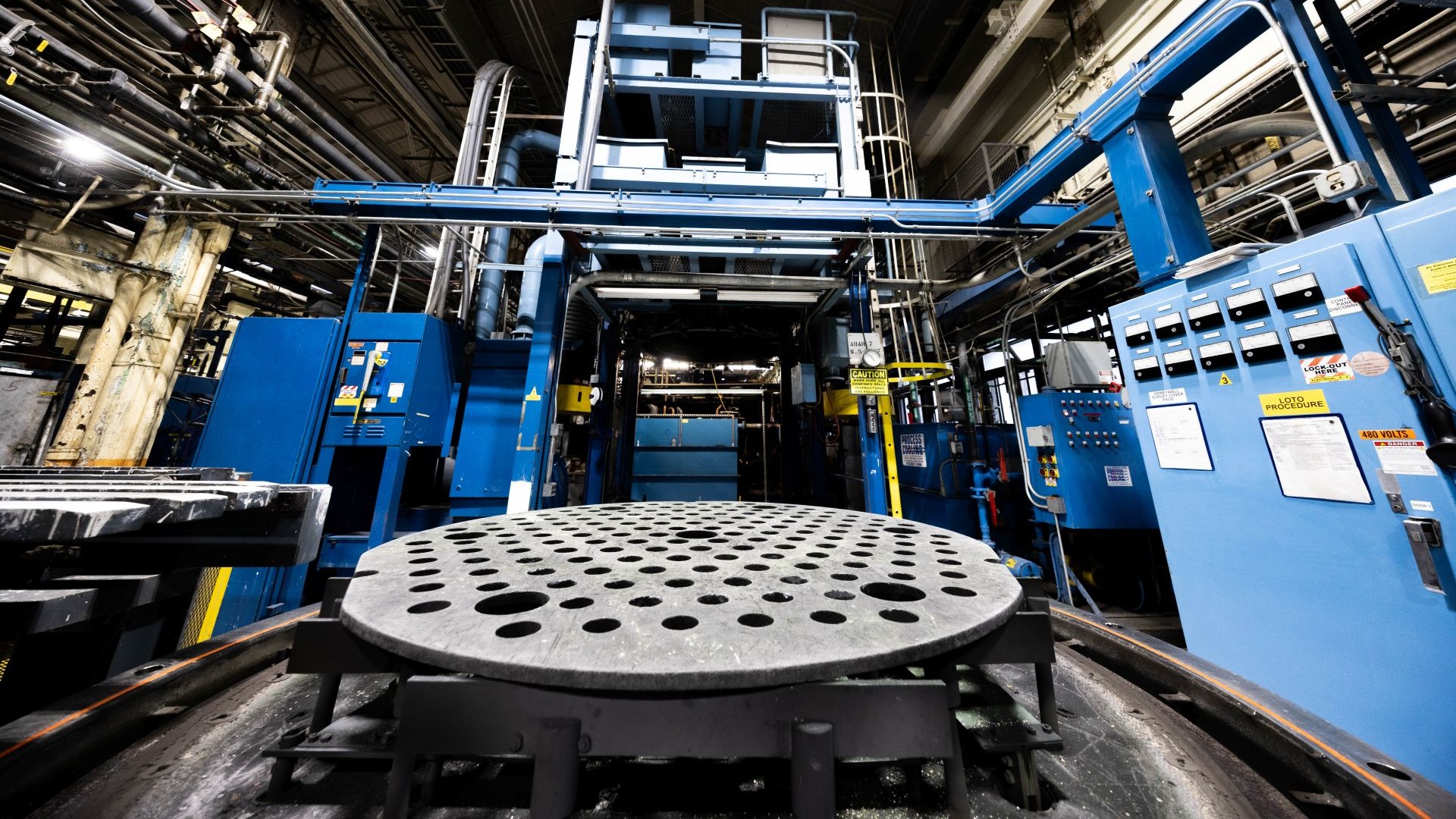
At GE Aerospace’s Lynn Component Manufacturing campus in Massachusetts, a steel-alloy inverted half dome descends from the ceiling in Plant 2 – one of ten ovens that heat-treat parts made at the site. The oven generates vacuum heat of up to 2,400 degrees Fahrenheit to braze or alter the properties of metal parts so they can withstand conditions inside a jet engine, and has been a key process step for decades. Every part at Lynn that requires heat treatment passes through this stage, and its operators had long managed idiosyncrasies that periodically caused unplanned downtime, putting on-time delivery of components for defence engines at risk.
The scale of the constraint was substantial. Before the improvement work began, only four of the ten ovens were considered reliable – a significant limit on the site’s production capacity given that everything requiring heat treatment must pass through them. Following a total productive management kaizen in May focused on preventive maintenance, the team has achieved stable, repeatable performance on six ovens and is aiming for eight by the end of 2026, which would be the highest number of consistently operational ovens in several years. Preventive maintenance compliance on the Plant 2 oven rose from approximately 15 per cent to 100 per cent.
WHAT THE KAIZEN ACTUALLY PRODUCED
A dozen people attended the week-long event in early 2026, working within total productive management, an approach aligned with FLIGHT DECK, GE Aerospace’s proprietary lean operating model, focused on improving equipment and process effectiveness through proactive ownership, loss elimination and continuous improvement. The Plant 2 oven was selected as a model cell because of the volume passing through it, with the intention of developing a standard process that could then be scaled across the site.
Adam Baran, site leader of LCM Plant 2, described the output: a checklist for every morning, standard work for checks, cleaning and maintenance, a standard parts list allowing immediate replacement to keep operations moving, and a swim lane process map for corrective and preventive maintenance transactions that produced standardised daily, weekly, monthly and quarterly maintenance processes. Cam Forgitano, a cell leader in Plant 2, said that because any part at Lynn needing heat treatment goes through the ovens, a great many people and businesses rely on them, and a preventive maintenance programme was needed to stay ahead of issues. He added that the kaizen brought to light how important it is to connect maintenance to the operators on the floor.
SIXTY-FOUR YEARS OF KNOWLEDGE, FORMALLY CAPTURED
Two operators, Todd Langlais and Joe Dithomas, have around 64 years at the Lynn site between them. Dithomas describes the ovens as having different personalities, each requiring familiarity – a characterisation that captures the underlying problem the exercise was addressing. Knowledge held individually by long-serving operators keeps equipment running while those operators are present, and disappears when they are not. Much of the kaizen involved documenting the heat treatment parameters, known in the cell as recipes, which a metallurgist designs across processes that can run up to 21 hours. Parts treated in the ovens span military and commercial engines including the F404, F414, F110, T700, T408 and CF6.
Plant Leader John Russell said of the two operators that they know the process better than management ever will, and that they know the questions to ask and the improvements that can be made. Langlais said there was a great deal of integrity in sitting down with management and influencing what happens, and that during preparatory work the FLIGHT DECK team came down weekly to ask how it was going and whether there was a better way. Dithomas said that knowing everybody was on board made a considerable difference. The target for 2026 is to repeat the approach dozens of times as total productive management is rolled out more broadly across the site.
Source and Images: GE Aerospace