
NASA’s Nancy Grace Roman Space Telescope lifted off from Kennedy Space Center on Sunday morning, beginning a three-month transit to the second Sun-Earth Lagrange point. It will return 1.4 terabytes of data a day, the highest rate of any NASA astrophysics mission to date, with first images expected in early 2027.
DELIVERED EARLY, LAUNCHED EARLY
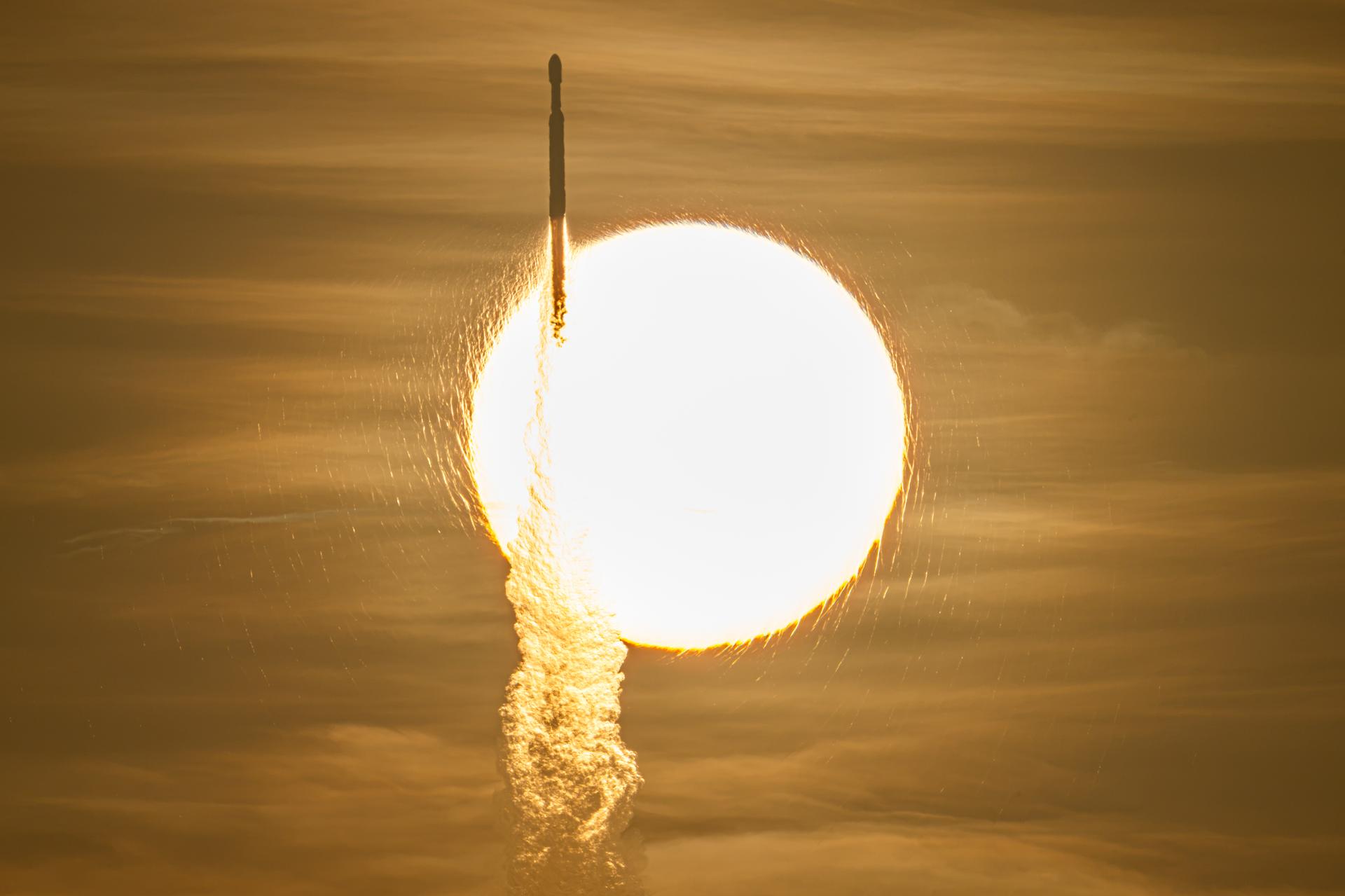
NASA’s Nancy Grace Roman Space Telescope launched at 7:26am Eastern Daylight Time on Sunday aboard a SpaceX Falcon Heavy from Launch Complex 39A at Kennedy Space Center in Florida. The observatory is now on a three-month journey of approximately one million miles to the second Sun-Earth Lagrange point, known as L2, where it will conduct surveys of dark matter, dark energy and exoplanets.
Ground controllers at NASA’s Goddard Space Flight Center in Greenbelt, Maryland began receiving telemetry seven minutes after launch. The Falcon Heavy performed as expected, separating from the observatory 31 minutes into flight, with the rocket’s boosters returning safely to the launch site for refurbishment after separating from the centre core. Solar panels and the lower instrument sun shade deployed successfully one hour and 23 minutes after launch.
NASA Administrator Jared Isaacman described the mission as delivered ahead of schedule and on budget, reflecting more than a decade of work by the NASA workforce and industry partners, and said Roman would give a new atlas of the universe and demonstrate what is possible when bold ambition is paired with disciplined execution. The launch date was itself brought forward: NASA’s Launch Services Program worked with SpaceX earlier this year to accelerate the schedule to accommodate the telescope’s early completion. Roman is the fourth primary NASA mission launched on a Falcon Heavy.
THREE GROUND STATIONS, ONE CONTINUOUS LINK
The communications arrangement during transit is a good illustration of how deep space operations actually work. During launch and early orbit, Roman used the Near Space Network’s ground stations and relay satellites for tracking, telemetry and command. About 70 minutes after launch the Deep Space Network took over, connecting first through the Canberra Deep Space Communication Complex in Australia. Approximately six hours later the link transfers to the Madrid complex in Spain, and then to Goldstone in California.
The sequence exists because the Earth rotates. A spacecraft a million miles out is visible from any given ground station for only part of each day, so continuous contact requires three complexes spaced roughly 120 degrees apart in longitude, with the link handed between them as the planet turns. It is an unglamorous piece of infrastructure and an absolute precondition for the mission.
A SURVEY INSTRUMENT RATHER THAN A POINTING TELESCOPE
Roman’s primary instrument, the Wide Field Instrument, will activate a few weeks into the voyage. It is a 300-megapixel infrared camera built around 18 four-kilobyte detectors, each roughly the size of a saltine cracker. NASA states the telescope is designed to survey the universe a thousand times faster than the Hubble Space Telescope, an advantage that comes from the combination of a large field of view with a rigid design and stable optical performance allowing it to move rapidly between observations without lengthy settling time.
That distinction is worth drawing out, because it describes a different kind of instrument rather than simply a better one. Hubble is a pointing telescope, exceptional at examining a chosen target in depth. Roman is a survey instrument, built to cover large areas of sky quickly. The science it enables is statistical: dark matter and dark energy are studied through their effects across enormous numbers of galaxies, which requires breadth rather than depth. The two approaches are complementary, and Roman’s surveys are expected to support research well beyond the mission’s stated goals.
The data volume follows from the survey approach. Roman will return 1.4 terabytes every day, the highest data rate of any NASA astrophysics mission so far. Machine learning, artificial intelligence and citizen scientists will help sift that volume and flag significant findings for astronomers to examine, which is an acknowledgement that no research team could review it manually.
THE CORONAGRAPH, AND WHAT IT IS REHEARSING FOR
Within the coming days Roman’s high-gain antenna and its visor-like deployable aperture cover will deploy, ground controllers will initiate the first of two mid-course corrections, and the Coronagraph Instrument will power on. A coronagraph blocks the light of a star so that far fainter objects near it become visible, which is the central difficulty in directly imaging planets around other stars. Roman’s instrument is intended to photograph Jupiter-like planets, and NASA describes it as demonstrating technology that future missions such as the Habitable Worlds Observatory concept could use to image Earth-like planets in the search for life.
Nicky Fox, associate administrator for the Science Mission Directorate, described Roman as a discovery machine that will bring us closer to answering questions about cosmic history, and said its field of view and survey speed would make the invisible visible and set the foundation for the search for life beyond the solar system. Julie McEnery, Roman’s senior project scientist at Goddard, said there was no telling what more would be known by this time next year.
Commissioning will run for three months, with calibrations and instrument tests, and NASA anticipates releasing the first images by early 2027. The mission is managed at Goddard with participation from the Jet Propulsion Laboratory, Caltech and IPAC, the Space Telescope Science Institute and a wider scientific team. The primary industrial partners are BAE Systems Inc., L3Harris Technologies and Teledyne Scientific and Imaging, with contributions from ESA, JAXA, the French space agency CNES and the Max Planck Institute for Astronomy.
Source and Images: NASA