

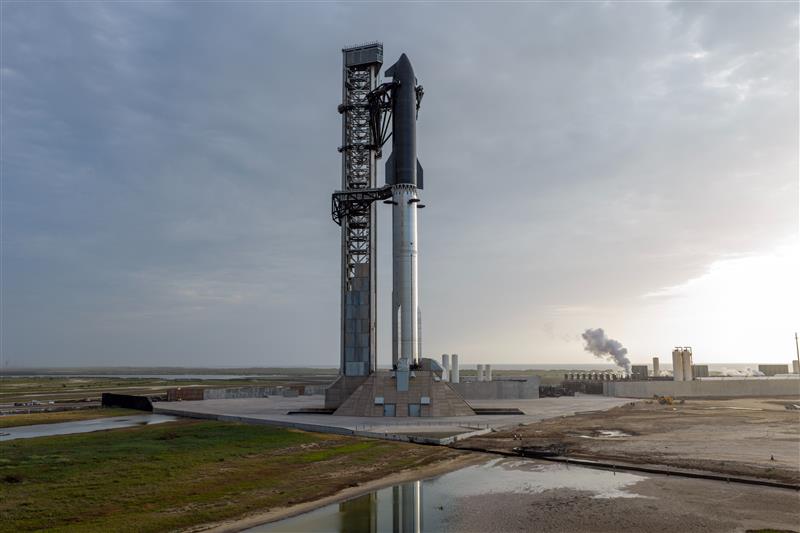
SpaceX is targeting as early as next week for the thirteenth flight test of Starship, with a 90-minute launch window opening at 5:45pm CT. The mission will aim to deploy 20 Starlink V3 satellites for the first time, test hardware and software modifications to improve the Super Heavy booster’s re-light reliability, and continue iteration on Starship’s heat shield for future reusability.
THIRTEENTH TEST BUILDS DIRECTLY ON FLIGHT 12 FINDINGS
SpaceX has confirmed that Starship’s thirteenth integrated flight test is targeting launch as early as next week, with a 90-minute launch window opening at 5:45pm Central Time. Live webcast coverage is expected to begin approximately 30 minutes before liftoff on SpaceX platforms and on X @SpaceX. The mission objectives and vehicle modifications have been designed in direct response to the specific anomalies recorded during the twelfth flight test, making Flight 13 a tightly iterative step forward in the Starship development programme rather than an introduction of major new capabilities. The schedule is subject to change, as is customary for all developmental test flights.
Flight 12 debuted the Starship and Super Heavy V3 vehicles and identified two principal areas requiring attention before the next test. At stage separation, slight differences in engine startup caused the booster’s directional flip to be off by approximately 90 degrees relative to the intended orientation. This has been addressed through a modification to the startup sequence to make it more robust to timing variability and to more reliably produce the flip in the desired direction, improving overall performance. After the flip, the Super Heavy booster attempted its boostback burn, but five of its 33 engines experienced re-light issues, cutting the burn short. Hardware modifications have been made to improve re-light reliability, alongside updates to engine alarms and abort logic calibrated to the conditions observed in multi-engine flight.
STARLINK V3 SATELLITES MAKE THEIR FIRST FLIGHT
The most significant new element of Flight 13 is the first-ever carriage of Starlink V3 satellites. The mission will carry 20 V3 satellites, which will extend solar arrays and antennas and attempt to establish connection with the wider Starlink constellation via high-capacity inter-satellite lasers. The V3 architecture is designed to greatly expand network capacity and user speeds relative to the existing constellation, making the payload test one of the most commercially significant objectives of the mission. The satellites will travel on the same suborbital trajectory as Starship and are expected to demise on re-entry approximately 20 minutes after deployment.
Six of the 20 satellites have been modified with a suite of cameras to scan Starship’s heat shield and transmit imagery to ground operators during the flight, continuing the development of methods to analyse heat shield condition and readiness for future return-to-launch-site missions. Several tiles on Starship’s exterior have been painted white to serve as imaging targets in the test.
UPPER STAGE OBJECTIVES: RAPTOR RELIGHT, INDIAN OCEAN SPLASHDOWN AND HEAT SHIELD ITERATION
Starship’s upper stage objectives for Flight 13 include a re-light of a single Raptor engine in the vacuum of space, a controlled entry, descent and splashdown in the Indian Ocean, and several heat shield experiments designed to continue iteration towards a fully and rapidly reusable vehicle. On Flight 12, Starship lost one of its three Raptor vacuum-optimised engines approximately 40 seconds after stage separation, with the vehicle demonstrating its engine-out capability and reaching its planned suborbital trajectory. Hardware and operational modifications have been made to address the interconnected causes, with additional reliability improvements planned in future Raptor versions.
Heat shield experiments include the attachment of multiple tiles to the metallic side of Starship’s aft flaps, modified tiles and attachment mechanisms in the aft skirt heatshield, and the installation of load-sensing tiles to measure structural stress during the higher dynamic pressure ascent profile planned for Flight 13. The higher dynamic pressure ascent puts additional stress on tile attachments relative to previous flights, in exchange for increased payload-to-orbit capability — a deliberate engineering trade-off that generates data directly relevant to the design requirements of operational Starship missions. The booster’s primary objective remains executing a successful offshore landing at an offshore point in the Gulf of America.
Source and Images: SpaceX