

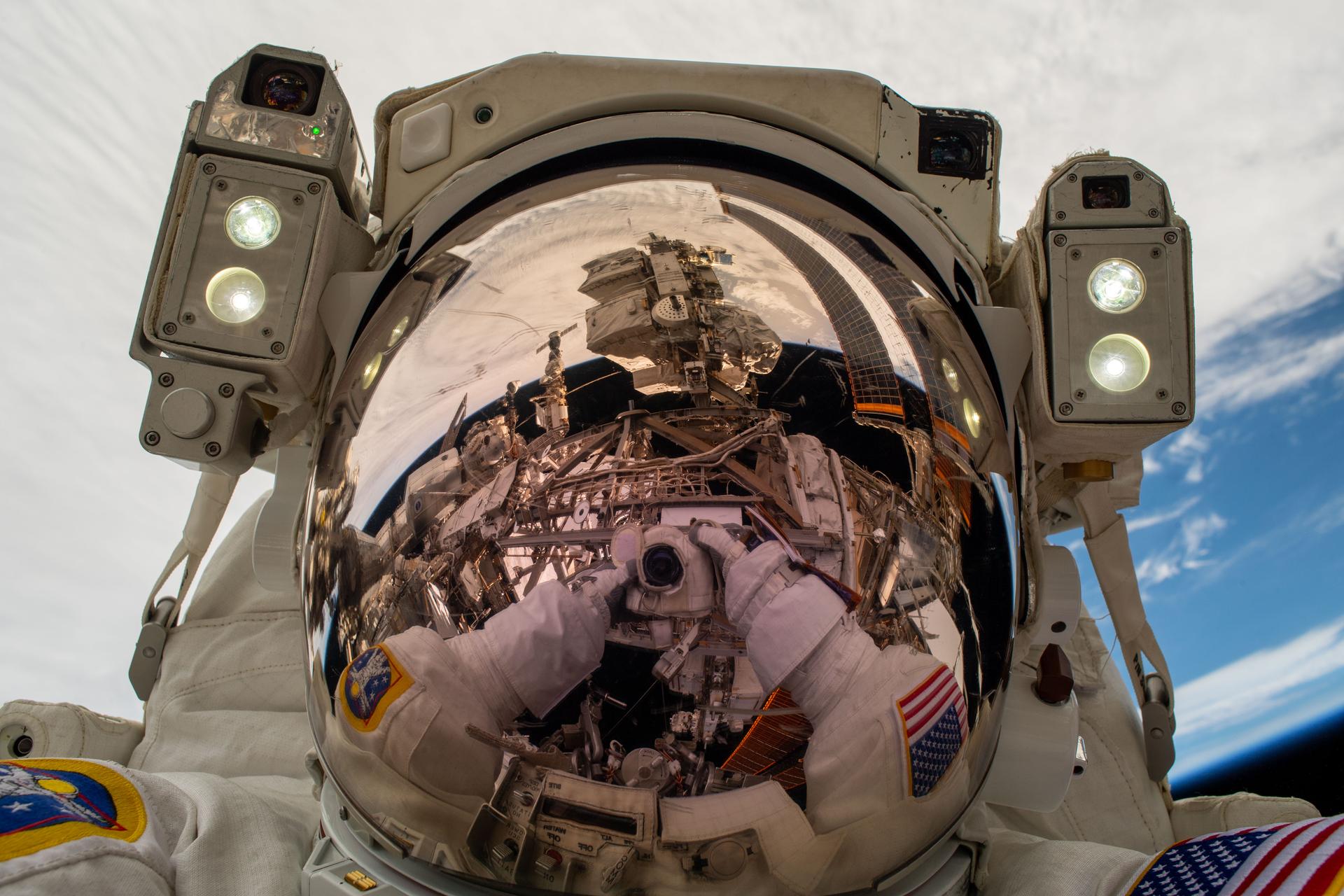
Flight engineers Joshua Kutryk and Anil Menon are preparing to install the eighth and final roll-out solar array during a spacewalk planned for Thursday.
Preparations continue for the second in the final series of spacewalks to upgrade the International Space Station’s power generation system on Thursday, NASA said. Meanwhile, the Expedition 75 crew focused its research efforts on life science at the beginning of the week.
Flight engineers Joshua Kutryk of the Canadian Space Agency and Anil Menon of NASA will install the eighth and final roll-out solar array during a spacewalk planned to start at 8:30 a.m. Eastern time on Thursday. The duo will work on the station’s starboard truss structure, opposite the port truss structure where they installed a roll-out solar array on 29 October.
Upon completion of the installation, expected to take about seven hours, the station’s power generating capacity will increase about 30 percent, from 160 kilowatts to about 215 kilowatts. NASA+ begins live spacewalk coverage at 7 a.m. Eastern time on Thursday, also streaming on other platforms.
Kutryk and Menon joined NASA flight engineers Jessica Watkins and Luke Delaney on Monday to study Canadarm2 robotic arm procedures needed to support Thursday’s spacewalk, and the quartet held two pre-spacewalk conferences with mission controllers, first on mission readiness and then on Canadarm2 considerations with robotics engineers.
Microgravity research continued on Monday as the astronauts helped researchers advance human health studies on Earth and in space. Kutryk wore the Bio-Monitor’s sensor-packed vest and headband while pedalling on the Destiny laboratory module’s exercise cycle, with results expected to show how an astronaut’s cardiorespiratory system adapts to weightlessness, informing crew health measures for future missions to the Moon, Mars and beyond. Delaney nourished growing vascular tissue samples printed inside the BioFabrication Facility, while Watkins verified the operation of a portable DNA sequencer used to genetically analyse antibiotic-resistant bacteria in microgravity.
Expedition 75’s three cosmonauts stayed focused on space research and lab maintenance inside the station’s Roscosmos segment. Station commander Pyotr Dubrov continued studying the manufacture of high-purity semiconductor crystals in microgravity, which NASA says are superior to those produced on Earth. Flight engineer Sergey Teteryatnikov attached electrodes to himself for a 24-hour session measuring his heart activity and blood pressure, and flight engineer Anna Kikina worked on ventilation system maintenance and cargo transfers inside the Progress 96 cargo spacecraft.
Source and Images: NASA