
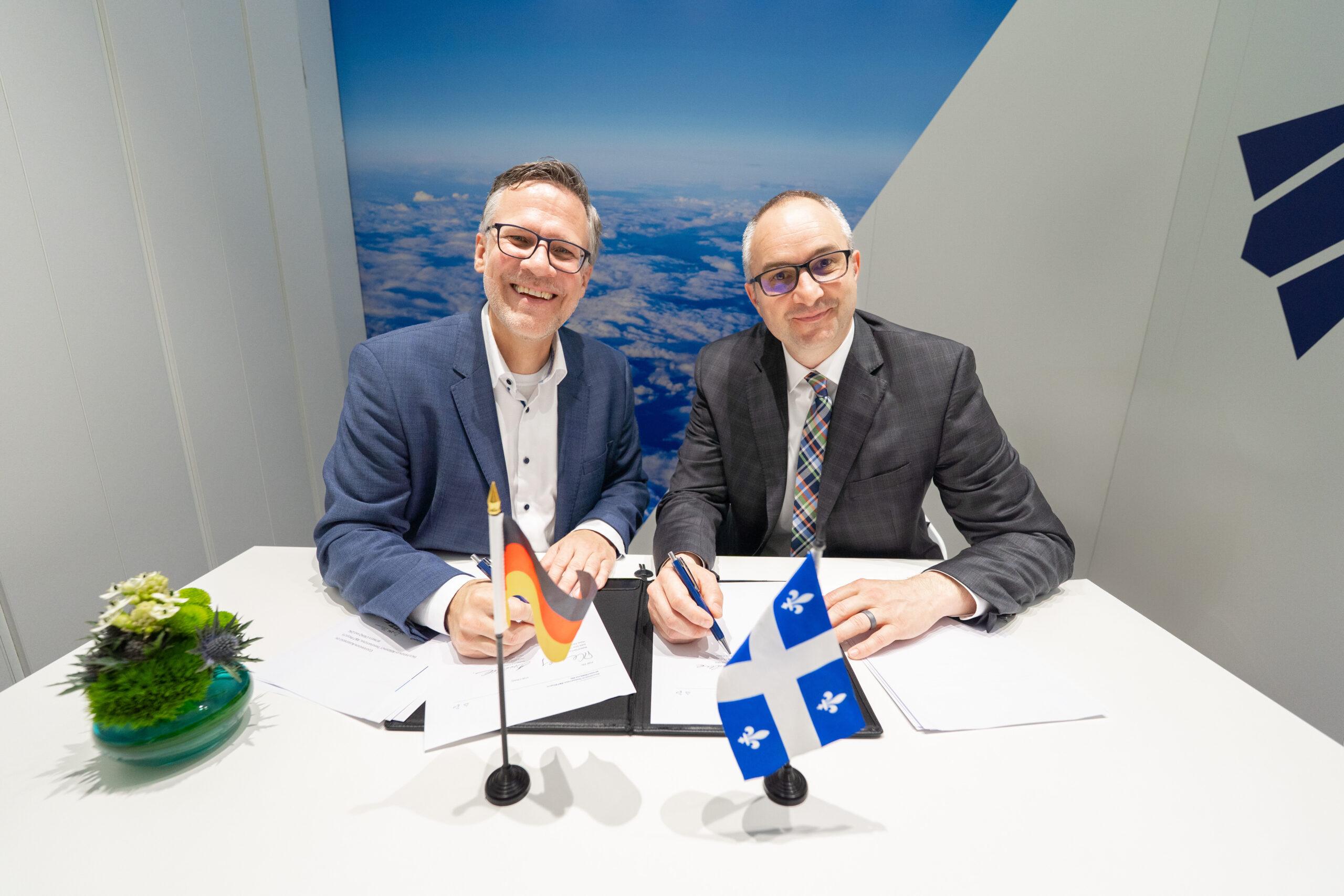
Le Bourget – June 17, 2025 — At the Paris Air Show, the Hamburg-based ZAL Center of Applied Aeronautical Research and the Consortium for Research and Innovation in Aerospace in Québec (CRIAQ) reaffirmed their long-standing alliance with the signing of a new Memorandum of Understanding (MoU). The renewed partnership aims to accelerate joint research in advanced aerospace technologies and promote international talent mobility.
The MoU was officially signed by Roland Gerhards, CEO of ZAL, and Guillaume Côté, CEO of CRIAQ, underscoring the organisations’ shared vision for innovation across borders. The collaboration will focus on key enabling technologies including advanced digital solutions like artificial intelligence, and future propulsion systems aimed at supporting the global push for more sustainable aviation.
“CRIAQ is a strong partner with whom we’ve already had successful collaborations,” said Gerhards. “We look forward to tackling new topics together and advancing aviation innovations in fields such as digital and propulsion technologies and applications.”
The partnership builds on a strong foundation of prior successful joint projects, including the “Lightweight Bionic Aircraft Interior” using 3D printing technologies, and new acoustic insulation metamaterials designed specifically for aerospace applications.
“ZAL is a world-class organization, and we are very proud to restate our commitment to collaborate further for the benefit of our research and innovation ecosystems,” said Côté. CRIAQ continues to reinforce Québec’s position as a hub for sustainable aerospace, digital aviation, and advanced air mobility.
ZAL brings together over 35 leading industry and research partners—such as Airbus, Lufthansa Technik, and the German Aerospace Center (DLR)—under one roof. Its 34,000 m² campus is home to around 800 researchers working on next-generation aviation solutions, from robotics and automation to digital cabins and hydrogen fuel cells.
Meanwhile, CRIAQ has been a cornerstone of Canadian aerospace innovation since 2002. Through its unique collaborative model, it connects companies, universities, and research centres, driving technological advancement and nurturing the next generation of aerospace innovators.
This renewed agreement between ZAL and CRIAQ highlights the importance of international collaboration in accelerating sustainable and digital transformation within the aerospace sector.
SOURCE AND IMAGE: ZAL AERO