
Artemis II crew surpasses Apollo 13 distance record during lunar flyby, validating Orion systems and advancing NASA’s deep space programme.
RECORD-BREAKING DISTANCE
On 6 April, the Orion spacecraft Integrity carried its four-person crew to a distance of approximately 406,770 km from Earth, surpassing the previous record set by the Apollo 13 mission in 1970.
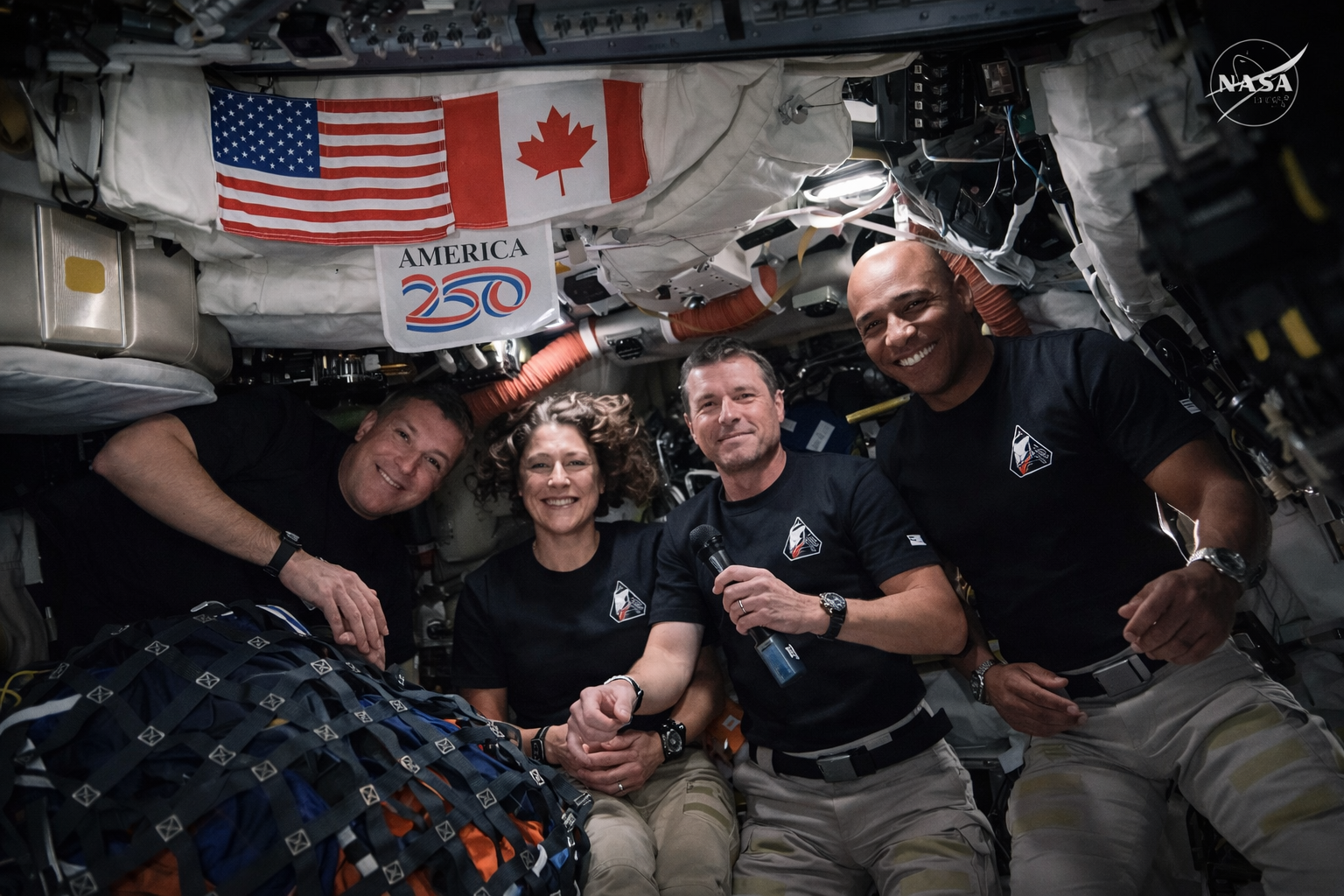
Commander Reid Wiseman, Pilot Victor Glover, and Mission Specialists Christina Koch and Jeremy Hansen achieved the milestone as the spacecraft followed a free-return trajectory, using the Moon’s gravity to loop around the far side before returning to Earth.
During the flyby, Orion maintained a distance of roughly 6,500 km above the lunar surface, enabling the crew to capture imagery and gather data relevant to future missions.
SYSTEM VALIDATION IN DEEP SPACE
A primary objective of Artemis II is the validation of Orion’s systems in a deep space environment.
The mission marks the first time astronauts have spent an extended period beyond the Van Allen radiation belts in the Orion spacecraft. NASA reports that the Environmental Control and Life Support System (ECLSS) has operated within expected parameters throughout the mission.
These results are considered critical for upcoming missions involving longer-duration operations in lunar orbit and on the surface.
OBSERVATIONS DURING LUNAR FLYBY
During the far-side pass, the crew observed a solar eclipse from lunar orbit, with the Moon blocking direct sunlight and revealing the solar corona. The astronauts also reported visibility of earthshine reflected across the lunar surface.
While not a mission objective, the observation provided additional visual and environmental context for operations in deep space.
RETURN PHASE UNDERWAY
As of 7 April, Orion has exited the Moon’s sphere of influence and is on its return trajectory to Earth.
The mission will conclude with a high-speed atmospheric re-entry at approximately 40,000 km/h, with temperatures expected to reach 2,800°C. Splashdown is scheduled in the Pacific Ocean on 10 April, where recovery operations will be conducted by the USS John P. Murtha.
PROGRAMME CONTINUITY
Artemis II serves as a key step in NASA’s broader lunar exploration programme. The mission’s outcomes will inform the planning of Artemis III, currently targeted for later in the decade, which is expected to include a crewed lunar landing.
SOURCE: NASA Artemis II Mission Coverage
IMAGE CREDIT: NAS© CAPTION: The Artemis II crew – CSA (Canadian Space Agency) Astronaut Jeremy Hansen (far left) and NASA astronauts Christina Koch (center left), Reid Wiseman (center right), and Victor Glover (right) – participated in a live conversation with President Donald J. Trump following their historic lunar flyby during Flight Day 6.